A free guide from Cima EHR
The AR aging report for behavioral health: how to read it and how to work it
What an accounts receivable aging report shows, the mistake that makes it look ten times bigger than the money you'll actually collect, what to do with the claims in each age bucket, a weekly routine with a payer call script, the five numbers worth tracking, and how to collect client balances without crossing a legal line.
Updated October 24, 2026. From the team that runs a licensed Texas PHP/IOP/outpatient program, rebuilt its own collections in 2026, and built AR aging into Cima EHR.
The short answer: an AR aging report lists the money still owed to you, grouped by how long ago the service happened (0–30, 31–60, 61–90 and over 90 days), with insurance owed by payer and client balances separately. Value it at what each payer will actually pay, not your full charge. Then work it every week: claims with no response after 30 days get a status check, denials get worked within 10 business days, anything near a filing or appeal deadline goes first, and nothing over 90 days sits without a written next step. Watch the share of AR over 90 days and the trend, by payer.
What the report shows
- Rows: one per payer for insurance AR, and one per client (or one total) for client balances.
- Columns: the open balance by age bucket and the total. Most reports, including ours, age each claim from the date of service. Some age from the date the claim was sent or the last activity; know which yours uses, because a claim sent on day 50 looks fine on a "days since sent" report and is already in trouble on a "days since service" one.
- Insurance balance for a claim = billed − insurance paid − contractual adjustment − the amount moved to the client. Client balance = what was moved to the client − what they paid. Credits (a client who overpaid one visit) should net against what they owe on others, so the report matches the chart.
A balance on an aging report is a symptom. The report tells you where to look; the claim's history tells you why it's there.
Charges vs money: the 10x mistake
When we rebuilt our own program's collections, the first finding wasn't a denial pattern. It was that our biller's report carried every open claim at the full charge, so "what we're owed" read roughly ten times higher than what the payers would actually pay on those claims. Per diem charges in particular are set far above contracted rates. Every decision made from that number, from "we can afford to hire" to "this claim is worth an hour on the phone," was wrong.
Fix it by pricing each open claim at its expected amount: the contracted or typical allowed amount for that payer and code, minus the client's share. Keep the gross charge in a column beside it if you like, but make decisions on the expected column.
Worked example (made-up numbers)
| Payer | 0–30 | 31–60 | 61–90 | Over 90 | Total |
|---|---|---|---|---|---|
| Plan A, at charges | $18,000 | $6,000 | $3,000 | $21,000 | $48,000 |
| Plan A, expected | $2,160 | $720 | $360 | $2,520 | $5,760 |
| Plan B, expected | $1,400 | $300 | $0 | $0 | $1,700 |
| Client balances | $650 | $400 | $350 | $900 | $2,300 |
Read it: Plan A has 44% of its expected balance over 90 days, so it's where the time goes, claim by claim. Plan B pays fast and needs nothing. Client balances are growing older, which means statements aren't going out or nobody follows them up.
Each bucket and what to do
| Age | What's normal | What to do |
|---|---|---|
| 0–30 days | Claims sent and processing. Most clean electronic claims with a contracted, state-regulated Texas plan should be decided within 30 days of receipt (Texas prompt pay). | Make sure every claim was sent within 7 days of service and acknowledged. Fix rejections the same day. Anything unsent is the most urgent line on the report. |
| 31–60 days | Slow payers, records requests, claims pended for coordination of benefits. | Status check on every claim with no payment or denial: a claim status request or a call (script below). Answer any request for records the same week. |
| 61–90 days | Problems. A claim here has usually been denied, lost or rejected without anyone noticing. | Escalate. If it was never accepted, Texas's 95-day filing limit for state-regulated plans is days away: resend now with proof. Appeal denials (see how to appeal). |
| Over 90 days | Appeals in progress, slow government payers, and the claims nobody is working. | Every claim gets a written next step and a date: appeal pending (with the deadline), resubmitted, billed to the client, or written off with a reason. A claim with no note is the problem. |
A weekly AR routine
An hour a week per few hundred open claims, on the same day each week. This is the routine we set for our own billing, with the service levels we hold it to:
- Unsent and rejected claims first. Anything with a service date over 7 days ago that hasn't been accepted. These have a hard deadline and no one else will notice them.
- New denials. Everything denied since last week, sorted by reason code. Decide each within 10 business days: correct, appeal, bill the client or write off. See what each denial code means.
- No response at 30 days. A status check on each, then every 30 days after. Write the answer and the reference number on the claim.
- Claims that haven't changed since last week in the 61–90 and over-90 buckets. The same claim in the same place three weeks running needs a different action, not another call.
- Client balances. Statements out for new balances; follow-ups on older ones (below).
- Five minutes on the totals: the five numbers below, against last week and last month.
The payer status call script
Call with a list, not one claim at a time; most reps will take several claims per call. Have the member ID, date of birth, dates of service, billed amount and your claim number ready. Ask, in order:
- Do you have a claim for this member for [date of service], billed [amount]? What's your claim number, and what date did you receive it?
- What's its status: paid, denied, pending or in process?
- If paid: what date, how much, by check, EFT or card, and the check or trace number? (Then find the deposit and the remittance.)
- If denied: the reason code and wording, and is it an appeal or a corrected claim you need? What's the deadline, and where does it go?
- If pending: what's it waiting for (records, coordination of benefits from the member, an authorization), and by when will it be decided?
- If not on file: which payer ID and address should it go to? (Check for a behavioral health carve-out.) Note the call as proof of your attempt.
- Your name and the call reference number?
For a plain status question, an electronic claim status request (X12 276/277) is faster and cheaper than a call; save the calls for problems.
Five numbers to track
| Measure | How to figure it | What it tells you |
|---|---|---|
| Share of insurance AR over 90 days | Expected balance over 90 days ÷ total expected insurance balance, by payer | Whether old claims are being worked. The target we set for our own program is 10–25% of expected dollars; your payer mix may differ. |
| Days in AR | Total AR ÷ average charges per day over the last 90 days (use the same basis, charges or expected, for both) | How many days of billing are tied up waiting. Watch the trend, not one week. |
| Days from service to payment | The median, by payer, for claims paid this month | Which payers are slow, and whether your own sending is slow. |
| Denials older than 30 days with no action | A count | Whether denials are being worked at all. The target is zero. |
| Client balance collected | Client payments ÷ new client balances, for balances 60+ days old | Whether intake estimates, statements and follow-ups are working. |
We don't quote industry benchmarks we can't source. Your own trend by payer is the number that changes behavior.
Client balances
Client balances grow quietly in behavioral health, because deductibles reset every January and a PHP or IOP stay racks up a copay or coinsurance every day. Most of the work happens before the first claim:
- At intake: run benefits, then give the client a written estimate of their share using what the plan allows, not your charge (Quick VOB's VOB checklist lists what to ask). Have them sign the financial agreement, and set up a card on file or a payment plan.
- Self-pay or uninsured clients get a good faith estimate under the No Surprises Act rules (45 CFR §149.610).
- A statement cadence: a statement when the balance is final, a reminder about 10 days later, a letter at 30 days, a payment-plan offer at 60, then a hardship or write-off review. A person decides each step.
- Statements show the client's share only. Never let the insurance balance roll into "total due." An itemized statement by date of service (billed, insurance paid, the client's share) prevents most disputes. Texas's SB 490 (2023) requires certain providers to send an itemized bill before pursuing collection; ask counsel whether it covers your practice or facility.
- Don't routinely waive copays or deductibles. Case-by-case hardship discounts, documented, are a different thing from a policy of waiving. See patient brokering laws for why this matters for treatment programs.
- Before a collection agency, check that the client's consent covers the disclosure for substance use records under 42 CFR Part 2, and send the minimum.
Write-offs
- Have a written policy: who can write off how much, and which reasons are allowed (timely filing, uncollectible client balance after the full cadence, hardship, small balance, a contractual amount posted wrong).
- Write off with a reason code, never by editing or deleting a charge. The trail is what an auditor, a buyer or your own month-end will need.
- Review write-offs by reason each month. Timely filing write-offs are a process failure; each one should lead to a fix.
AR aging in Cima
- AR aging by payer and by client, 0–30, 31–60, 61–90 and over 90 days from the date of service, computed from the ledger every time, so it can't drift from the claims. Client credits net against what they owe.
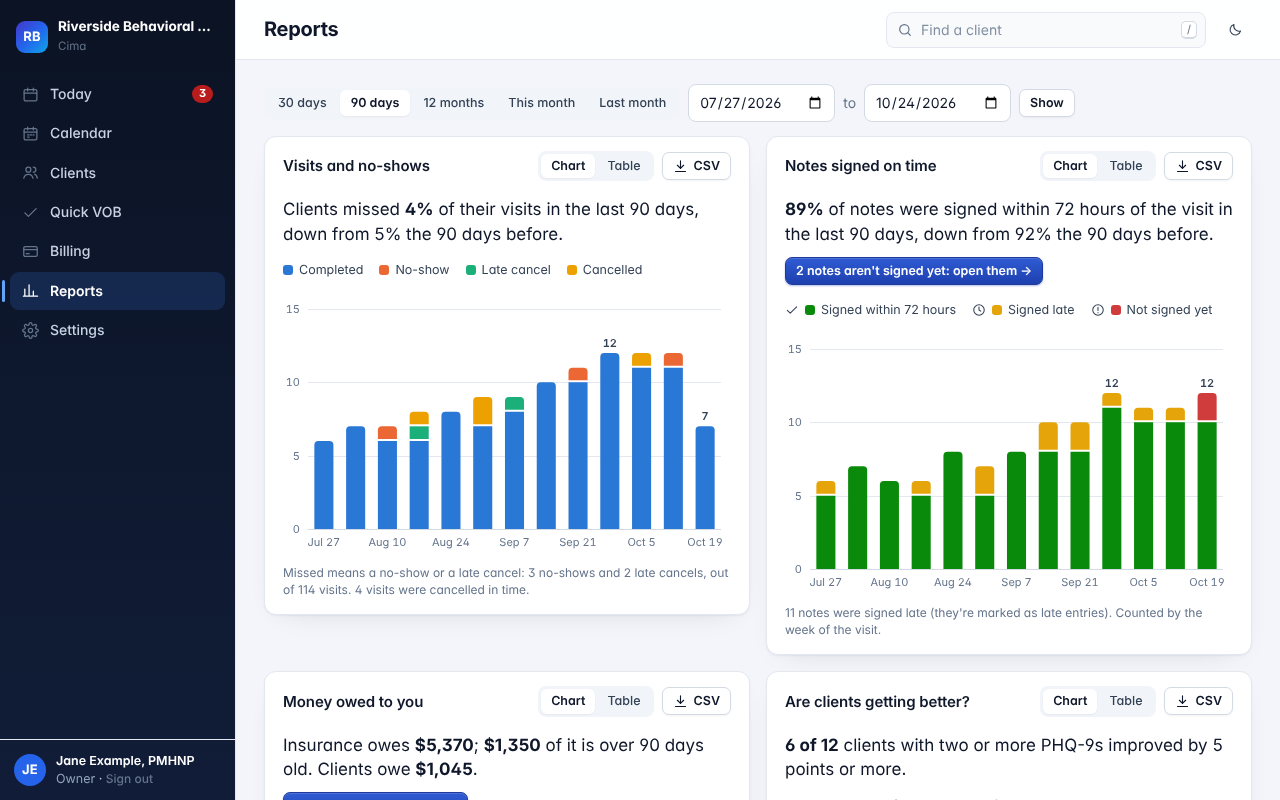
- Reports puts it in a sentence ("Insurance owes $X; $Y of it is over 90 days old") with the five largest payers broken out, next to first-pass acceptance, denial reasons and money collected, each compared with the period before. Every chart downloads as a CSV.
- Payments are never edited or deleted, only reversed with a reason, and every claim keeps a dated history.
- Ask the payer for a claim's status from the claim itself. See reports, billing and, for programs, Cima for IOP and PHP.
See what you're really owed, by payer and by age
Cima EHR builds AR aging from the ledger, explains denials in plain English and keeps every claim's history. Want your AR cleaned up and a weekly routine set up for your team? Cima Consulting's billing set-up is $1,500, and an operator's time by the hour is $175 per hour.
Start with the payments posting themselves: ERA and EFT enrollment. Or see Cima Consulting's billing and credentialing services.
Questions
What is an AR aging report?
A report of the money still owed to a practice, grouped by how long it has been owed, usually in 30-day buckets from the date of service (0–30, 31–60, 61–90, over 90), with insurance balances by payer and client balances separately. It tells you where follow-up time should go.
Should AR be measured at charges or at expected payment?
At expected payment for decisions. Charges, especially per diem program charges, are often several times the contracted rate, so a charge-based report can overstate what you'll collect by an order of magnitude. Keep charges beside it if you need them for reconciliation.
What is a good percentage of AR over 90 days?
It depends on your payer mix and how many appeals you have open. For our own Texas program we target 10–25% of expected insurance dollars over 90 days. More important than any benchmark is the trend by payer, and that every claim over 90 days has a written next step.
How do you calculate days in AR?
Divide total accounts receivable by your average charges per day over a recent period, commonly the last 90 days. Use the same basis for both (charges with charges, or expected with expected). Track it monthly and by payer.
How often should a practice work its AR?
Weekly, on a set day: unsent and rejected claims, new denials, claims with no response at 30 days, claims that haven't moved, and client balances. Daily posting of remittances makes the weekly review much shorter.
When should a claim be written off?
When every option is exhausted: the appeal deadline passed or the appeal failed, the filing limit passed without proof, or a client balance went through your full statement and hardship process. Write it off with a reason code under a written policy, and fix the cause.
Sources
- Texas Insurance Code chapter 1301 and chapter 843 (filing and payment deadlines for state-regulated plans)
- 45 CFR §149.610, good faith estimates for uninsured and self-pay individuals
- Texas Legislature, SB 490 (2023), enrolled text (itemized bills before collection)
- 42 CFR Part 2, confidentiality of substance use disorder records
- X12, Claim Status Category Codes (used in 276/277 claim status answers)
- Our own program's 2026 AR review and the service levels we set from it (totals only; no client data)
Know what you're owed, and who's working it.
AR aging, denial reasons and every claim's history in one place.
Get early access