A free guide from Cima EHR
Behavioral health claim denials: what the codes mean and how to stop them
Why therapy, substance use and IOP/PHP claims come back rejected or denied, how to read the codes on an 835 or EOB, the denials programs see most with the fix for each, and the routine that keeps denied money from aging out. Written by the team that runs a licensed Texas PHP/IOP/outpatient program and built its own EHR and claims engine.
Updated October 24, 2026. General billing information, not legal advice; payer rules differ by plan and contract.
The short answer: most behavioral health denials come from a short list of fixable causes: no authorization for the level of care or too many units (CARC 197 and 198), the claim sent to the medical plan when a behavioral health company manages the benefit (109), a clinician or program not credentialed for the service (170, 185), eligibility that ended or another plan that pays first (27, 22), missing or wrong data (16), and medical necessity (50). First tell a rejection (the claim never got into the payer's system: fix it and send it again) from a denial (the payer decided: correct the claim or appeal). Then read the group code and reason code on the remittance, fix the cause on this claim and on every claim like it, and work every denial within days, not months, because the filing and appeal clocks keep running.
Rejected, denied or paid less?
Four different things come back after you send a claim. Each needs a different action, and mixing them up is the most common way a fixable claim turns into a write-off.
| What came back | Where you see it | What it means | What to do |
|---|---|---|---|
| Rejection | The clearinghouse's report, or the payer's claim acknowledgment (X12 277CA), usually within a day or two. | The claim failed an edit and never entered adjudication. As far as the payer is concerned, it wasn't filed. | Fix the data and send it again as a new, original claim. Not an appeal. Medicare calls these "unprocessable" (remark code MA130), with no appeal rights. |
| Denial | The electronic remittance (X12 835, the ERA) or the paper EOB/EOP, with $0 paid and a reason code. | The payer processed the claim and decided not to pay it. | If the claim was wrong, send a corrected claim (frequency code 7, with the payer's claim number). If the claim was right, appeal it. |
| Paid less | The 835 with a payment and a CO adjustment, usually CO-45. | The contractual write-off: the difference between your charge and the allowed amount. Not a denial. | Check the allowed amount against your contract's fee schedule. A wrong rate is an underpayment dispute, not a denial. |
| The client's share | PR adjustments on the 835: PR-1 deductible, PR-2 coinsurance, PR-3 copay. | Processed correctly; the client owes it. | Move it to the client's balance and bill them. See working your AR aging for patient balances. |
A claim that was "processed" with $0 paid because the whole amount went to the deductible isn't denied. Counting those as denials makes your denial rate look worse than it is, and sends someone to appeal a correct decision.
Reading the codes: group, CARC, RARC
The 835 and the 277CA are HIPAA standard transactions (45 CFR Part 162), so every payer uses the same codes. Every adjustment on an 835 has three parts. The code lists are maintained by X12 and updated several times a year, so read the current wording on X12's Claim Adjustment Reason Code list and Remittance Advice Remark Code list rather than an old cheat sheet.
- Group code, who carries the amount: CO (contractual obligation: the provider writes it off and can't bill the client), PR (patient responsibility: the client owes it), OA (other adjustment) and PI (payer-initiated reduction).
- Claim Adjustment Reason Code (CARC), why: a number such as 197 or 50.
- Remittance Advice Remark Code (RARC), the detail: an N- or M- code that says which information was missing or which rule applied. With CARC 16 ("lacks information") the remark code is the only thing that tells you what to fix.
A worked example (made-up claim)
An IOP day billed at $600 to a commercial plan comes back with three lines: CO-45 $420, PR-3 $40 and a payment of $140. Nothing was denied: the allowed amount was $180, the client owes a $40 copay, and $420 is your contractual write-off. The same day with CO-197 $600 and $0 paid is a denial: no authorization on file. And PR-204 $600 means the plan says the service isn't a covered benefit and puts it on the client, which you should verify before you bill anyone.
The denials we see most, and the fix for each
These are the reason codes that come up most for outpatient behavioral health, therapy and IOP/PHP claims, with the plain-English meaning (paraphrased; X12 has the official wording), the usual cause and how to stop it.
| CARC | Plain meaning | Usual behavioral health cause | Fix now / prevent |
|---|---|---|---|
| 197 | Authorization absent | No prior auth for PHP or IOP, or the auth was for a different level of care, provider or NPI. | Ask for a retro-authorization if the plan allows one, then appeal with the auth. Prevent: verify auth rules by level of care at admission (prior authorization guide). |
| 198 | Authorization exceeded | More days or units than approved, or days after the auth's end date. A step-down from PHP to IOP without a new auth. | Request the extension and appeal with it. Prevent: track units used and the last approved day; request the continued-stay review before it runs out. |
| 109 | Not covered by this payer; send to the correct payer | Sent to the medical plan when a behavioral health company (a carve-out) processes those claims. | Resend to the right payer ID with proof of the original date. Prevent: identify the carve-out at VOB (behavioral health carve-outs). |
| 170 / 185 | Not paid for this provider type / rendering provider not eligible | An associate, intern, LCDC or new hire billed as rendering before being credentialed, or a license type the plan doesn't pay. | Rebill under the eligible supervising or facility provider only if the plan's rules allow it. Prevent: keep a who-can-bill-what list per payer (credentialing sets it up). |
| 27 / 26 | Coverage ended / not yet started | The client lost or changed coverage mid-treatment; a new plan year with a new plan. | Find the current coverage and bill it. Prevent: re-verify eligibility before each visit or each week of a program, and at the start of every month. |
| 22 | Another plan may pay first (coordination of benefits) | A second policy the client didn't mention, or the payer's COB record is out of date. | Bill the primary, then this plan with the primary's payment. Often the client must update COB with the plan by phone. |
| 16 | Missing information or a billing error | Read the RARC: subscriber details, a missing referring or attending provider, an invalid date, a missing auth number on a facility claim. | Correct the field and send a corrected claim. Prevent: a claim check before sending (below). |
| 18 | Exact duplicate | A claim resent as an original while the first was still processing, or a second note for the same per diem day. | Check the first claim's status (276/277) instead of resending. Use frequency 7 for corrections. |
| 50 | Not medically necessary, per the payer | Notes that don't show why this level of care is still needed; days with too few hours to support the per diem. | Appeal with the record, organized by the payer's criteria and the six dimensions of the ASAM Criteria. Prevent: notes that document the dimensions and the hours, and regular chart audits. |
| 96 / 204 | Non-covered charge / not covered under the client's plan | A benefit exclusion, a code the plan doesn't recognize for this setting, or a service the plan wants billed another way. | Check the benefit and the code the payer expects. Prevent: confirm the exact code and revenue code per level of care with each payer before the first claim. |
| 242 | Not provided by a network provider | An HMO or EPO member with no out-of-network benefit; a contract not yet effective. | Ask for a single case agreement or network gap exception before care, not after. |
| 4 / 5 / 11 | Modifier wrong or missing / code doesn't fit the place of service / diagnosis doesn't fit the code | Telehealth without modifier 95 or 93; place of service 02 vs 10; a Z-code or R-code as primary on a psychotherapy claim. | Correct and resubmit. Prevent: let signing the note set the code, modifier and place of service. |
| 97 | Included in payment for another service | An individual session or assessment billed separately on a day the per diem already covers. | Check your contract: many per diem rates include the day's individual and group services. |
| 29 | The filing time limit has expired | A claim that sat unsent, or kept bouncing as a rejection without anyone noticing. | Appeal only with proof of timely filing. Prevent: see timely filing limits by payer. |
| 252 | Records or documentation needed | The plan wants notes, the treatment plan or the auth before it pays. | Send exactly what was asked, by the payer's route, within its deadline; log the date sent. |
Front-end rejections: the checklist
Rejections are the cheapest problem to fix and the easiest to lose track of, because nothing arrives in the mail. These are the checks our own claim engine runs before a claim can be sent, built from what payers actually bounce:
- The practice: a valid billing NPI (it passes the check-digit test), the tax ID in 12-3456789 form, the taxonomy code, and a street billing address (not a PO box) with a 5- or 9-digit ZIP.
- The clinician: their own NPI and taxonomy as the rendering provider.
- The client: the payer ID, the member ID exactly as on the card, sex as the plan has it, a full address, and when the client isn't the policyholder, the policyholder's name and date of birth.
- The visit: at least one valid ICD-10 code and no more than 12, a place of service code that exists, each line pointing to 1–4 diagnoses, at most 4 modifiers per line, no $0 fees, no future dates.
- Telehealth: place of service 02 or 10 needs modifier 95 (video) or 93 (audio-only), as the payer requires.
- Authorization: when the payer needs one, an authorization covering the date, and no more visits than it approved.
- The clock: a warning two weeks before your filing limit, and a hard stop past it.
Then watch the acknowledgments. A claim with no 277CA two business days after it went out hasn't been received; find out why before you assume it's processing.
Traps specific to behavioral health
- The wrong code for the level of care. Payers don't agree on how PHP and IOP days are billed: per diem HCPCS codes on a professional claim, revenue codes on a facility claim (UB-04/837I), or a specific code the payer's contract names. In our own program, one payer paid only its own PHP code and left every other code unpaid for months. Get the code, revenue code and type of bill for each level of care in writing from each payer before the first claim. More in Cima for IOP and PHP programs.
- Step-downs. A move from PHP to IOP is usually a new authorization. Claims for IOP days under the old PHP auth come back 198 or 197.
- Hours that don't support the day. A per diem day needs the program's hours documented in that day's notes. A day with one group note where the program runs three is a denial or a later recoupment waiting to happen.
- Associates and interns. Many plans won't pay for a pre-licensed clinician as the rendering provider, and a few won't pay for some license types at all. Know each payer's rule before scheduling.
- Carve-outs. The card says one company; a behavioral health company processes the claim. The payer ID on the card's back for behavioral health is the one that matters.
- Unsigned notes. Never send a claim for a session whose note isn't signed. If the payer asks for records, an unsigned note supports nothing.
A denial routine that keeps money from aging
When we rebuilt our own billing follow-up, the money wasn't lost to exotic denials. It was lost to old claims nobody checked and denials nobody worked. These are the service levels we now hold our billing to:
- Claims out within 7 days of service. Every day a claim waits is a day off the filing clock.
- Post every remittance the day it arrives, with its codes, so a denial is visible the same day. Electronic remittances make this automatic (see ERA and EFT enrollment).
- Work every denial within 10 business days. Decide: fix and resubmit, appeal, bill the client, or write off with a reason. Write the appeal deadline on the claim the day the denial arrives.
- Check status on anything at the payer 30 days with no answer, and every 30 days after, with a claim status request or a call. Write down the answer and the reference number.
- Look for the pattern weekly. Sort the week's denials by reason code and by payer. Eleven denials from one payer for one reason is one fix, not eleven appeals.
- Fix the cause upstream. A 197 is an intake and UR problem; a 170 is a credentialing problem; a 16 is a data problem. Tell the person who owns that step.
Two numbers to watch
- First-pass acceptance: of the claims sent in a period that got an answer, the share that weren't rejected the first time. It measures your data and your claim check.
- Denial rate: of the claims the payer decided in a period, the share denied, counting a claim's first decision. Exclude contractual write-offs and deductible-only claims, or the number means nothing.
Compare each with the same period before. We don't quote industry benchmarks we can't source; your own trend, by payer and by reason, is what tells you where to act.
How Cima handles denials
We built these steps into Cima EHR's billing because we needed them ourselves:
- Signing the note creates the charge, with the code, modifiers, place of service and diagnoses from the visit.
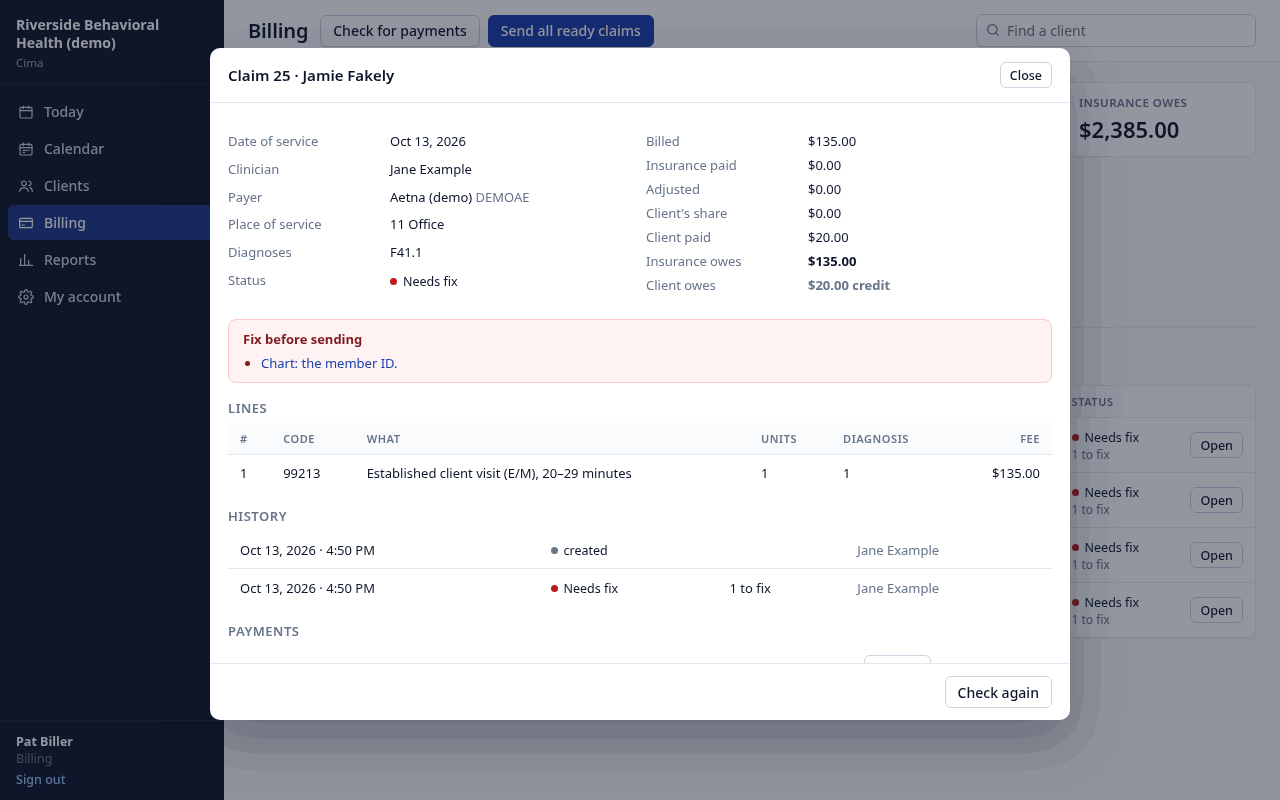
- Every claim is checked before it can go out, against the list above, and each problem says exactly where to fix it ("Chart: the member ID").
- Acknowledgments move claims to Accepted or Rejected on their own, with the payer's reason. Remittances from payers you've enrolled with post the payment, the write-off and the client's share, and mark the claim Paid or Denied with its codes. A payer's reversal is never posted automatically; it's flagged for a biller to review.
- Reports show first-pass acceptance, the denial rate and the top denial reasons in plain English, each compared with the period before (see Reports).
- Claims are sent at the clearinghouse's standard per-claim price, about 30¢, and electronic remittances about 20¢ (pricing). Never a percentage of collections.
Catch the denial before you send the claim
Cima EHR checks every claim, posts every remittance and shows why payers deny, in plain English. Want it set up for you? Cima Consulting's billing set-up is $1,500: fee schedule, clearinghouse, ERA and EFT enrollment, and a first-month claim review.
Next in the series: how to appeal a denial, with letter templates and the Texas review process. Or see Cima Consulting's billing and credentialing services.
Questions
What is the most common reason behavioral health claims are denied?
For IOP and PHP programs, authorization problems lead: no authorization for the level of care (CARC 197) or more days than approved (198). For therapy practices, eligibility (coverage ended, another plan primary), billing the medical plan instead of the behavioral health carve-out, and clinicians who aren't credentialed with the plan come up most. All of these are caught before the visit with a benefits check and a credentialing list.
What is the difference between a rejected claim and a denied claim?
A rejected claim failed an edit at the clearinghouse or the payer's front door and was never processed; you fix it and send it again as a new claim, and it doesn't stop the filing clock. A denied claim was processed and refused; you send a corrected claim if it was wrong or appeal if it was right.
What does CO-197 mean?
Group code CO (contractual obligation, so you can't bill the client) with CARC 197: precertification or authorization was absent. The payer required an authorization for the service and found none matching the client, date, service and provider. Ask whether the plan accepts a retro-authorization, then appeal with it, and check whether the auth was issued under a different NPI or level of care.
Can I bill the client for a denied claim?
Not when the denial is under group code CO: that amount is the provider's under the contract. When it's under PR (for example a non-covered service), the client may owe it, but in-network contracts often limit when you can bill a member, especially if you didn't tell them in advance. Read your contract, and give clients a written estimate of their share before care.
What is the difference between a CARC and a RARC?
The CARC (Claim Adjustment Reason Code) says why the amount was adjusted. The RARC (Remittance Advice Remark Code, an N- or M- code) adds detail, such as which piece of information was missing. Both lists are maintained by X12 and change several times a year.
How long do I have to fix a denied claim?
It depends on the payer and the contract: a corrected claim usually has to arrive within the payer's corrected-claim or filing limit, and an appeal within the appeal window in the denial notice or provider manual. Write both dates on the claim the day the denial arrives. See timely filing limits and how to appeal.
Sources
- X12, Claim Adjustment Reason Codes, Remittance Advice Remark Codes and Claim Status Category Codes (read October 2026; the lists are updated several times a year)
- CMS, EFT and ERA basics (the 835 remittance)
- 42 CFR §410.78, Medicare telehealth services, including audio-only mental health visits (commercial and Medicaid plans set their own place-of-service and modifier rules)
- Our own claim engine's pre-send checks and denial-reason report, and the billing service levels we set for our Texas program in 2026
Fewer denials start before the claim goes out.
Every claim checked, every remittance posted, every denial explained.
Get early access