NewFor intensive outpatient and partial hospitalization programs
Every group, written out.
Print it at 8:30.
Run it at 9:00.
Cima Curriculum is the whole group program for an IOP or PHP: a guide a counselor can run cold, a packet worth keeping for every client, a plan for the whiteboard, and an online portal that puts today's groups on one screen. Six weeks of real therapeutic approaches, with Twelve Step work running through all of them.
Opening to programs now. Written for, and run every day at, a licensed Texas PHP and IOP program we operate.
A program, not a stack of worksheets
Counted from the curriculum itself in October 2026. It grows with every release, and every program on Cima Curriculum gets the new sessions.
- 91PHP groups, written out
- 145IOP groups, over 16 weeks
- 45guides for rituals, gatherings, outings and keepsakes
- 0client records stored
Three things in one
An online portal for your team, everything the counselor needs at the front of the room, and the therapeutic approaches that fill the hour.
The online portal
Today's groups on one screen for every counselor, the whole library, a builder for your own schedule, clinical sign-off and your team, in one sign-in.
The portal →In the room
A minute-by-minute run of show, the words to say, the whiteboard plan, a one-page quick card and a client packet, printed clean in black and white.
In the room →Therapeutic modalities
One approach taught deep each week: CBT, DBT, ACT, motivation and relapse prevention, trauma and the body, relationships and meaning, with Twelve Step facilitation throughout.
The approaches →The online portal
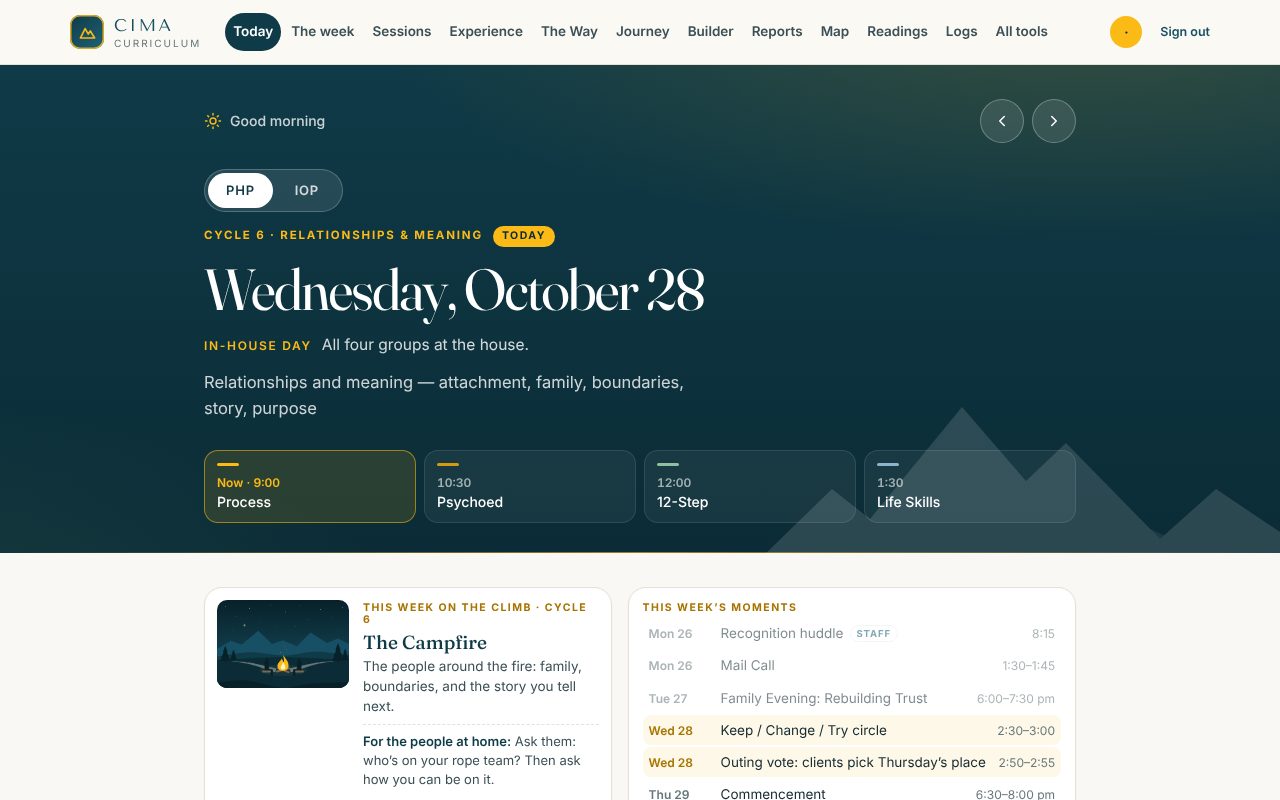
Today, on one screen
- Each counselor opens Today and sees the day's groups in order, the opening and the closing, and the week's outing and meeting.
- One tap from any group to its quick card, facilitator guide, client packet and whiteboard plan.
- Every group shows what clients leave with, its approach and its ASAM dimension, and flags heavy material before you walk in.
- The week's moments beyond the groups (a family evening, a recognition huddle, the outing vote) sit beside it, each linked to its guide.
Curriculum Builder
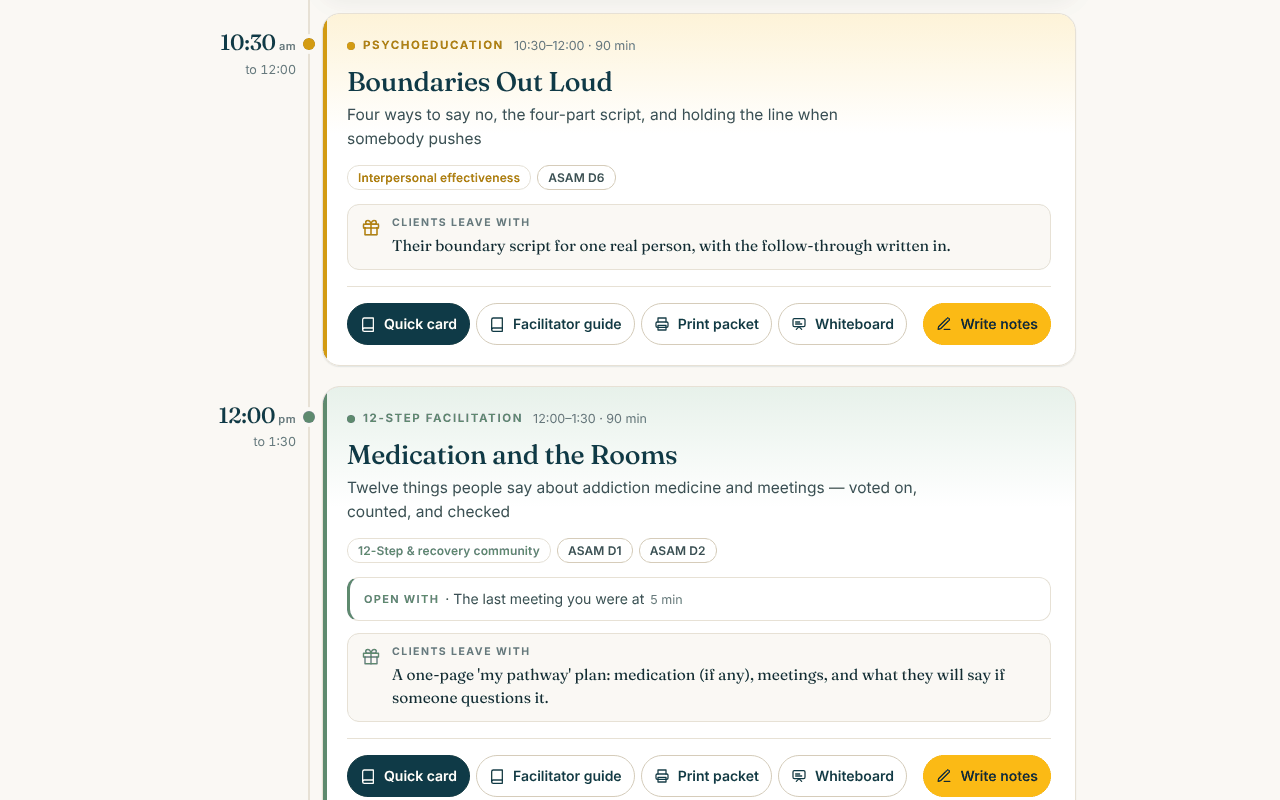
Your days, your blocks, your weeks
- Run the six-week loop as it is, or build your own: set the weeks, days and block times, then pick a session for each slot or auto-fill the empty ones.
- Live checks as you go: a session too long for its block, one repeated, two heavy topics in one day, ASAM coverage each week, and all Twelve Steps.
- Save it to your program and make it live, and Today runs your schedule. Share it, or print it as a schedule.
Clinical sign-off
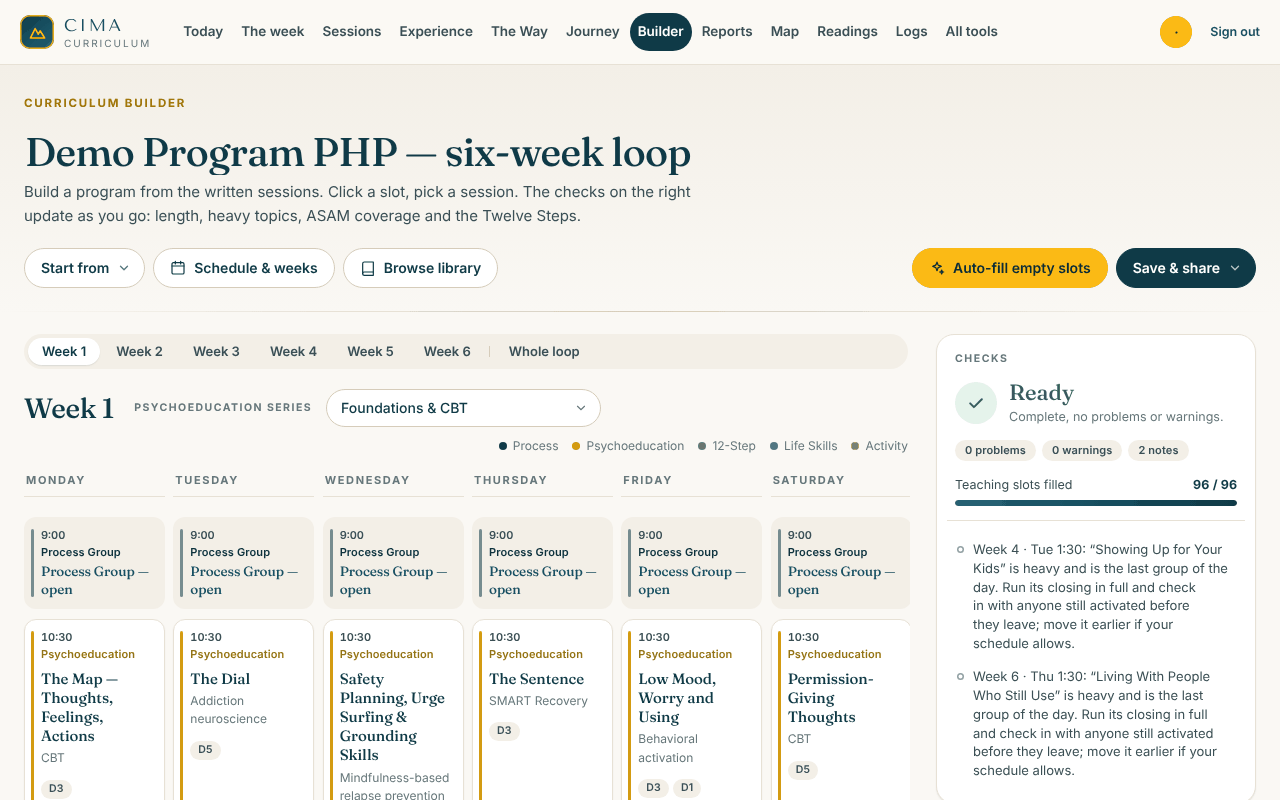
A clinical lead signs a session off from the top of its guide. Their name and credentials are recorded for your program, and the draft banner comes off.
Your team, your roles
Owners and admins run the program and the team, clinical leads sign sessions and edit the week, staff can read. Colleagues at your email domain can join on their own.
Your name on it
Your program's name, colors and logo in the portal, and your name and crisis contacts on what you print.
Honest group notes
Notes drafted per client from what the clinician saw, never cloned, then copied field by field into your EHR. The text never leaves the counselor's browser.
In the room
A guide a counselor can run cold
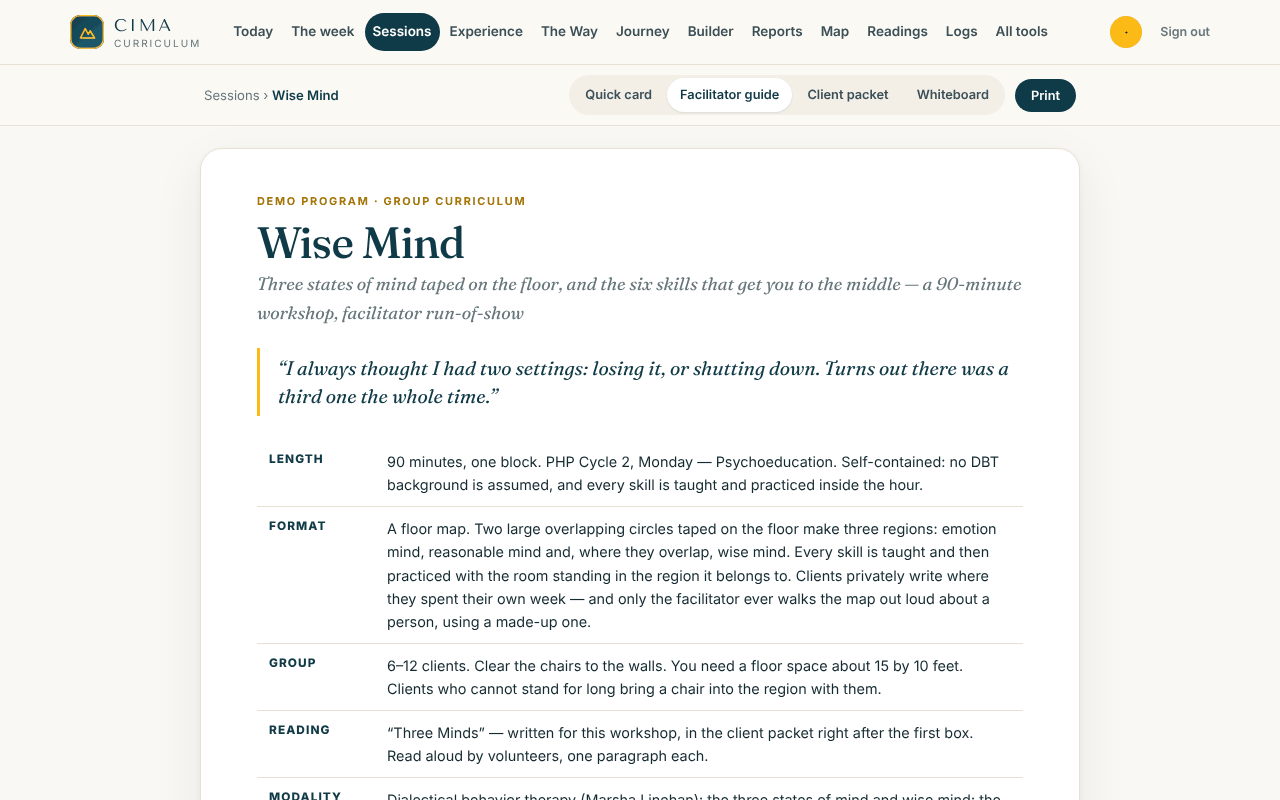
- Length, format, group size, materials and the reading, on the first page.
- A run of show by the minute: what happens, what to say, what to watch for, and what to do if the room goes sideways.
- What makes this hour different, and the single measure of whether the group worked.
- Your crisis protocol and on-call contacts printed at the top. Written so a counselor covering someone else's group can pick it up that morning.
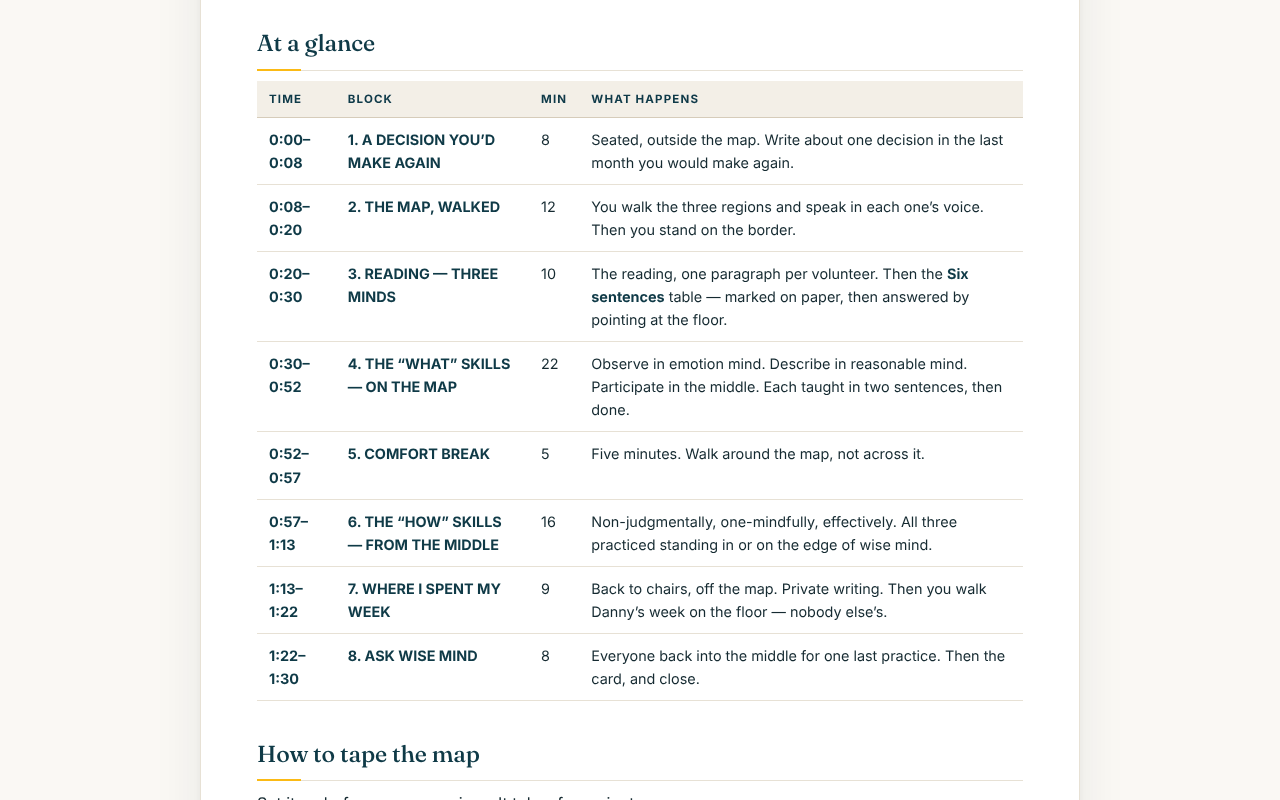
The run of show
Every minute of the hour, planned
- Each block has its time, its length and exactly what happens, so a 90-minute group fills 90 minutes and ends on time.
- The longer groups have their break planned in, at a point that suits the work.
- The closing is written too, so nobody leaves a heavy hour still activated.
The whiteboard
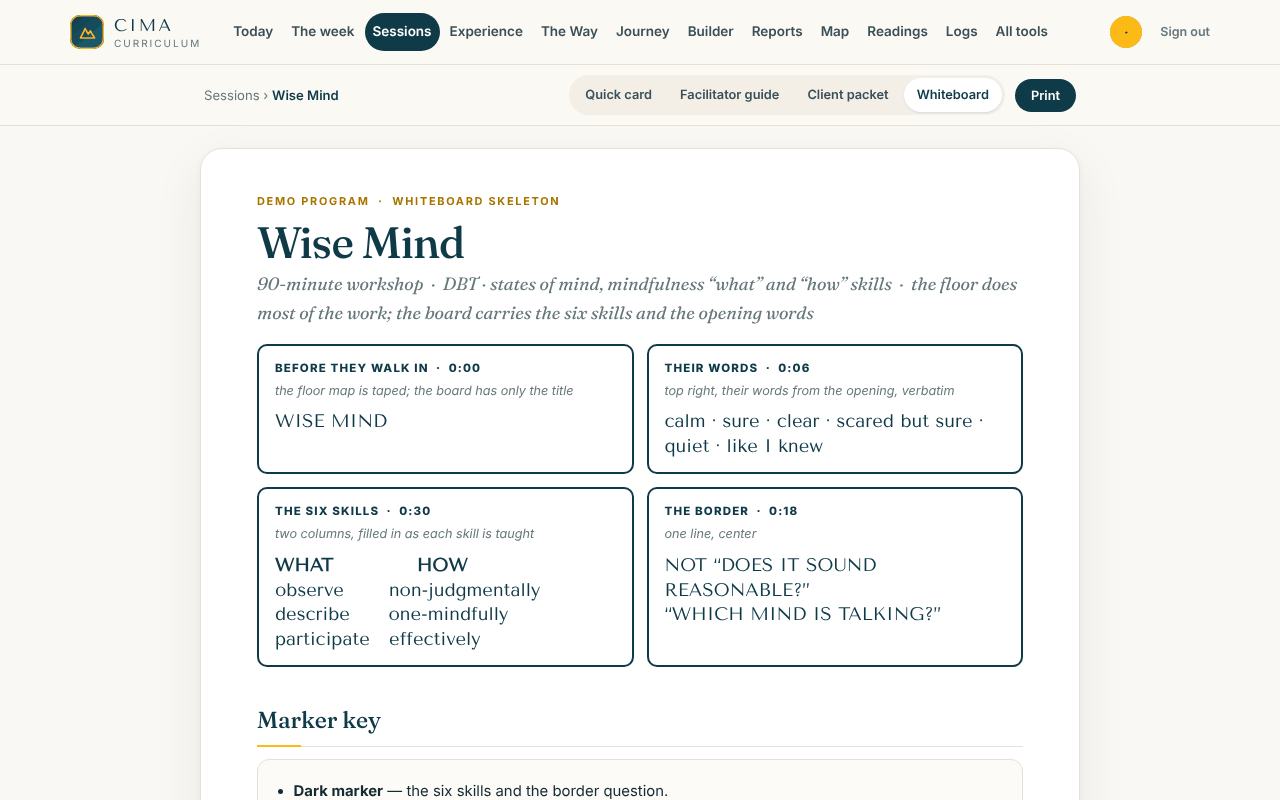
The board, planned before they walk in
- What's on the board at minute zero, what goes up at each point in the hour, and where it goes.
- A marker key, so the board reads the same whoever runs the group.
- Clients' own words go on the board, verbatim, where the plan says.
The client packet
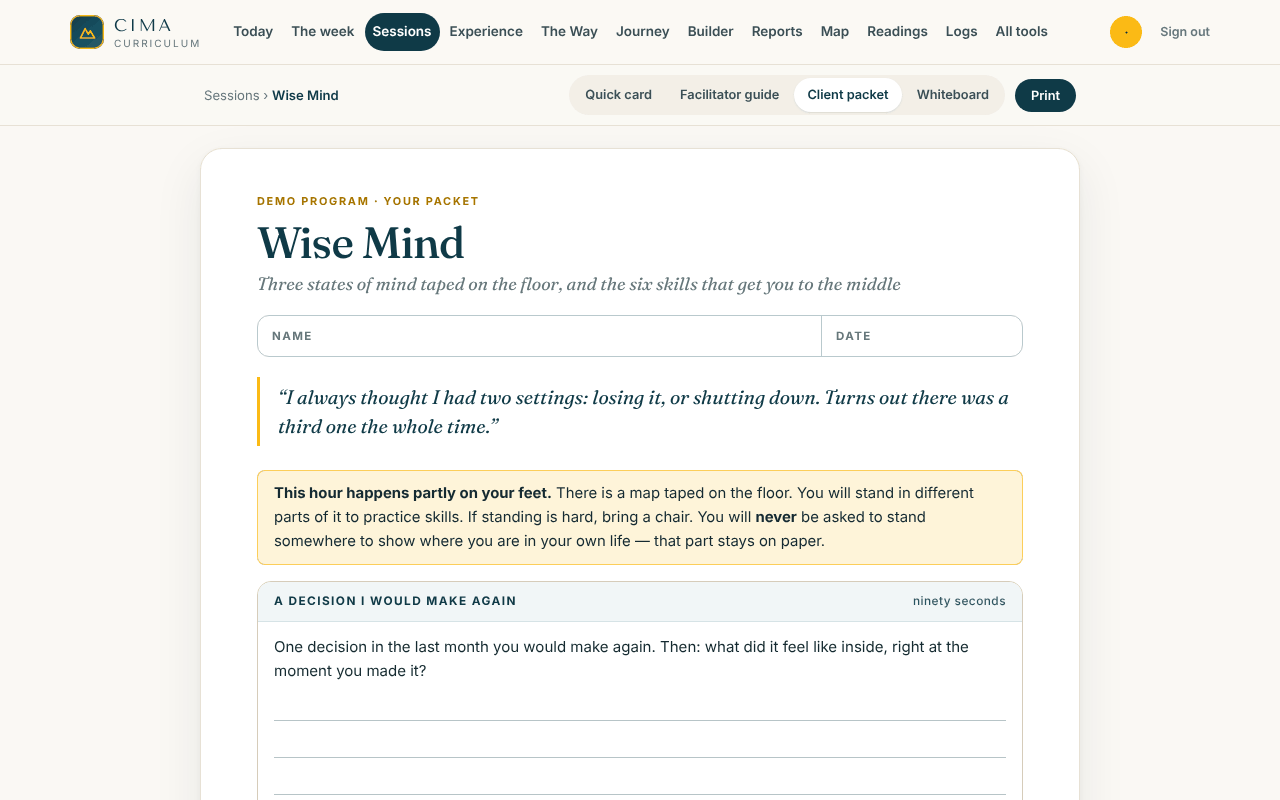
Something worth keeping
- A packet for every group: the reading, the exercise and the takeaway, written for the client, not the chart.
- Most groups end with something to carry: a wallet card, a script, a plan, a letter.
- Clients keep what you print, even after your plan ends.
No two groups run the same way
Chairs in a circle and a discussion is one way to run a room. The PHP sessions alone use 26. A check before every release compares each session with every other one, so no two share a skeleton.
Wise Mind
Three states of mind taped on the floor. Every DBT skill is taught, then practiced standing in the region it belongs to.
The Struggle
A demonstration with an actual rope, then each client's own table of what they've tried against their thoughts and what it cost them long term.
Asking Without Burning It Down
Two volunteers run one real ask in the middle while the outer ring coaches one letter of DEAR MAN each. Then everyone runs their own in pairs.
A Higher Power That Fits
Four corners for four honest positions, from "I have a faith" to "I don't believe." Clients stand where they choose, or don't, and each corner writes from there.
What Matters
Clients sort value cards into very important, important and not, then narrow to the few they'll walk by.
Permission-Giving Thoughts
Everyone writes the sentences their own head uses on an unsigned slip. They're tallied on the board, and the room writes the talk-back to the top five.
Calming a Body on Alert
Seven regulation tools tried in turn by the whole room, each rated 0 to 10 for what it did in their own body.
The room screen
For the TV in the group room: a welcome, today's opening line, this week's milestones, the shout-out box and 988.
Therapeutic modalities
Six weeks, one climb
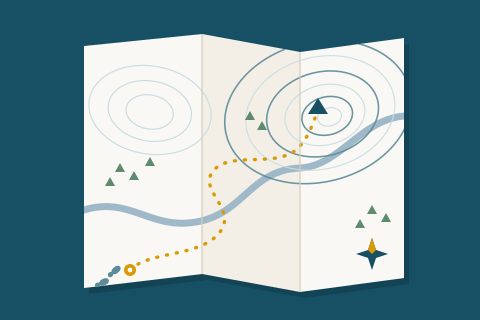
Each week teaches one approach deep, as a course, not a sampler. Clients start at Base Camp the day they arrive and reach the Summit the day they leave, crossing six stretches in whatever order the rotation brings them.
 Day one
Base Camp
Whatever week they arrive
Where they're starting from, the trail that brought them here, and the first step.
 Cycle 1
The Trail Map
Foundations and CBT
Reading the map: the thought, the feeling and the urge, and the route between them.
 Cycle 2
The Crossing
DBT
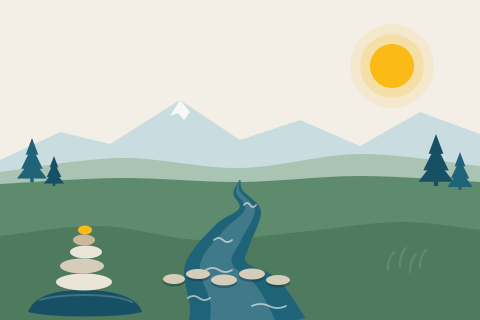
Stepping stones across rough water: skills for the feelings that used to send them to a drink or a drug.
 Cycle 3
The Pack
ACT
What they carry and what they can set down: values to walk by, and room for the thoughts that won't leave.
 Cycle 4
The Lighthouse
Motivation and relapse prevention
Seeing the rocks before they reach them: warning signs, slips, and a life that competes with using.
 Cycle 5
After the Rain
Emotions, trauma and the body
The body, the past and the feelings underneath, met at a pace they can stand.
 Cycle 6
The Campfire
Relationships and meaning
The people around the fire: family, boundaries, and the story they tell next.
 The last day
The Summit
Graduation
The view back down, a letter from the top, and the route home.
Admission is rolling, so nobody waits for a new group to start. A client joins the climb wherever it is, and six weeks later they've crossed every stretch once. The IOP runs its own 16 weeks, three hours a day.
Beyond the six weeks
More than 20 approaches, taught for real
Every session names its approach and its ASAM dimension. Sessions that cite research name a published source, and none of it is invented.
- CBT
- DBT
- ACT
- Motivational interviewing
- Relapse prevention
- Mindfulness-based relapse prevention
- Twelve Step facilitation
- SMART Recovery and REBT
- Trauma-informed grounding
- Seeking Safety
- Behavioral activation
- Family systems
- Interpersonal effectiveness
- Narrative
- Shame and self-compassion
- Grief
- Meaning-centered
- Positive psychology
- Community reinforcement and recovery capital
- Psychodrama and role-play
- Expressive arts
- Health and behavioral medicine
- Life skills
Twelve Step facilitation, done right
All twelve Steps, from the real pages, each with a spiritual practice in the room. Every session also gives the atheist, the agnostic and the person hurt by religion an equal way in, said out loud. Meetings rotate through SMART Recovery, Recovery Dharma, medication-friendly and online meetings as well as AA and NA.
An IOP that covers what clients face
Medication for addiction, hands-on naloxone practice with a kit to take home, nicotine and vaping, sleep, pain, trauma, and a suicide safety plan for every client.
Safety on every page
Heavy topics carry care rails, and nobody is made to disclose. Private writing stays private: in the hardest hours, nobody reads it but the client.
What makes it different
Most programs run groups from a topic list, a binder of handouts, or whatever the counselor wrote the night before. Here's what changes.
| What matters | The usual way | Cima Curriculum |
|---|---|---|
| The hour itself | A topic and a worksheet; the counselor fills the time | A minute-by-minute run of show, the words to say, and what to do if the room goes sideways |
| Across a week | A different topic every day, a sampler of everything | One approach taught deep each week, like a course |
| How the room works | Chairs in a circle, a talk and a discussion | 26 room designs: floor maps, a rope, fishbowls, stations, card sorts, rehearsals |
| The Twelve Steps | Mentioned, or left to the meetings | All twelve from the real pages, practiced in the room, with an equal way in for people who don't believe |
| Safety | In a policy binder | Your crisis protocol and on-call numbers on every guide, and care rails on heavy topics |
| Joining mid-stream | Wait for the next cohort, or start halfway through a series | Every session stands alone, so a client can start any day |
| What clients keep | Handouts | A workbook in their own hand, packets, wallet cards and letters from their peers |
| Group notes | One note copied for the whole group | Each client's own note, drafted from what the clinician saw |
| Quality | Take it on trust | Every session graded in an audit we publish, lower grades included |
The groups teach. This is what they remember.
People remember an experience by its high points and how it ends, so the high points are designed: the same ones for every client, every time, each with a staff guide and printables.
Arrival
A seat waiting, a letter from someone who sat there before, and a peer to walk the first week with.
Every day
An opening and a closing, different on each of the 36 days of the six-week loop.
Milestones
Seven days, halfway, 30, 60 and 90 days, and coming back after a slip.
Out together
A meeting with a mission, an outing the clients vote on, the gym and a shared table. Outings open and close with a 0 to 10 mood number.
Graduation
Peers witness, a stone goes around the circle, sealed letters, and a door to walk through.
Family and alumni
Six family evenings, a Family Day, an Alumni Night and a year of check-ins after.
The client workbook
The Climb
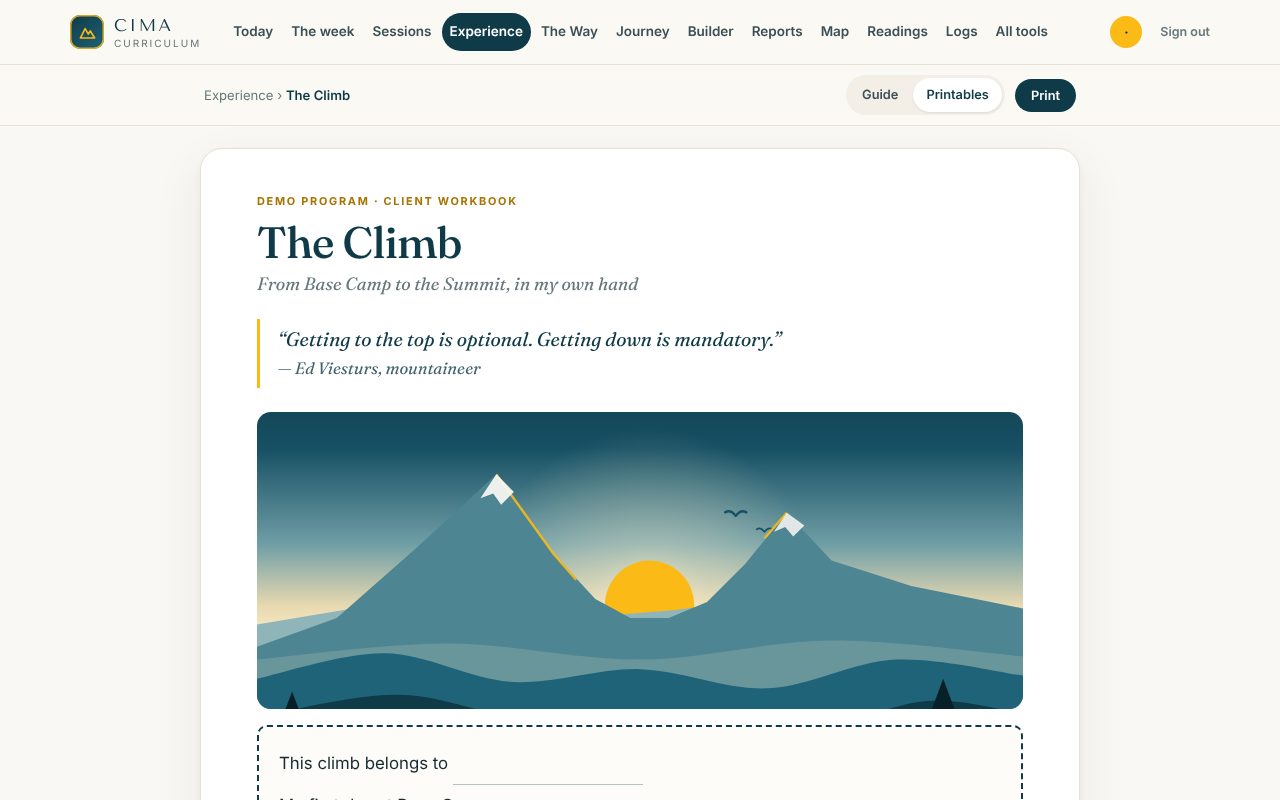
A workbook every client fills in their own hand, from Base Camp to the Summit, with the same illustrations as the program. Each exercise is short and hands-on, and each comes with a staff guide for running it in 20 minutes.
- My Trail So Far: their story as a trail map, drawn before it's written.
- The Trailhead: Step One in their own words, with a secular way in.
- And along the way: a values compass, a lighthouse map of their warning signs, a body map, their rope team, a meeting log and a stamp for every stretch.
- The Summit: the view back down, a letter to whoever starts next, and a page signed at graduation. It goes home with them.
The room screen
A welcome on the wall
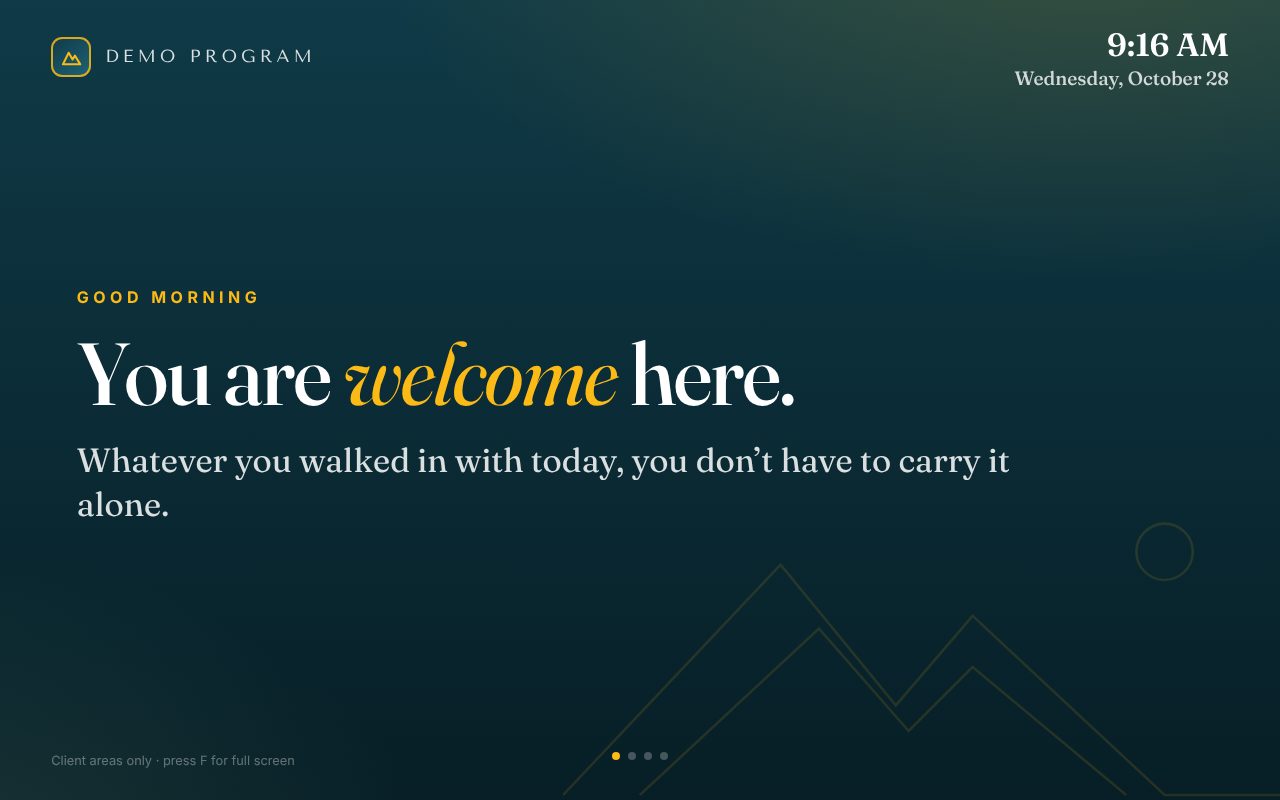
- Put it on the TV in the group room or the lobby and press F for full screen.
- It turns through a welcome, today's opening line, this week's birthdays, milestones and graduations, the days of recovery in the room, the shout-out box and 988.
- Names are first names your staff add with the client's OK, and they stay on that one device.
We graded every session, and we publish the grades
In October 2026 every session was read and graded: the evidence behind it, how different it is from its neighbors, and what it covers. These are the curriculum's grades, the lower ones included. The full audit comes with every plan.
Evidence
77 of the 90 PHP sessions audited name a published source; most of the rest are practical life-skills hours.
Session variety
26 different room designs across the PHP sessions, and no two sessions share a skeleton.
IOP
The most varied part: medication for addiction, naloxone, nicotine, sleep, pain, trauma and suicide safety planning.
Twelve Step facilitation
All twelve Steps from the real pages, practice in the room, and an equal way in for people who don't believe.
Range of approaches
Heavy on Twelve Step work. Contingency management is left to each program, as a policy.
Topics covered
The core was strong and some topics were thin. Since then: co-occurring depression and anxiety, Seeking Safety, safety plans and naloxone, nicotine, cannabis and gambling.
Still thin: sessions specific to women and to men, and chronic pain in the PHP. Before every release, validators check each session's structure, timing and safety rails.
Priced by your census, not your seats
Your plan follows the number of clients you serve in a month, PHP and IOP together, with each client counted once. A small program pays a small price, and your whole clinical team is included.
Small
Up to 15
clients a month
Growing
16 to 40
clients a month
Program
41 to 80
clients a month
Network
81 or more
or more than one site
- Every PHP and IOP session: guides, packets, quick cards and whiteboard plans
- The Climb client workbook
- The experience: arrival, rituals, milestones, outings and graduation
- Printables: certificates, wallet cards and each client's weekly schedule
- Today, the Builder and per-client note drafting
- Your crisis contacts on every guide, and clinical sign-off for your team
- New sessions as the curriculum grows
- Your whole staff, with no per-seat fees
We're opening Cima Curriculum to programs now. Tell us your census and we'll send your price and set up your program with you.
What programs ask us
Do you store client information?
No. Cima Curriculum holds no client records: no names, no charts, no diagnoses. Group notes are drafted in the counselor's browser and pasted into your EHR, so client information stays where it already is. The room screen's first names stay on the one device that runs it.
Does it work with our EHR?
Yes. Notes are copied into your EHR field by field, so it works next to any EHR, Cima EHR included. Cima EHR's Program plan handles the group notes, attendance and per diem billing if you need an EHR too.
Is it evidence-based?
Each session names its approach, and sessions that draw on research name a published source. Claims are modest, and none is invented. The audit graded the evidence an A−, and we publish its grades above.
Can we change the curriculum?
Yes. Build your own weekly program from the library with your days, block times and weeks; the checks tell you what your program is missing. Your clinical leads sign off each session for your program.
We only run an IOP. Does it fit?
Yes. The IOP has its own 145 sessions over 16 weeks, three hours a day. Start from the sixteen-week IOP in the Builder and set your own days and block times.
Is the Twelve Step content religious?
It teaches the Steps as the fellowships do and includes a spiritual practice in each session. Every session also gives atheists, agnostics and people hurt by religion an equal way in, said out loud, and the meetings rotate through SMART Recovery, Recovery Dharma, medication-friendly and online meetings as well as AA and NA.
What counts as a client for our census?
Each different person your program serves in an average month, PHP and IOP together. A client who attends both counts once.
Can clients keep what we print?
Yes. Packets, workbooks, cards and certificates are theirs to keep, even after your plan ends. What the license doesn't allow is sharing the curriculum with another program, publishing it or reselling it.
Who wrote it?
It was written for a licensed Texas PHP and IOP program we run, and it's used there every day. Every session passes the same checks before it ships: structure, timing, safety, that it stands alone, and that no research is invented.
Give your clients a climb they'll remember.
Set up with your name and crisis contacts, then print the first session the next morning.
Get early access