A free guide from Cima EHR
UB-04 vs CMS-1500 for behavioral health
The short answer: the CMS-1500 (sent electronically as an 837P) bills a clinician's or group's professional services, line by line with CPT or HCPCS codes and a place of service. The UB-04 (also called the CMS-1450, sent as an 837I) bills a facility's services, with a type of bill, revenue codes, statement dates and an attending provider. A freestanding IOP or PHP bills whichever form each contract names; many commercial contracts take the per diem on a CMS-1500, while hospital-based programs, community mental health centers, Medicare and TRICARE use the UB-04. Here's how to tell, and how to fill each one for a program day.
Updated October 24, 2026. General information, not billing or legal advice: your payer contracts and manuals control.
The two claims side by side
| CMS-1500 / 837P (professional) | UB-04 / 837I (institutional) | |
|---|---|---|
| Who bills it | Clinicians, groups and clinics billing professional services | Facilities: hospitals, community mental health centers, residential programs, and freestanding programs whose contract says so |
| What identifies the service | CPT or HCPCS code (box 24D) with up to 4 modifiers | Revenue code (form locator 42), usually with a HCPCS code beside it (FL 44) |
| Where it happened | Place of service on each line (box 24B), such as 11 office, 57 non-residential substance abuse treatment facility, 52 psychiatric facility partial hospitalization, 10 or 02 telehealth | Type of bill (FL 4): the kind of facility, the kind of care and which claim in a series this is |
| Dates | A date of service on each line | A statement period (FL 6) plus a date on each line (FL 45) |
| People | Rendering provider on each line (24J) and the billing provider (box 33) | Attending provider (FL 76) and the billing provider (FL 56) |
| Diagnoses | Up to 12, with a pointer from each line to up to 4 of them | A principal diagnosis (FL 67) and others; no line pointers |
| Extra codes | None beyond modifiers | Condition codes (FL 18–28), occurrence codes and dates (FL 31–36), value codes (FL 39–41), type of admission, point of origin and discharge status |
| Prior authorization | Box 23 | FL 63 (treatment authorization code) |
Both are HIPAA standard electronic transactions (ASC X12 version 5010), and almost nobody mails paper anymore. Your clearinghouse turns what the EHR sends into the 837P or 837I the payer receives. The paper forms are still the easiest way to think about the fields, which is why billers say "UB" and "1500."
Which one your program bills
The form isn't your choice and it isn't set by the code. It's set by the kind of provider you are to that payer and by what your contract says. Read the billing section of each contract (or ask the provider relations rep in writing) for four things: the claim form, the per diem code, the revenue code if any, and the type of bill or place of service.
| Situation | Usual claim |
|---|---|
| Hospital outpatient PHP or IOP | UB-04 / 837I, type of bill 13X. For Medicare (per CGS and First Coast), condition code 41 (PHP) or 92 (IOP), with each service on its own line. |
| Community mental health center PHP or IOP | UB-04 / 837I, type of bill 76X. Some payers treat clinic-based programs this way. |
| FQHC or rural health clinic IOP (Medicare, since 2024) | UB-04 / 837I with condition code 92 and revenue code 0905. |
| Freestanding licensed IOP or PHP, commercial contract | Either. Many contracts take the per diem (H0015, S9480, S0201) on a CMS-1500; others want a UB-04 with a revenue code and the type of bill they assign. |
| TRICARE PHP or IOP | UB-04 with revenue codes, condition code 41 on PHP claims, each date of service on its own line. |
| Outpatient (OP) sessions in the same program | Usually CMS-1500 / 837P, with the clinician who saw the client as the rendering provider. |
| Medication visits by the program's prescriber | CMS-1500 / 837P under the prescriber's NPI, when the plan pays them outside the per diem. |
So one program often sends both: per diem days on whichever form each plan wants, and outpatient and prescriber visits on the 1500. The codes themselves are covered in IOP and PHP billing codes, and what makes a day billable in per diem billing for IOP and PHP.
Type of bill (UB-04 form locator 4)
A four-digit code: a leading zero, then the type of facility, the type of care, and the frequency (which claim in a series this is). Payers reject an 837I for a type of bill they don't expect for your contract, so get it in writing before the first claim.
| Digits | Meaning | Behavioral health examples |
|---|---|---|
| Facility and care (first two) | What kind of provider and setting | 13X hospital outpatient; 76X community mental health center; 85X critical access hospital; 71X rural health clinic; 77X FQHC. A freestanding program uses the code its contract assigns. |
| Frequency (last) | Which claim in a series | 1 a whole claim (admit through discharge); 2, 3 and 4 the first, continuing and last interim claims; 7 a replacement; 8 a void. |
Medicare bills long PHP and IOP courses in interim claims (for a hospital, 0132, then 0133s, then 0134), sent in order, each after the payer has answered the one before. Cima sends each program day as its own whole claim (frequency 1) instead, which keeps one denied day from holding up the rest; check that your payers accept daily claims.
One IOP day on each form
A made-up example: a client in a substance use IOP attends three hours on October 13, 2026, under an authorization, with a primary diagnosis of alcohol dependence. Here's where each piece goes.
| Piece | CMS-1500 (837P) | UB-04 (837I) |
|---|---|---|
| The service | 24D: H0015, 1 unit (24G) | FL 42: 0906; FL 44: H0015; FL 46: 1 unit |
| Date | 24A: 10/13/2026 | FL 6: from and through 10/13/2026; FL 45: 10/13/2026 |
| Setting | 24B: the place of service your contract names (57 is common for a non-residential SUD program) | FL 4: the type of bill your contract names, ending in 1 |
| Visit details | None | FL 14 type of admission 3 (elective); FL 15 point of origin 1 (non-health-care); FL 17 status 01 (discharged home, since each outpatient day ends at home) |
| Diagnosis | 21A: F10.20, with pointer A on the line (24E) | FL 67: F10.20 |
| Authorization | Box 23 | FL 63 |
| Who | 24J: rendering clinician's NPI; 33: the program's NPI (type 2) and address | FL 76: attending provider's NPI and taxonomy; FL 56: the program's NPI |
Whatever the form, the claim has to match the chart: the level of care on the authorization, the hours in that day's signed notes, and the diagnosis on the treatment plan. An auditor checks the claim against those, not against the form.
Attending, rendering and billing providers
- Billing provider (box 33, FL 56): the program, with its organization (type 2) NPI, tax ID and a street address (not a PO box). Its taxonomy is usually a clinic code, such as 261QR0405X for a substance use disorder clinic or 261QM0801X for a mental health clinic. It should match your NPPES record and what you credentialed with.
- Rendering provider (837P line, 24J): the clinician who delivered the service. For a per diem day with several group leaders, payers usually want the program's primary clinician or leave it to the billing provider; your contract says which.
- Attending provider (837I, FL 76): the clinician with overall responsibility for the client's care on that claim, with NPI, last and first name and taxonomy (qualifier ZZ). State Medicaid programs such as Maine's check that the attending is enrolled, so pick someone who is credentialed with the plan. In programs this is often the medical director or clinical director.
Condition, occurrence and value codes
These UB-04-only fields carry facts the revenue lines can't. Most commercial per diem claims from a freestanding program need none of them, but some payers require them, and Medicare and TRICARE always do for these levels.
- Condition codes (FL 18–28) flag the kind of claim. The two that matter here: 41, partial hospitalization, required by Medicare (with type of bill 13X, as Amerigroup's Texas Medicare-Medicaid plan also instructs) and by TRICARE on PHP claims; and 92, intensive outpatient, which CMS requires on every Medicare IOP claim since 2024.
- Occurrence codes (FL 31–34) pair a code with a date, such as the date of an accident or the onset of symptoms (occurrence code 11). Occurrence span codes (FL 35–36) give a from–through range. An outpatient program day rarely needs one; add it only when the payer's manual or a denial asks for it.
- Value codes (FL 39–41) pair a code with an amount. Outpatient behavioral health claims rarely use them.
The full code lists belong to the National Uniform Billing Committee's UB-04 data specifications, which payers license. Your payer's UB-04 billing guide tells you which ones it requires.
How Cima bills both
Cima builds every claim from the signed note, and the Program plan for IOP and PHP adds facility billing for per diem days. Under Settings, Program, you choose:
- The form for per diem days: 837P (the default, as most commercial IOP and PHP contracts are billed) or 837I. Office, outpatient and prescriber visits always go as 837P, under the clinician who signed the note.
- For 837I: the first two digits of the type of bill your contracts use (Cima won't save facility billing without them), a four-digit revenue code for PHP and for IOP (defaults 0913 and 0906), and the attending provider. Leave the attending blank and the client's own clinician is used.
- What goes on each facility claim: one claim per client per program day, frequency 1, statement dates from and through that day, type of admission 3, point of origin 1, status 01, the revenue code beside the level's HCPCS code, the principal and other diagnoses, and the authorization number when one covers the date.
- Checks before sending: the program's NPI, tax ID, taxonomy and street address, the attending's or rendering clinician's NPI and taxonomy, a valid ICD-10 code, an authorization with visits left, and the days left before your filing limit (95 days by default for Texas practices). A claim that fails says exactly what to fix.
- After sending: the payer's acknowledgment (277CA) moves the claim to accepted or rejected with the reason, and the electronic remittance (835) posts the payment, adjustment and client's share on its own.
Honest limits today: per diem claims on the 837P go out with place of service 11, and Cima doesn't add condition or occurrence codes to the 837I. If a contract needs place of service 57 or 52, or condition code 41 or 92, talk to us before you bill that plan that way. Claims are sent through the clearinghouse at its standard rate, about 30¢ a claim.
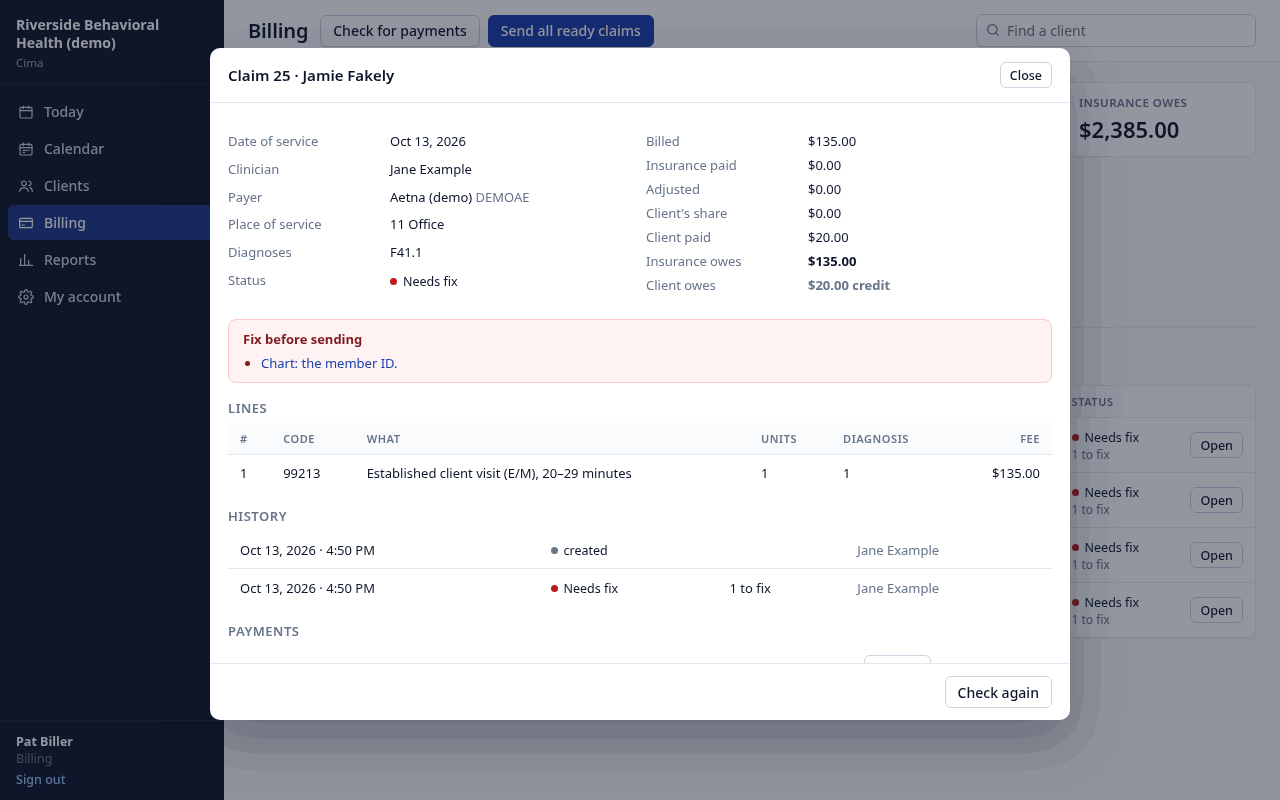
One EHR, both claim forms
Cima's Program plan bills per diem days on a CMS-1500 or a UB-04, outpatient sessions on the 1500, and checks every claim before it leaves. $399 a month for up to 25 clients.
Read more about the EHR for IOP and PHP programs, see pricing or take the tour. Not sure which form, codes and type of bill your contracts call for? Cima Consulting's billing set-up ($1,500) works it out with you, plan by plan, and the IOP and PHP billing checklist lists everything to settle before the first claim.
Questions
Can a freestanding IOP bill on a UB-04?
Yes, if the contract says so. Many commercial plans contract freestanding programs to bill the per diem on a UB-04 with a revenue code (0906 or 0905 for IOP) and a type of bill they assign. Others want the same day on a CMS-1500. Most freestanding programs can't bill Medicare for IOP or PHP either way.
Is the UB-04 the same as the CMS-1450?
Yes. CMS calls the institutional paper claim the CMS-1450; its common name is the UB-04. Its electronic version is the 837I. The CMS-1500's electronic version is the 837P.
What type of bill does an IOP use?
Hospital outpatient programs use 13X and community mental health centers use 76X; for Medicare IOP, critical access hospitals use 85X. A freestanding program uses the type of bill named in its contract. The last digit is the frequency, usually 1 for a single day's claim.
Who goes in the attending provider field?
The clinician with overall responsibility for the client's care during the billed period, with their NPI and taxonomy. In a program that's usually the medical director or clinical director, and they must be credentialed with the plan.
Do I need condition code 92 on a commercial IOP claim?
Only if the payer asks for it. Condition code 92 is Medicare's IOP flag (since 2024) and 41 is the partial hospitalization flag Medicare and TRICARE require. Check each commercial plan's UB-04 guide.
Can I send the same day on both forms?
No. One program day is one claim to one payer on one form. Sending it both ways is a duplicate claim, and it will deny or be recouped.
Sources
- CMS, MLN Matters MM13222, and CGS, January 2024 IOP billing notice (condition code 92; types of bill 13X, 76X and 85X; RHC and FQHC IOP with revenue code 0905; interim billing).
- First Coast Service Options, IOP billing requirements for institutional services.
- Amerigroup Texas, partial hospitalization program billing (type of bill 013X, condition code 41).
- Ambetter, behavioral health type of bill scenarios (13X for hospital-based PHP and IOP, 76X for clinic-based).
- TRICARE For Life, PHP and IOP claims (UB-04, condition code 41, revenue codes, one line per date of service).
- Maine MaineCare, UB-04 and 837I attending provider bulletin; Montana Medicaid, sample UB-04 (FL 76 NPI, ZZ taxonomy qualifier, names).
- CMS, NPPES (NPI and taxonomy records).
Form locator and box numbers follow the published UB-04 and CMS-1500 layouts; your payer's billing guide is the final word. This guide is general information, not billing or legal advice.
Bill each plan the way its contract says.
Per diem days on a 1500 or a UB-04, outpatient visits on the 1500, every claim checked first. See Cima for programs.
Get early access