A free guide from Cima EHR
The IOP and PHP billing checklist
Billing a program is a cycle, not a task: set up the provider records and a code map for each plan once, verify and authorize every admission, close attendance from signed notes every day, send claims every week, post payments and work denials as they arrive, and reconcile claims against notes every month. This checklist puts each step in that order, with who does it and what to check. It's the routine we use to bill the licensed Texas PHP, IOP and outpatient program we run, and the one Cima's Program plan is built around.
Updated October 24, 2026. General information, not billing, legal or tax advice. Cima isn't a law, accounting or billing firm.
Before the first claim
- Organization NPI and taxonomy. Get the program's type 2 NPI in NPPES with a clinic taxonomy from the NUCC code set that matches what you are, such as 261QR0405X (substance use disorder clinic) or 261QM0801X (mental health clinic). Use the legal name and street address exactly as on the IRS letter, everywhere.
- Clinician NPIs and taxonomies. Every clinician who will be a rendering or attending provider needs their own NPI and taxonomy, and must be credentialed with the plan if the plan checks.
- Contracts and effective dates in writing. Don't bill a plan as in-network before its effective date; those claims deny. Until a contract is effective, a single case agreement for one client, at a rate agreed in writing before admission, can bridge the gap.
- A fee schedule. Set your standard charge for each code at or above what your best-paying plan allows, so you never bill a plan less than it would pay. Programs set one daily fee for each level of care. Self-pay rates and a good faith estimate for uninsured and self-pay clients are required by the No Surprises Act.
- Who bills. In-house, a billing company, or a mix. If a billing company would be paid a percentage of collections, have your attorney approve the arrangement first, especially for an SUD program.
- Clearinghouse enrollment. Enroll the program's NPI and tax ID, then add each plan's payer ID as contracts come in.
- Payer portals, ERA and EFT. Register for each plan's provider portal (many use Availity), and enroll in electronic remittance (835 ERA) and direct deposit (EFT) for each plan. Each plan approves ERA enrollment on its own schedule, often one to three weeks, so start early.
- Part 2 consent for billing. For an SUD program covered by 42 CFR Part 2, sending a claim discloses SUD information for payment, so the client's written consent must be on file. The 2024 rule (compliance date February 16, 2026) allows a single consent for treatment, payment and health care operations; check your forms against 42 CFR 2.31 with your attorney.
- A compliance routine. A compliance officer, exclusion checks on every hire and regular billing and documentation audits, the basics in HHS-OIG's compliance program guidance.
The payer code map
The single most useful billing document a program has: one row per plan and level, filled in from the contract (or the provider rep's written answer) before the first claim. Every coding question afterward is answered by this table, not by memory.
| Plan | Level | Form | Code and units | Revenue code / TOB or POS | Billable day | Auth and limits |
|---|---|---|---|---|---|---|
| Plan A (example) | PHP | 837I (UB-04) | S0201, 1 per day | 0913, type of bill per contract | Per contract, e.g. 6 hours | Pre-auth; concurrent review on the plan's schedule; filing limit |
| Plan A (example) | IOP | 837I (UB-04) | H0015, 1 per day | 0906, type of bill per contract | 3 hours | Pre-auth; individual sessions bundled? |
| Plan B (example) | IOP | 837P (CMS-1500) | S9480, 1 per day, modifiers if any | Place of service per contract | Per contract | Who to call for a continued stay; carve-out manager? |
| Any plan | OP | 837P | 90832–90837, 90853, H0004 or H0005 | Place of service 11, or 10/02 with modifier 95 or 93 | Per session | Visit limits, if any |
The rows above are placeholders to show the shape, not any plan's real terms. For what each code and revenue code means, see IOP and PHP billing codes; for the form, type of bill and attending provider, see UB-04 vs CMS-1500.
At every admission
- Verify benefits for each level you might use (PHP, IOP, OP): coverage, deductible, out-of-pocket, prior authorization, and whether a carve-out manages behavioral health. The VOB checklist lists the questions; behavioral health carve-outs explains the second company.
- Get the authorization before the first day: number, level, number of days, start and end dates, and the next review date, all entered on the chart. The prior authorization guide covers the request.
- Put the right level and diagnosis on the chart on day one. The level drives the code, the hours and the authorization match.
- Signed consents: consent to treatment, financial agreement, and the Part 2 consent that covers payment.
- Collect what the client owes (copay or deposit) under your financial policy, and give self-pay clients a good faith estimate.
Every day
- Sign every group and individual note the same day, with start and end times and each client's own entry. In the program we run, unsigned drafts explain a large share of "missing" billable days.
- Record early departures with the time, so the day's hours are honest.
- Close attendance: each client's hours against their level. A short day is a scheduling or engagement issue for the counselor, never something to fix by writing a note for time the client wasn't there.
- Watch authorizations: any that end within 5 days get their continued-stay review drafted now, citing the ASAM dimensions or the plan's criteria. See per diem billing for what a reviewer and an auditor look for in the notes.
Every week
- Charge the week's qualifying days: one unit of the level's code per client per day that met its hours, with an authorization covering the date.
- Scrub before sending: NPIs and taxonomy, member ID, diagnosis, units, revenue code, authorization number, and days left on the authorization.
- Send claims and read the acknowledgments (277CA). Fix and resend rejections the same week; a rejected claim was never received, so the filing clock keeps running.
- Post payments from the ERAs and look at every denial's reason code. Fix the cause, not just the claim: the same reason on the next claim means the fix didn't take.
- Follow up on claims with no answer past the plan's processing time with a claim status check or a call.
Every month
- Reconcile claims against notes by client and date into four buckets: charged but never submitted, documented but never billed, at the payer or denied, and billed with no note. The first two are money; the last is refund exposure to fix before an auditor finds it.
- Compare payments to contract rates. Underpaid claims get worked while the problem is small. Report money as expected cash at contracted rates, never as charges.
- Review AR by age and by payer. Anything past 90 days needs a person on it.
- Audit a sample of charts the way a payer would: medical necessity for the level, signatures and timeliness, treatment-plan links and hours. Comply's chart audit checklist is the form.
- Re-check benefits for clients still in care, since coverage can change at the first of the month.
Texas deadlines to calendar
| Deadline | Rule | Applies to |
|---|---|---|
| Submit the claim by the 95th day after service | Texas Insurance Code 1301.102 | In-network claims to fully insured preferred provider plans regulated by Texas |
| The plan decides a clean claim within 30 days (electronic) or 45 days (paper) | Texas Insurance Code 1301.103 | The same plans; use it when a clean claim sits unpaid |
| Each plan's own filing limit | Your contract or the plan's provider manual | Self-funded employer plans, Medicaid managed care, TRICARE and out-of-state plans, which set their own limits |
Self-funded employer plans aren't governed by these Texas rules. Put every plan's real limit in the code map, and check the current rules with the Texas Department of Insurance.
Where Cima fits
Cima's Program plan for IOP and PHP does the daily and weekly parts of this checklist from the chart itself:
- Levels of care with their day and week hours, per diem code and modifiers; facility billing (837I) with a revenue code per level, type of bill and attending provider, or professional claims (837P).
- Group notes with each client's own entry, signed in one step; look-alike entries refused before signing.
- Attendance from signed notes, and a list of program days that are ready to bill or say exactly why not (short hours, no authorization, no diagnosis). Ready days are charged in one step.
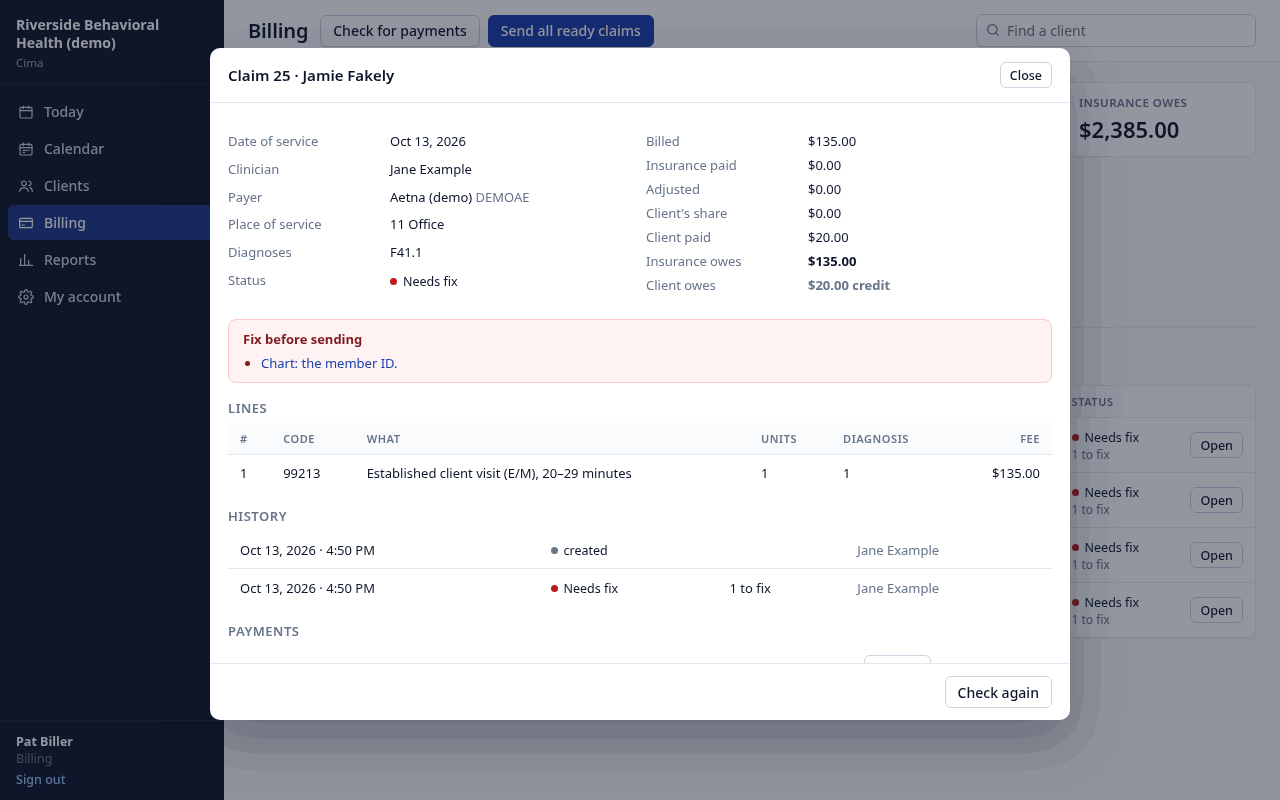
- Claims checked before sending: NPIs, taxonomy, address, diagnosis, authorization days left, and the filing limit (95 days by default for Texas practices).
- Acknowledgments and ERAs posted on their own, with denials and reasons on the claim, AR aging by payer, and authorizations whose review is due within 5 days.
- Coverage checks through the clearinghouse, and Quick VOB for admissions calls.
Claims, ERAs and eligibility checks are billed per transaction at the clearinghouse's standard rate, about 30¢, 20¢ and 30¢ each.
Run the cycle from the chart
Cima's Program plan is $399 a month for up to 25 clients: notes, attendance, per diem claims, ERAs and authorizations in one place.
See the EHR for IOP and PHP programs, pricing or the tour. Want the set-up half done for you? Cima Consulting's billing set-up ($1,500) covers the fee schedule, clearinghouse, ERA and EFT enrollment, eligibility, authorization and claim scripts, and a first-month claim review. Opening a new program? How to start an IOP or PHP in Texas covers the license and contracts that come first, and credentialing gets each plan in network.
Questions
What do I need before I can bill insurance for an IOP?
The state license, a type 2 NPI with the right taxonomy, a contract (or a single case agreement) with an effective date, a clearinghouse enrollment, the plan's codes and form in writing, an authorization for the client, and signed notes that meet the day's hours.
How often should a program send claims?
At least weekly. Waiting turns small rejections into missed filing limits, and Texas fully insured plans can refuse claims filed after the 95th day.
Should a program bill in-house or use a billing company?
Either works if someone owns the weekly routine. In-house keeps the notes and claims close together; a company adds people. If a company is paid a percentage of collections, have your attorney review the arrangement first.
What's the most common reason program claims are denied?
Authorization problems: no authorization for the date, the wrong level, or days used up. Checking authorization days before every claim prevents most of them.
How long does ERA enrollment take?
Each plan approves it on its own schedule, often one to three weeks. Enroll as each contract is signed so payments post electronically from the first claim.
Sources
- CMS, NPPES (NPI) and NUCC, health care provider taxonomy code set.
- CMS, No Surprises Act (good faith estimates for uninsured and self-pay clients).
- 42 CFR §2.31 (Part 2 consent requirements).
- HHS Office of Inspector General, General Compliance Program Guidance.
- Texas Insurance Code §1301.102 (95-day claim filing) and §1301.103 (30- and 45-day clean claim payment).
- X12, claim adjustment reason codes.
This checklist is general information, not billing, legal or tax advice. Cima isn't a law, accounting or billing firm.
From signed note to posted payment, in one place.
Cima's Program plan runs the daily and weekly billing routine from the chart. See Cima for programs.
Get early access