A free guide from Cima EHR
Group therapy notes for IOP and PHP: individualized entries that hold up
A group note has two parts. The session part (topic, what the group covered, start and end time, who led it) is the same for everyone. Each client's entry is not: their attendance and time, how they took part, what they said and did, how they responded to the topic, and the treatment plan goal they worked on. When every client's entry reads the same, payers treat the notes as cloned, and cloned notes don't support the day you billed. Here is what each entry needs, examples of both kinds, the Texas rules, and a fast way to write them.
Updated October 24, 2026. Written by the team that runs a licensed Texas PHP, IOP and outpatient program and built Cima for it. Rules cited as of this date; examples are made up. General information, not legal or billing advice.
The session part and each client's entry
Write the session part once. Write each client's entry for that client. This is what goes in each:
| Part | What it contains | Same for every client? |
|---|---|---|
| Session | Group name and level of care, date, start and end time, in person or video, the topic, a short summary of what the group covered, and the facilitator's name and credentials | Yes |
| Attendance and time | Present, late, left early (with the time), absent or excused | No |
| Participation | Active, moderate, minimal or none, and mood and affect as observed | No |
| What this client said and did | Something only this client said or did today: a disclosure, a skill practiced, a question, a challenge to another member, a refusal | No, never |
| Response to the topic | How the client connected the topic to their own situation, or didn't | No |
| Treatment plan goal | Which goal or objective from this client's plan the group served | No |
| Plan or follow-up | Anything to act on: tell the primary counselor, a safety check, a homework item | No |
The goal line is what ties the group to medical necessity: it shows why this person was in this group. It comes from the client's own plan; see the SUD treatment plan guide for writing goals that notes can point to.
What Texas requires of group notes
For a licensed Texas chemical dependency treatment facility, the record rules in 26 TAC chapter 564 apply to every group, accredited or not:
- Within 72 hours. Every treatment service, including group counseling, chemical dependency education and life skills, is documented within 72 hours with the date, the nature of the contact, its duration, and the signature and credentials of the person who provided it (26 TAC §564.804(l)).
- The topic. Group counseling, education and life skills notes also include the topic or issue addressed (§564.804(l)(1)).
- Group size. Group counseling is limited to 16 clients; education and life skills groups to 35, except multi-family groups, seminars and events meant for a large audience (§564.901(b)).
- A written curriculum. Education and life skills sessions follow a written curriculum and include client participation and discussion (§564.901(c)).
- Required education. Programs educate clients about tuberculosis, HIV, hepatitis B and C and sexually transmitted diseases, and about the health risks of tobacco and nicotine (§564.901(d)–(e)). In the program we run, those topics land on a fixed Tuesday each month so every client cycles through them, and each attendee's entry records it.
- Who leads counseling. Chemical dependency counseling is provided by a qualified credentialed counselor, a graduate or a counselor intern (§564.901(p)).
- Signed and accurate. Every entry is dated and authenticated by its author; electronic records use a unique user ID and time stamp (§564.507). Providers may not falsify, alter, destroy or omit significant information from required records (§564.20).
Adolescent and adult clients are kept in separate outpatient groups, too. Check the current text with HHSC; the rules moved from 25 TAC chapter 448 to 26 TAC chapter 564 in 2024.
Why cloned group notes get clawed back
"Cloned" documentation is the same text in note after note, whether copied forward from a client's last note or across every client in a session. Payers say plainly that they don't accept it. AmeriHealth's provider notice on cloned documentation, for example, says documentation that is the same from patient to patient is considered cloned and doesn't meet medical-necessity requirements. Payer record audits also look for each note to describe the client's progress, or lack of it, toward the plan's goals (Optum's treatment record audit tool is a public example).
For an IOP or PHP the stakes are higher than for a single session. Per diem days are billed from the group hours (see how per diem billing works in Cima for IOP and PHP), so the group entries are the proof for the whole day's charge. An auditor who pulls a month of a client's group days and finds the same paragraph on every one, and on every other client's chart, can find the whole month unsupported. And a cloned entry can be wrong: "all members participated actively" on the day one client sat silent is an inaccurate record, which is its own problem under the Texas rule against falsifying records.
Group days also feed the continued-stay review. If the entries say nothing about this client, the ASAM continued-stay documentation has no evidence of progress to cite.
Cloned vs. individualized: the same group, three clients
A made-up PHP group: Relapse prevention: warning signs, Tuesday 9:00–12:00, in person. Session summary (written once): "Short teaching on early warning signs of relapse, practice in pairs identifying personal warning signs, and a check-in on the week's goals and supports."
Cloned (what not to write)
Client attended group and participated. Client was engaged and receptive to the material on relapse warning signs. Client will continue to work on relapse prevention skills.
Client attended group and participated. Client was engaged and receptive to the material on relapse warning signs. Client will continue to work on relapse prevention skills.
Nothing here could only be true of C or D. It restates the topic, guesses at engagement, and names no goal. Copy it to a third chart and nobody could tell.
Individualized
Mapped three warning signs: isolating, skipping meals and short sleep. Said she had a strong craving on Sunday and used urge surfing for twenty minutes instead of calling her old dealer; group reflected on what made it work. Goal 1b: use one coping step for each trigger. Plan: add Sunday evening to her craving log.
Challenged the thought that "one drink at the wedding would be fine" and listed what happened the last two times. Quiet in pair work until prompted; then named irritability with his kids as his first warning sign. Goal 2a: plan for the 11/16 wedding. Plan: primary counselor to review the wedding plan in Thursday's session.
Arrived on time but said little; declined to share warning signs in pairs, saying "I don't have any." Made eye contact only during the check-in. Reported sleeping 3 hours. Goal 3a: mood and sleep. Plan: PHQ-9 today; primary counselor notified for same-day check-in.
Each names something only that client said or did, records how they responded (including not responding), ties the group to that client's own goal, and says what happens next. Minimal participation is written honestly, with the follow-up.
Each individualized entry takes two to four sentences. Length isn't the point: a specific observation is.
Late arrivals, early exits and absences
- Left early: record the time ("left at 11:15 for a court date"). Hours count to the time the client left, and a PHP or IOP day that falls short of its hours shouldn't be billed as a full per diem day.
- Late: record the arrival time and why, if known; count hours from arrival.
- Absent or excused: an entry that says why, if known, and the follow-up (a call, a message to the primary counselor). Repeated absences belong in the next plan review and continued-stay review.
- Never mark someone present who wasn't, and never add an entry after the fact without marking it a late entry with the date it was written (late entry progress notes has a template).
Writing twelve entries without copying
A full group is where copying starts: twelve clients, three hours, and the next group in fifteen minutes. What works for us:
- Set up tomorrow's groups today. In the program we run, the next day's group notes are opened the evening before, each tied to a plan goal, so facilitators walk in with the roster and the topic already in place.
- Jot during group, one line per client. Initials and the one thing they said or did that you'll want later. A phrase is enough: "C: Sunday craving, urge surfed 20 min."
- Write right after group, while it's fresh. Two to four sentences per client from the jot line: observed, said or did, response to the topic, goal, plan.
- Check for sameness before signing. Read the entries next to each other. If two could be swapped, one of them isn't about that client yet.
- Sign within the window. Texas allows 72 hours; earlier is better for memory and for billing.
Sentence frame for any entry: [Attendance, participation, affect]. [What this client said or did]. [How they responded to today's topic]. Goal: [their plan goal]. Plan: [follow-up, if any].
How Cima handles group notes
Group notes are why we built the group workflow in Cima EHR for IOP and PHP programs the way we did:
- One session, each client's own entry. The leader writes the topic and "what the group covered" once. Each client on the roster gets their own entry, saved as their own note on their own chart; nobody else's entry is ever on it.
- Required, per client: attendance (present, left early with the time, absent or excused), and for anyone present, participation, mood and affect, "what this client said and did, and how they responded to today's topic" (at least 12 words), and the treatment plan goal worked on. Absent clients get a reason and follow-up instead.
- Look-alike entries are refused. Before signing, Cima compares every pair of entries. If two share 80% or more of their words, nothing is signed, and it says which two clients and how alike they are: "write what was different for each client."
- One PIN signs the group. When the topic, a summary of at least 10 words and every entry are complete, the leader signs every entry at once with their PIN. The session locks; later corrections are addenda on that client's note, and group sessions can't be deleted.
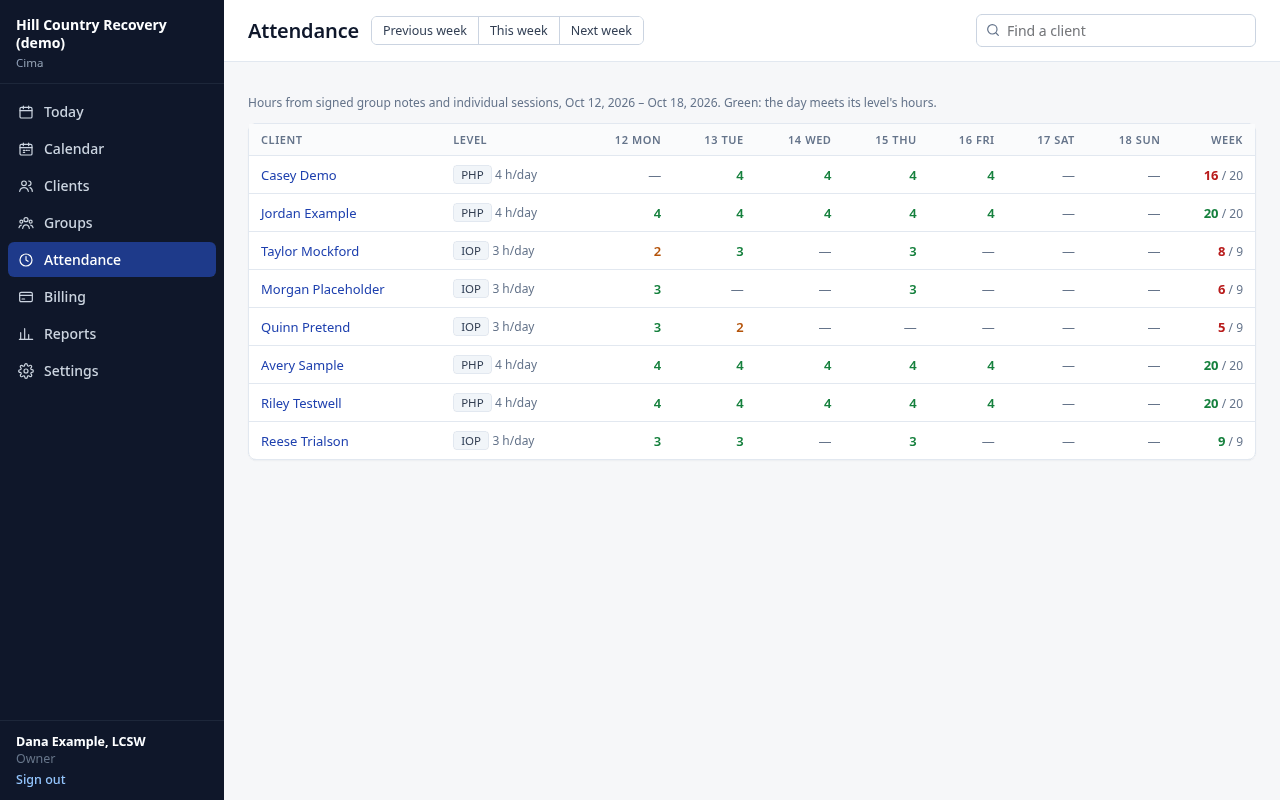
- Hours come from signed entries. Attendance counts each client-day's hours from signed group entries, to the minute a client left early. A day that meets its level's hours (defaults: PHP 4 hours, IOP 3; change them to match your contracts) becomes one per diem charge; a short day shows in red instead.
- Unsigned groups stay visible. Every group session that has started and isn't signed shows on the leader's Today screen.
Group notes that can't be cloned
Cima's Program plan is $399 a month for up to 25 clients in the program: groups, attendance, per diem billing and continued-stay reviews. Take the tour.
Want your team trained on this, or your group notes read by an outsider? Cima Consulting runs live staff trainings on documentation that holds up ($500 per session) and chart audits ($750 per 10 charts). To check your own charts each quarter, use Comply's chart audit checklist; its "group notes show the client's own participation" line is this page in one sentence. See also every program feature in Cima.
Questions
Does every client need a separate group therapy note?
Each client needs their own entry in their own record that documents their attendance, participation and response, and the goal it served. The session's topic and summary can be shared text; the client's part can't.
Can I use a group note template?
Yes, for structure: fields for attendance, participation, affect, response, goal and plan keep entries complete. The problem is pre-filled sentences that end up identical across clients. Templates should ask questions, not answer them.
How long should each client's entry be?
Usually two to four sentences. What matters is one specific observation only true of that client that day, how they responded, and their goal.
What if a client didn't say anything?
Write that, honestly and specifically: what you observed, whether they declined to share, and what you did about it. "Minimal participation; declined to share; primary counselor notified" is a valid entry. "Participated actively" when they didn't is not.
How soon must group notes be signed in Texas?
Licensed chemical dependency treatment facilities document every treatment service within 72 hours (26 TAC §564.804(l)). If you miss it, write it with today's date and mark it a late entry; never backdate.
How many clients can be in an IOP group in Texas?
Up to 16 for group counseling and up to 35 for education and life skills sessions, with exceptions for multi-family groups, seminars and large-audience events (26 TAC §564.901(b)). Payer contracts may set their own limits.
Sources
- 26 Texas Administrative Code §564.804(l), documentation of treatment services (as of October 2026). law.cornell.edu
- 26 TAC §564.901, requirements applicable to all treatment services (group size, curriculum, required education, who provides counseling). law.cornell.edu
- 26 TAC §564.507 (documentation standards and authentication) and §564.20 (records not falsified, altered or omitted). §564.507 · §564.20
- 26 TAC §564.905, additional requirements for adolescent programs (adults and adolescents kept separate). law.cornell.edu
- AmeriHealth, provider notice on cloned documentation. amerihealth.com
- Optum, Treatment Record Audit Tool (progress notes describe progress toward the plan's goals). PDF
- HHSC, chemical dependency treatment facilities (current rules and guidance). hhs.texas.gov
General information, not legal or billing advice. Payer rules differ by plan and change; confirm with each plan and your contracts.
One group, each client's own note, signed in one step.
Free for 30 days. We'll set up your groups, levels and hours with you.
Get early access