A free guide from Cima EHR
SUD treatment plan guide: goals, objectives and a sample plan
A substance use treatment plan holds up when every problem from the assessment is on it (or referred out, or deferred with a reason), every objective is something a stranger could count by a date, every intervention says who does what how often, and the client's part and signature are on it. In Texas the plan is due within five individual service days of admission and reviewed at least by the midpoint of the projected stay. Below: each part with weak and strong examples, the review schedule, and a complete made-up IOP plan.
Updated October 24, 2026. Written by the team that runs a licensed Texas PHP, IOP and outpatient program and built Cima for it. Rules cited as of this date; examples are made up. General information, not clinical or legal advice.
What payers and surveyors check
A Texas surveyor reads the plan against 26 TAC §564.804, the licensing rule for chemical dependency treatment facilities. A payer auditor reads it to decide whether the services billed were planned and medically necessary; Optum's treatment record audit tool is a public example of what they score. They ask for nearly the same things:
| Element | Texas licensing rule (26 TAC 564) | Payer record audit (Optum tool) |
|---|---|---|
| Built from the assessment | Plan addresses the problems and needs found in the assessment; unaddressed needs are referred or justified (§564.804(a)) | A plan at each level of care, consistent with the assessment |
| Measurable objectives | Individualized, realistic, measurable, time-specific, appropriate to the level of care, in behavioral terms (§564.804(b)(2)) | Measurable goals with time frames |
| Interventions | Type and frequency of services and interventions (§564.804(b)(3)) | Services in the plan match the services delivered |
| Discharge and length of stay | Individualized discharge criteria, initial discharge plans and a projected length of stay (§564.804(c)–(d)) | Discharge planning from the start |
| Client participation | Developed by the counselor and client; dated and signed by both (§564.804(a), (e)) | Client's agreement shown by a signed form or in a progress note |
| Reviews | At intervals the program defines in writing, at least by the midpoint of the projected stay (§564.804(h)) | Reviewed and updated with the client at regular intervals, and when goals are met or new problems appear |
The Texas definition of treatment planning adds that, at a minimum, the plan addresses the substance use disorder and the issues that affect progress: relationships with family and significant others, employment, education, spirituality, health concerns and legal needs, as identified (§564.1, "treatment planning").
Deadlines: when the plan is due and reviewed
| What | When (Texas licensed program) | Signed by |
|---|---|---|
| Comprehensive psychosocial assessment | Within 3 individual service days of admission | A qualified credentialed counselor (QCC) |
| Initial treatment plan | Within 5 individual service days of admission | Client and counselor; a QCC too if an intern or graduate wrote it |
| Plan review | At the interval in your written policy, and no later than the midpoint of the projected length of stay | Client, counselor and supervising QCC if applicable |
| Level-of-care change (PHP to IOP, IOP to OP) | At the change | QCC signs the decision; the plan is revised |
"Individual service day" means a day on which that client receives services, not a calendar day (§564.1). An IOP client who attends Monday, Wednesday and Friday reaches service day 5 on the second Wednesday. Payers can be stricter: for hospital and community mental health center PHPs billed to Medicare, the physician recertifies the need for PHP by the 18th day and then at least every 30 days (42 CFR §424.24(e)).
Write your review interval into policy, because §564.804(h) asks for it in writing and the surveyor checks the chart against it. Many programs pick 30 days at every level; some pick a shorter interval at PHP to match how often their payers review. Whatever you choose, the plan review also happens at every level-of-care change and whenever a goal is met or a new problem appears.
Problems: from the assessment, in the client's words
Start from the assessment's list of problems, needs and strengths. Every item ends up in one of three places: on the plan, referred to someone else (documented), or deferred with a written reason (§564.804(a)). Surveyors check exactly this: the assessment says "unstable housing" and the plan never mentions it.
Problem 1: Opioid use disorder.
Problem 1: Opioid use disorder, moderate, on buprenorphine. In the client's words: "I'm done with pills, but I panic when my back hurts and I think about using."
The diagnosis tells a reviewer what you're treating; the client's words tell them this plan was written with this person. Add the strengths you'll use ("kept the same job 6 years," "sister is supportive") because the rule bases goals on strengths and preferences as well as problems (§564.804(b)(1)).
Goals and measurable objectives
A goal is the outcome the client wants, broad and in plain language. An objective is a step toward it that you could count: a behavior, a number, a date. Texas requires objectives that are individualized, realistic, measurable, time-specific, suited to the level of care and stated in behavioral terms. Test each one: could someone who never met the client tell, on the target date, whether it happened?
| Weak objective | Why it fails | Strong objective |
|---|---|---|
| Client will gain insight into addiction. | Not a behavior; no measure; no date | By 11/13, client will name 3 personal triggers and one coping step for each, and use one of them, recorded in a group or individual note, at least twice a week. |
| Maintain sobriety. | A goal, not a step; no measure of how you'd know | Client will provide negative urine drug screens (other than prescribed buprenorphine) at each weekly screen through 12/04. |
| Attend groups. | Restates the schedule; no target | Client will attend at least 8 of 9 scheduled IOP days in each 3-week period through 12/04, and call the program before any absence. |
| Reduce anxiety. | No baseline, no measure, no date | GAD-7 will drop from 15 (10/27) to 9 or below by 12/04; client will practice paced breathing daily, logged on the phone, 5 of 7 days. |
Keep objectives few and real: two or three per problem is usually enough. A plan with fourteen objectives nobody reviews is worse than four that every note talks about. And don't paste the same objectives into every chart; a surveyor reading five plans in a row notices.
Interventions and frequency
Each intervention says what the program will do, how often, and who does it. The rule asks for the type and frequency of services, suited to the program's intensity (§564.804(b)(3)), and outpatient treatment in Texas includes educational and process groups and individual counseling (§564.904(d)).
Group therapy. Individual therapy. Relapse prevention.
IOP group counseling and education, 3 hours a day, Monday, Wednesday and Friday, led by the primary counselor (relapse prevention, CBT and DBT skills). Individual counseling with the primary counselor, 50 minutes weekly (motivational interviewing, pain-and-craving plan). Medication check with the program prescriber every 2 weeks. Urine drug screen weekly.
The frequency on the plan has to match the schedule the client actually attends and the level you bill. If the plan says 9 hours a week of IOP and the attendance record shows 6, either the plan or the attendance needs an explanation in the chart. Cima's attendance view for IOP and PHP counts each client's documented hours from signed notes, so a gap like that shows up the same week.
Discharge criteria and projected length of stay
Texas requires individualized discharge criteria, initial discharge plans and a projected length of stay on the plan itself (§564.804(c)–(d)). Write criteria you can check, and a length of stay that's an estimate, not a promise; it sets the midpoint review date.
Discharge when goals are met. Length of stay: per insurance.
Step down to OP when: 21 days without non-prescribed use, GAD-7 at or below 9, pain-and-craving plan in use. Projected IOP stay: 6 weeks (to 12/04); midpoint review by 11/13. After IOP: weekly OP, prescriber every 4 weeks, community support meetings.
These criteria become the step-down language in your ASAM continued-stay reviews, so the plan, the review and the notes all tell the same story, and they carry through to the discharge plan and summary.
Client participation and signatures
- Write it with the client. The rule says the counselor and client develop the plan, with family when appropriate. Show it: the client's words in the problems and goals, and a line on what the client asked for.
- Signatures: the client and the counselor date and sign the plan; if an intern or graduate wrote it, a QCC reviews and signs it too (§564.804(e)). Sign on the day you sign. A plan signed after the 5-service-day deadline is late; mark it as a late entry, never date it earlier.
- Record the meeting. Writing or reviewing the plan with the client is a counseling contact, and Texas requires every treatment service to be documented within 72 hours with the date, nature, duration and the signer's credentials (§564.804(l)). We write a progress note for each plan meeting; it's also where the client's agreement shows if a signature is missing.
- If the client disagrees or won't sign, say so on the plan, with what they disagreed with and what you did about it.
- Give the client a copy, and for clients with co-occurring disorders, the rule expects the client (and family, if requested) to receive one.
Plan reviews and level-of-care changes
A review isn't a new signature on the old plan. Under §564.804(i) it contains three things: progress on each goal and objective, revised goals and objectives, and a justification for continuing the stay. A useful way to run it:
- Bring the period's facts: days attended and missed, drug screens, screening scores (PHQ-9, GAD-7) and their trend, and what the notes say about each goal.
- Rate each objective: met, progressing, not progressing, or not started, with the evidence and dates.
- Decide each one: continue, rewrite with a new target date, or resolve. Add objectives for any new problem.
- Justify the level: why this level is still needed, by ASAM dimension, or that the client is ready to step down.
- Sign with the client and write the progress note for the meeting.
A change in intensity, such as PHP to IOP, needs a QCC-signed decision with the rationale and effective date, a revised treatment plan, and documented coordination with the receiving provider (§564.804(k)). Payers will usually need a new authorization for the new level too; the prior authorization guide covers that side.
A sample IOP treatment plan
Made up from start to finish. Use it for the shape, not the content: every plan you write has to come from that client's own assessment.
- Diagnoses
- Opioid use disorder, moderate, on maintenance therapy (buprenorphine). Generalized anxiety disorder.
- Strengths and preferences
- Same job 6 years; sister is supportive; prefers evening appointments after IOP ends; wants practical skills, "not just talking."
- Problem 1: Opioid use
- "I'm done with pills, but I panic when my back hurts and I think about using."
- Goal: stay off non-prescribed opioids and manage pain without them.
- Objective 1a: negative screens (other than buprenorphine) at each weekly screen through 12/04.
- Objective 1b: by 11/13, write a pain-and-craving plan with 3 steps and use it at least twice a week, recorded in notes.
- Objective 1c: take buprenorphine as prescribed; keep every prescriber visit through 12/04.
- Problem 2: Anxiety
- "My chest gets tight at work and I can't sleep."
- Goal: feel calm enough to work and sleep.
- Objective 2a: GAD-7 from 15 (10/27) to 9 or below by 12/04.
- Objective 2b: paced breathing daily, logged 5 of 7 days, starting 11/03.
- Problem 3: Support and work
- "My sister's the only one who knows."
- Goal: have people who know and help.
- Objective 3a: invite her sister to one family session by 11/20.
- Objective 3b: attend 2 community support meetings a week from 11/10, recorded in individual sessions.
- Interventions and frequency
- IOP group counseling and education: 3 hours a day, Monday, Wednesday, Friday; primary counselor and group staff.
- Individual counseling: 50 minutes weekly; primary counselor (motivational interviewing, CBT for anxiety, pain-and-craving plan).
- Medication management: every 2 weeks; program prescriber.
- Urine drug screen: weekly. GAD-7 and PHQ-9: every 2 weeks.
- Required health education topics (HIV and other infections, tobacco) in group on the program's cycle.
- Referrals and deferred needs
- Back pain: release signed to coordinate with her primary care doctor. Legal: none identified. Housing: stable.
- Discharge criteria and length of stay
- Step down to OP when: 21 days without non-prescribed use, GAD-7 at or below 9, pain-and-craving plan in use. Projected IOP stay 6 weeks (to 12/04). Midpoint review by 11/13.
- Client participation
- Plan written together in individual session 11/02. Client asked to add the sister session and evening OP. Client agrees; copy given.
Making the notes point back to the plan
The plan only proves medical necessity if the notes use it. Every individual note in Texas has to include the goals addressed, clinical observation and new issues (§564.804(l)(2)); payers look for progress, or the lack of it, toward the plan's goals in each note. In practice:
- Individual notes name the objective worked on and what moved: "Objective 1b: wrote steps 1–2 of the pain-and-craving plan; used breathing at work Tuesday."
- Group notes say which goal this client worked on in that group and what they said or did. See group therapy notes for IOP for examples.
- Screenings feed the objectives that use them: the GAD-7 every 2 weeks is the measure for objective 2a.
- A new problem in a note ("lost her job on 11/12") goes on the plan at the next review, or sooner.
Treatment plans in Cima
In Cima EHR for IOP and PHP programs (and on every plan, including Solo; see Cima for addiction counselors), the treatment plan form follows this page:
- Required parts: problems in the client's words, goals, measurable objectives with target dates, interventions, frequency, a review-by date, and whether the client took part and agrees (or a "No" that has to be explained in the plan). A plan missing one can't be signed, and objectives shorter than 8 words are sent back with "say more."
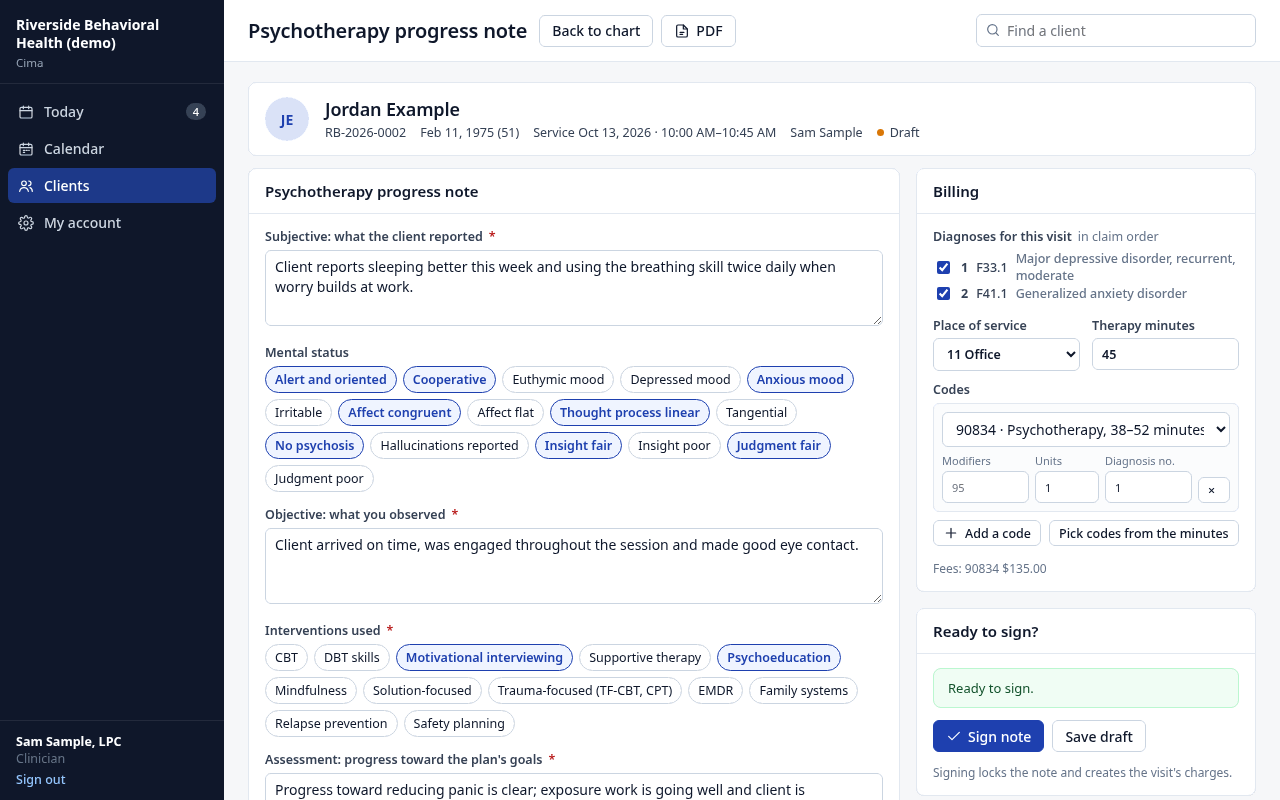
- Notes tied to the plan: the progress note asks for progress toward the plan's goals, and every group entry requires the treatment plan goal the client worked on.
- Screenings on the client's phone: PHQ-9 and GAD-7 sent with paperwork and scored for you; a PHQ-9 safety answer emails the clinician and the owner at once.
- Signed means locked. Signing uses the clinician's PIN; changes after that are addenda, and the chart's history stays intact.
- Drafting help, once the practice owner turns it on, turns your shorthand into the plan's sections using only what you wrote. You check it and sign.
The client's own signature on the plan is a separate step today: export the plan as a PDF, have the client sign it, and file it in the chart's Files tab.
Plans, notes and screenings in one chart
Cima's Program plan is $399 a month for up to 25 clients in the program, with group notes, attendance, per diem billing and continued-stay reviews. 30 days free.
Opening a program and need the forms and policies behind this? The IOP / PHP Program Launch from Cima Consulting builds the clinical program and policy manual with you, and how to start an IOP in Texas covers the license. Already open? A chart audit ($750 per 10 charts) checks plans, signatures and medical-necessity support, or run your own with Comply's chart audit checklist.
Questions
How soon does a treatment plan have to be done in Texas?
For a licensed chemical dependency treatment facility, within five individual service days of admission (26 TAC §564.804(f)). Service days are days the client receives services, so for an IOP client attending three days a week that's usually the second week. Check your payer contracts too; some want the plan sooner.
How often should an SUD treatment plan be reviewed?
Texas leaves the interval to your written policy but requires a review at least midway through the projected stay, and the review must evaluate each goal and objective, revise them, and justify the continued stay. Review it also at each level-of-care change and when a goal is met or a new problem appears.
What makes an objective measurable?
A behavior someone can observe or count, a number or frequency, and a date. "Attend at least 8 of 9 IOP days in each 3-week period through 12/04" is measurable; "gain insight" isn't.
Does the client have to sign the treatment plan?
In Texas, yes: the plan and each review are dated and signed by the client and the counselor, plus a supervising QCC when an intern or graduate is the author. If the client refuses, document the refusal and what they disagreed with.
Can we use a treatment plan library or template?
Templates help with structure, but the content has to come from the client's assessment and words. Identical goals and objectives across charts are one of the first things a surveyor or payer auditor flags.
Is the treatment plan review billable?
It depends on the payer and your contracts. A plan meeting with the client is a counseling contact that needs a progress note, but whether it can be billed as individual counseling is a question for your biller and each payer's policy.
Sources
- 26 Texas Administrative Code §564.804, Treatment Planning, Implementation and Review (as of October 2026). law.cornell.edu
- 26 TAC §564.1 (definitions: individual service day, qualified credentialed counselor, treatment planning) and §564.803 (assessment within 3 service days). §564.1 · §564.803
- 26 TAC §564.904, outpatient services (groups and individual counseling). law.cornell.edu
- 26 TAC §564.909, co-occurring psychiatric and substance use disorders (measurable outcomes; copy of the plan). law.cornell.edu
- Optum, Treatment Record Audit Tool (client agreement, measurable goals with time frames, regular review, progress toward goals in notes). PDF
- 42 CFR §424.24(e), Medicare certification and plan of care for partial hospitalization. law.cornell.edu
- The rules moved from 25 TAC chapter 448 to 26 TAC chapter 564 in 2024; confirm the current text with HHSC's chemical dependency treatment facilities page.
General information, not clinical or legal advice. Payer rules differ by plan and change; confirm with each plan and your contracts.
Plans that the notes, the reviews and the bill all agree with.
Free for 30 days. We'll help you set up your plan, group and review templates. See treatment plans in the feature list.
Get early access