A free guide from Cima EHR
Late entry progress notes: how to document late without backdating
A late entry is a note written after it was due, labeled "late entry," dated and signed the day it is actually written, naming the date and time of the service it describes and why it's late. You never date it earlier, and you never change a signed note in place: new information goes in an addendum, and an error is corrected so the original stays readable. Here is the difference between a late entry, an addendum and a correction, what Medicare and Texas expect, a template, and examples.
Updated October 24, 2026. Written by the team that runs a licensed Texas PHP, IOP and outpatient program and built Cima for it. Rules cited as of this date. General information, not legal or billing advice; your compliance officer and payer contracts have the final word.
Late entry, addendum, correction, entered in error
| What | When to use it | What it must show |
|---|---|---|
| Late entry (delayed entry) | The whole note for a service is written after the deadline (in Texas, 72 hours for treatment services in a licensed SUD program) | "Late entry," the real date and time written, the date and time of the service, the reason, the author's signature and credentials |
| Addendum | A signed note is missing information you know now: a fact left out, a result that arrived later, a clarification | Its own date and author, a link to the original note, and the original left untouched |
| Correction | Something in a note is wrong (the wrong time, the wrong goal, a typo that changes meaning) | The original still readable, the corrected content, the date and who made it |
| Entered in error | The note is on the wrong chart or describes a service that didn't happen | The note marked as entered in error, the reason, who marked it and when; it stays in the record's history, it isn't deleted |
| Signature attestation | A Medicare record is complete but the author's signature is missing or illegible | A signed, dated statement by the author attesting to the entry; see CMS's rules for when it's accepted |
The rule underneath all five: anyone reading the record later can see what was written, when, and by whom, including what was there before a change.
What Medicare and Texas require
Medicare (and the payers that follow it)
The Medicare Program Integrity Manual, chapter 3, sets the standard Medicare's reviewers use for amendments, corrections and delayed entries (§3.3.2.5), and many commercial auditors read records the same way. Any amendment, correction or delayed entry must:
- be clearly and permanently identified as an amendment, correction or delayed entry;
- clearly show the date and the author of the change; and
- clearly identify all original content, without deleting it.
On paper, that means a single line through the error so it can still be read, with the author's signature and date. Reviewers are told not to consider entries that don't follow these principles, even if that leads to a denied claim. The same chapter covers signatures (§3.3.2.4), including when a signature attestation can fix a missing signature.
Texas licensed SUD programs (26 TAC chapter 564)
- The 72-hour clock. All treatment services (counseling, chemical dependency education, life skills) are documented within 72 hours, with the date, the nature and duration of the contact, and the signature and credentials of the provider (§564.804(l)).
- Dated and authenticated. Every document and entry is dated and authenticated by the person responsible for it; electronic records use a unique user ID and time stamp. Corrections on paper are a single line through the error, dated and initialed by the writer (§564.507).
- No falsifying. Providers may not falsify, alter, destroy or omit significant information from required records (§564.20). A backdated note, or a signed note edited without a trace, runs straight into this.
- Other deadlines that create late entries: the assessment within 3 individual service days, the treatment plan within 5 (see the SUD treatment plan guide), and the discharge summary within 30 days of discharge (see the SUD discharge summary guide).
Chapter 564 has no separate late-entry section: the 72-hour rule sets the clock, the authentication rule sets how entries are dated, and the falsification rule is why a late note is labeled late instead of dated early.
A late entry template
Put the late-entry line first, so nobody can read the note without seeing it:
- Line
- LATE ENTRY. Written [date and time written] for the [service: individual counseling / group / UR review] on [service date, start–end], [n] days after. Reason: [why it's late, in a few words]. Written from [the facilitator's same-day jot notes / memory / the session sign-in sheet].
- Then
- The note's normal content: what happened, the client's response, the goal addressed, risk, plan. Only what you actually remember or recorded at the time.
- Sign
- Signed with today's date and time, and the author's credentials.
Examples: backdated vs. honest
A made-up case: an IOP group ran Monday 11/02, 6:00–9:00 pm. The facilitator was out sick Tuesday and Wednesday and writes Client F's entry on Friday 11/06.
Note dated 11/02 9:15 pm, signed 11/02. Written Friday, but the date picker was set back to Monday so it "looks on time."
LATE ENTRY. Written 11/06 10:40 am for the IOP group on 11/02, 6:00–9:00 pm, 4 days after. Reason: facilitator out sick 11/03–11/04. Written from same-day jot notes. Present, moderate participation, anxious. Described Sunday's argument with his brother and named the walk he took instead of drinking. Goal 1b. Plan: primary counselor to follow up Thursday.
A signed 10/28 note said "PHQ-9 not done." On 10/30 someone opens it and changes it to "PHQ-9: 12." The record now shows only the new text.
Addendum, 10/30 2:05 pm, to the individual counseling note of 10/28: client completed the PHQ-9 on her phone after the session; score 12, item 9 "not at all." Reviewed with client by phone 10/30. Original note unchanged.
The honest versions take thirty seconds longer and survive an audit. The backdated ones turn a late note, which is a timeliness finding, into an integrity problem.
What never to do
- Backdate. Not the note, not the signature, not a treatment plan or review that was due last week. Late work gets today's date and a late-entry line.
- Edit a signed note without a trace. Use an addendum or a correction that keeps the original visible.
- Delete a finalized note. A note that shouldn't be there is marked entered in error, with the reason, and stays in the history.
- Write what you don't remember. If there are no jot notes and you can't recall the session, write only what you can stand behind and tell your supervisor; whether the service should be billed is a compliance question, not a writing one.
- Patch a chart after a records request to make a claim look supported. If an audit request shows you a gap, talk to your compliance officer before anyone touches the record.
- Sign for someone else, or let someone use your login or PIN.
Keeping late entries rare
Late entries are legal when they're honest, but a pattern of them is a finding of its own in a chart audit. What keeps them rare in the program we run:
- One list of what each person owes. Every unsigned note and every note past due, per staff member, every morning. Our rule is simple: never backdate, and late work gets a dated late-entry note.
- Groups opened the evening before, so facilitators write entries the same day instead of building them later. See group therapy notes for IOP.
- Deadlines counted for you: the 72-hour note window, the 5-service-day plan, the 5-days-ahead continued-stay review.
- A quarterly look at late entries by staff member, as part of your own chart review (Comply's chart audit checklist has a "late entries marked as late; nothing backdated" line).
How Cima records late entries and addenda
Cima's note store was built so the honest way is the only way. On every plan, from Solo to Cima for IOP and PHP programs:
- Signatures are stamped when they happen. A note is signed with the clinician's PIN, and the signature carries the real time. There's no field to set a different signing date.
- Late entries are marked automatically. A note signed more than 72 hours after the service ended is recorded as a late entry on the note itself.
- Signed means locked. A signed note can't be edited. Changes are addenda, each with its own author and date, shown under the original.
- Entered in error, never deleted. Marking a note entered in error takes the clinician's PIN and a reason, keeps the note in the chart's history, and voids its claim if the claim hasn't gone out.
- Tamper checks and a full access log. Each signed version is fingerprinted so any change to stored content shows up, and every view of a chart is logged. More on the security page.
- What's waiting shows on Today: notes waiting for your signature, group sessions to sign, and notes awaiting a supervisor's co-signature.
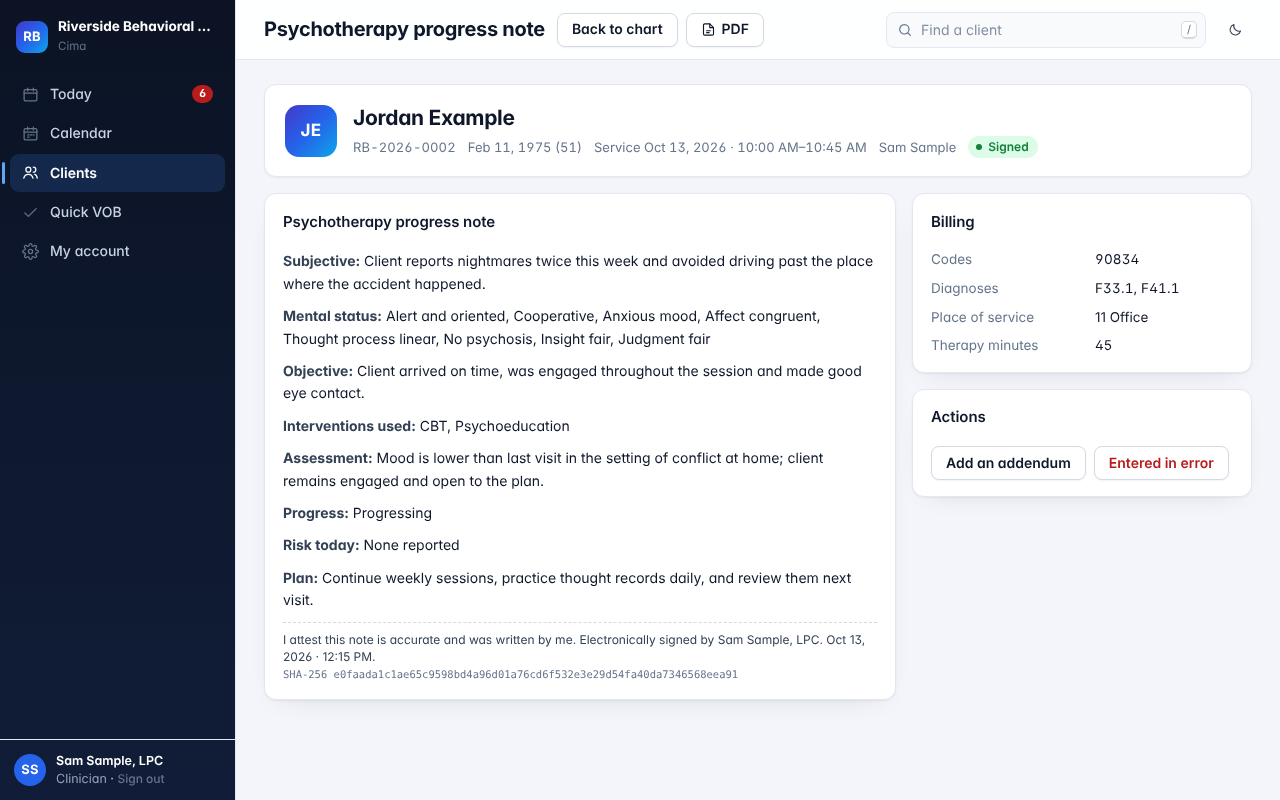
Notes that are dated honestly by design
PIN signatures stamped when they happen, automatic late-entry marking, addenda instead of edits, and nothing deleted. 30 days free; Solo from $59 a month, programs $399.
Worried about what's already in your charts? Cima Consulting's chart audit checks signatures, timeliness and late entries the way a payer auditor does, with a fix list by chart and by staff member: $750 per 10 charts. Running a program on Cima? See groups, attendance and UR in the Program plan.
Questions
Can you backdate a progress note?
No. Date and sign a note on the day you write it. If it describes an earlier service, label it a late entry, give the service date and time, and say why it's late. Backdating can turn a timeliness problem into a false record.
What's the difference between a late entry and an addendum?
A late entry is the whole note, written after it was due. An addendum adds information to a note that already exists and is signed, without changing the original.
How late is too late for a late entry?
There's no single cutoff in the rules we cite; the longer the gap, the less weight a reviewer gives the details, which is why the "written from" line helps. For Texas licensed SUD programs the documentation deadline is 72 hours, and anything after is late. Your payer contracts and policies may set limits on billing late-documented services.
Can I fix a typo in a signed note?
Use a correction or addendum that keeps the original readable and shows who changed it and when. In an EHR that locks signed notes, that's an addendum.
Do late entries get claims denied?
A properly labeled late entry is generally considered by reviewers; entries that hide when they were written are the ones Medicare's manual tells reviewers to disregard. Whether a specific payer pays a late-documented service depends on its policy and your contract.
Sources
- Centers for Medicare & Medicaid Services, Medicare Program Integrity Manual, chapter 3, §3.3.2.4 (signatures) and §3.3.2.5 (amendments, corrections and delayed entries). cms.gov (PDF)
- 26 Texas Administrative Code §564.804(l), documentation of treatment services within 72 hours (as of October 2026). law.cornell.edu
- 26 TAC §564.507, documentation standards: dated and authenticated entries, corrections. law.cornell.edu
- 26 TAC §564.20, records not falsified, altered, destroyed or omitted. law.cornell.edu
- HHSC, chemical dependency treatment facilities (current rules and guidance). hhs.texas.gov
General information, not legal or billing advice.
Honest timestamps, locked notes, nothing deleted.
Free for 30 days. See how notes work in Cima.
Get early access