A free guide from Cima EHR · Texas reimbursement
The Texas Medicaid SUD fee schedule: how to look up and read TMHP's rates
The short answer: Texas Medicaid's fee-for-service rates are public. TMHP publishes them two ways: the Online Fee Lookup, where you enter a code with a provider type, specialty and program, and static fee schedules by provider type, including the "Texas Medicaid Fee Schedule – Outpatient Behavioral Health." Look up the substance use codes (assessment H0001, individual counseling H0004, group counseling H0005, IOP H0015) under the provider type you're enrolled as, and use the schedule in effect on your date of service. Then remember the catch: most members are in managed care plans, and TMHP says plans aren't required to follow the fee-for-service schedule. Your real rate is in each plan's contract. Below: the step-by-step lookup, how to read the result, the limits that come with each code, and the questions to put to each plan.
Updated October 27, 2026. TMHP, HHSC and plan sources checked October 27, 2026. Written by people who run a licensed Texas PHP, IOP and outpatient program. Not billing or legal advice.
Part of our reimbursement guides, with IOP reimbursement rates (all payers) and PHP reimbursement.
Where Texas Medicaid publishes its fees
- TMHP's Fee Schedules site is the source. TMHP is the state's Medicaid claims administrator; HHSC sets the rates.
- The Online Fee Lookup (OFL) answers "what does code X pay provider type Y in program Z." No account needed.
- The static fee schedules are PDF and Excel files by provider type and specialty. The one behavioral health programs use most is the "Texas Medicaid Fee Schedule – Outpatient Behavioral Health"; the latest version we found was dated July 29, 2026.
- The Texas Medicaid Provider Procedures Manual (TMPPM) holds the rules that go with the fees: who can bill, units, limits and authorization. Substance use services are in the Behavioral Health handbook. TMHP updates the manual monthly; the version current when we checked was updated September 30, 2026.
The fee tells you what a code pays. The manual tells you whether you can bill it, how often and with what documentation. Read both.
The SUD codes to look up
| Service | Code | Unit | Notes from TMHP and the plans |
|---|---|---|---|
| Assessment | H0001 | Per assessment | Limited to once per day for any provider and once per episode of care (TMPPM Behavioral Health handbook). |
| Outpatient individual counseling | H0004 | Per 15 minutes | Outpatient SUD treatment is billed with H0004 or H0005, limited to specific diagnosis codes. |
| Outpatient group counseling | H0005 | Per hour | TMHP's 2019 benefit notice limits a group to 16 people. |
| Intensive outpatient (SUD) | H0015 | Per day | For adults, paid mainly by managed care plans as an in-lieu-of service; plans like Superior require the HCPCS code on IOP claims since July 1, 2025 (details). |
| Intensive outpatient (mental health) | S9480 | Per day | Same in-lieu-of route; ask each plan which provider types it contracts for it. |
| Residential treatment and withdrawal management | Per the TMPPM and each plan | Usually per day | Residential SUD treatment may only be provided by a licensed chemical dependency treatment facility. Superior's billing guidelines, for example, bill H0012 once per day, with up to 35 days per episode authorized and no more than 70 days in a rolling six months. |
Units are as TMHP's outpatient behavioral health schedule and handbook describe them; confirm each one on the current schedule, because the unit changes what a fee means. The code descriptors and revenue code pairings are in IOP and PHP billing codes.
Before any of this: Medicaid substance use treatment, outpatient or residential, has to be delivered in a licensed chemical dependency treatment facility (TMHP's 2019 benefit change notice). The order is the HHSC CDTF license, then TMHP enrollment, then the plans.
Step by step: the Online Fee Lookup
- Open the Online Fee Lookup search. Without logging in, you choose the provider type, specialty and program yourself. With a TMHP account, you can pick your NPI instead and the lookup fills in your type and specialty.
- Pick the provider type and specialty you're enrolled as (or will be). A chemical dependency treatment facility and an individual counselor can get different answers for the same code.
- Pick the program: Texas Medicaid for the fee-for-service Medicaid fee. Other programs, such as CHIP and Healthy Texas Women, have their own benefits, so look them up separately if you'll serve those members.
- Enter the code or codes: a single code, a list or a range. Up to 10 codes display right away; bigger searches become a batch file available within 36 hours (TMHP's fee lookup job aid).
- Read the result. If the code isn't a benefit for that provider type, specialty and program, the lookup says so. That's an answer too: for that combination, fee-for-service Medicaid doesn't pay the code, and any payment would come from a plan contract.
- Save a screenshot or the file with the date. Fees change, and you'll want to show what the fee was when you budgeted.
Step by step: the static fee schedules
- Open Static Fee Schedules.
- Choose a provider type and specialty from the required drop-downs and search. A list of schedules for that type and specialty appears.
- Open the schedule in PDF or Excel. Excel is easier: filter the code column for H0001, H0004, H0005 and H0015 and keep the rows.
- Match the schedule to your date of service. Current schedules are listed first; archived ones sit below them and go back five years. Paying a claim from last year? Use last year's schedule.
Reading the result
- The adjusted fee is the one to use. TMHP's job aid says the "Adjusted Fee" column shows the fee with all percentage reductions applied.
- Multiply by units. A fee per 15 minutes is per 15 minutes: a 60-minute individual session billed as H0004 is 4 units. Check the handbook for how partial units count before you round anything.
- Your payment may still differ. TMHP notes that an individual provider's payment can vary by provider type, client type program, place of service and other factors.
- Limits aren't all on the schedule. The columns don't show every benefit limitation, and some codes need prior authorization. The limits are in the TMPPM (below).
- Medicare comes first for dual eligibles. For a client with Medicare and Medicaid, Medicare is the primary payer, and Medicaid's fee doesn't apply on its own.
A rate worksheet
Copy this into your budget and fill it from the lookup, one row per code you'll bill. The fee column stays blank until you've looked it up for your own provider type and date; the rest comes from the handbook and your schedule.
| Code | Unit | Adjusted fee (from TMHP, with date) | Units in a typical service | Per service | Limit / authorization |
|---|---|---|---|---|---|
| H0001 | Assessment | _____ as of __/__/__ | 1 | = fee | Once per episode, once per day |
| H0004 | 15 minutes | _____ as of __/__/__ | 4 for a 60-minute session | = fee × 4 | Yearly hours, then prior authorization |
| H0005 | Hour | _____ as of __/__/__ | Hours of group attended | = fee × hours | Yearly hours, then prior authorization; 16 per group |
| H0015 | Day | Plan contract rate (or "not a benefit") | 1 per qualifying day | = rate | Plan's prior authorization |
Multiply each per-service figure by the services you expect a month and you have the fee-for-service side of the projection. The IOP break-even calculator takes those rates, your payroll and rent and tells you the census you need.
Limits and authorizations that come with the codes
- Assessment: H0001 is once per day for any provider and once per episode of care (TMPPM Behavioral Health handbook).
- Outpatient counseling hours: TMHP's 2019 notice described yearly limits of 26 hours of individual and 135 hours of group counseling for outpatient treatment, with prior authorization beyond them considered on documented medical necessity, and removed the earlier age-20-and-under restriction on those requests. Check the current handbook before relying on the numbers.
- Daily edits: TMHP deactivated NCCI medically unlikely edit limits for substance use disorder treatment codes in May 2019; the yearly limits still apply.
- Residential episodes: HHSC's parity findings describe replacing fixed residential episode limits, from January 1, 2019, with medical-necessity review for additional episodes.
- Diagnosis: outpatient SUD codes are restricted to specific diagnosis codes. A claim with a diagnosis outside the list denies.
Plans add their own authorization rules on top. Our utilization review guide sets up the log that keeps them straight.
How managed care rates relate to the schedule
TMHP's fee lookup guide is explicit: managed care plans aren't required to follow the Texas Medicaid fee schedules, so their payments can differ. In practice that means:
- The plan contract sets your rate. It may be a dollar amount per code, a percentage of the Texas Medicaid fee schedule, or a per diem for a program level. Each is legal; you need to know which one you signed.
- A percentage of the schedule moves when the schedule moves. If your rate is tied to the fee schedule, ask which date's schedule, and whether the rate updates automatically when TMHP's fee changes.
- IOP and PHP may have no fee-for-service anchor. Adult IOP and PHP reach Texas Medicaid mainly as in-lieu-of services a plan may choose to offer, so the per diem is whatever that plan's contract says.
- Members change plans. A client can be in one plan this month and another next month, with a different rate. Check eligibility before admission and every month.
Which plans serve your counties is on Texas Medicaid plans by area.
What to ask each plan
Ask in writing during contracting, and keep the answers with the contract:
- For each code we'll bill (H0001, H0004, H0005, H0015, S9480, residential), what's the rate, and is it a fixed amount or a percentage of the Texas Medicaid fee schedule? Which schedule date?
- Does the rate change when TMHP's fee schedule changes, and from what date?
- Do you offer adult IOP and PHP as in-lieu-of services in our counties, in which programs (STAR, STAR+PLUS, STAR Health), and at what per diem?
- What units do you use for H0004 and H0005, and how do you count a partial unit?
- Which services need prior authorization, how far ahead, and what documentation?
- Do you require the HCPCS code with the revenue code on facility claims?
- Do you credential our clinicians individually, or only the facility?
- What's the timely filing limit, and where do corrected claims and appeals go? (Superior's billing training lists 95 days from the date of service.)
- Does another company manage behavioral health authorizations or claims for your members?
When rates change
- HHSC proposes, then TMHP publishes. HHSC's Provider Finance Department sets Medicaid rates and posts rate packets when it proposes changes; its September 15, 2023 SUD rate packet is one example. A packet covers a specific program, so check which one before using its numbers.
- TMHP announces changes in its news and banner messages, and the new schedule replaces the old one for later dates of service.
- Your contract may not follow. A plan rate stated as a dollar amount stays put until you renegotiate.
Setting your fees in Cima
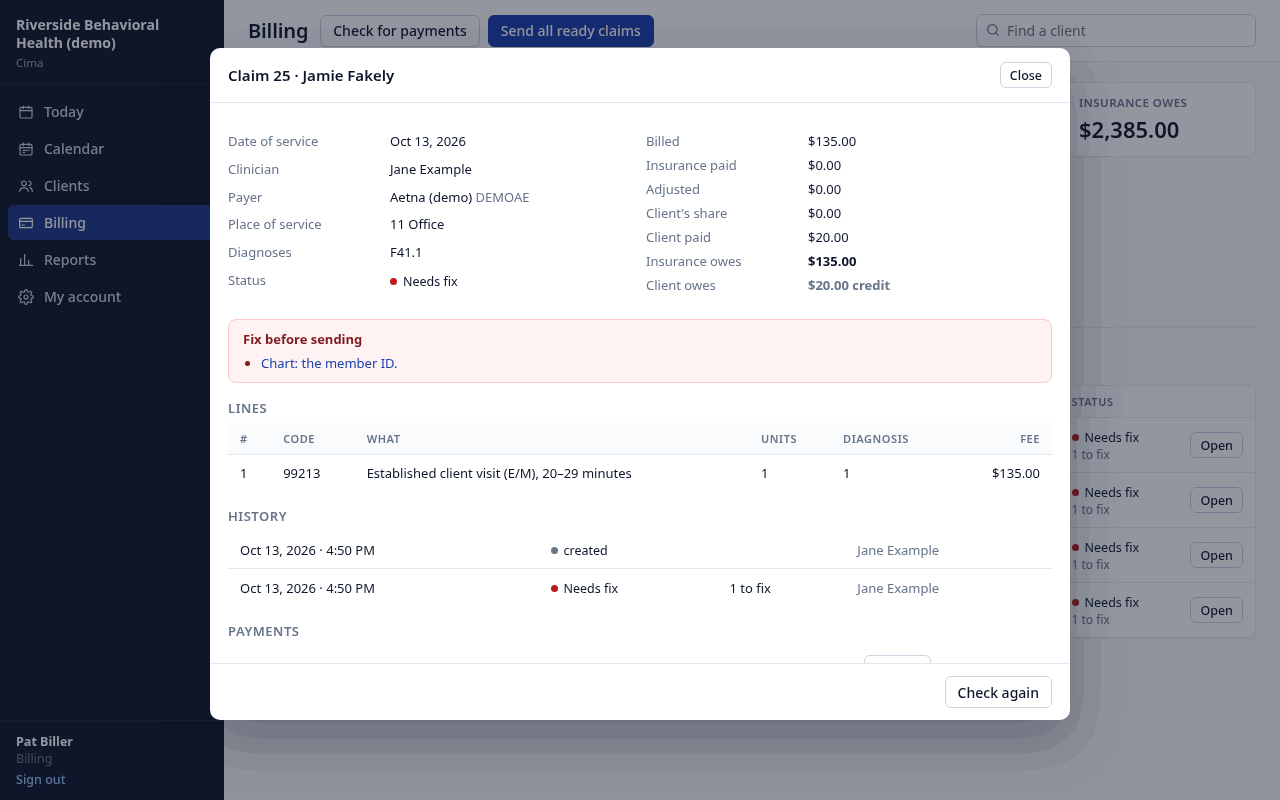
In Cima EHR for programs, Settings, Fees holds your charge for each code, and the claim checker won't send a line whose fee is $0. Each level of care in the Program plan carries its own per diem code (H0015 or S9480 for IOP). When a plan pays, the 835 remittance posts the payment, the contractual adjustment and the client's share on that claim, so you can compare what each plan paid against the rate you were promised. Reports show what's owed by age for each payer and the denial reasons that keep coming back. See Cima's pricing, or start with the IOP and PHP billing checklist.
Get the Medicaid side right before you open
Cima Consulting takes a Texas program from the CDTF license through TMHP and each plan contract, and sets up your fee schedule and claims. Medicaid enrollment with the first plan is $500 per clinician; a facility contract with one plan is $950 per plan; billing set-up is $2,950.
The full program launch, license to first claim, is the IOP / PHP Program Launch.
Questions
Where is the Texas Medicaid fee schedule?
On TMHP's Fee Schedules site: the Online Fee Lookup for a code by provider type, specialty and program, and static fee schedules by provider type in PDF and Excel. Substance use codes are on the outpatient behavioral health schedule.
What does Texas Medicaid pay for H0015?
For adults, IOP is paid mainly by managed care plans as an in-lieu-of service, so the rate is in each plan's contract. Look H0015 up in TMHP's Online Fee Lookup under your provider type: it shows a fee-for-service fee if there is one, or says the code isn't a benefit for that combination.
Do Texas Medicaid managed care plans pay the TMHP fee schedule?
Not necessarily. TMHP says plans aren't required to follow the Texas Medicaid fee schedules. A contract may tie its rates to the schedule or not; your rate is whatever your contract with each plan says.
How is H0004 billed in Texas Medicaid?
TMHP's outpatient behavioral health schedule lists H0004 per 15 minutes, so a 60-minute individual session is 4 units. Outpatient SUD counseling has yearly limits, with prior authorization beyond them.
Can an individual LCDC bill Texas Medicaid for SUD counseling?
TMHP's 2019 notice says Medicaid substance use treatment must be delivered in a licensed chemical dependency treatment facility. Check the current Behavioral Health handbook and ask TMHP about your provider type before you plan on it.
Which fee schedule applies to an old claim?
The one in effect on the date of service. TMHP keeps archived static schedules for five years below the current ones.
Sources
All checked October 27, 2026. TMHP and HHSC revise fees and rules; open the current version before relying on any detail.
- TMHP, Fee Schedules, Online Fee Lookup and Static Fee Schedules (Outpatient Behavioral Health schedule dated July 29, 2026).
- TMHP, Fee Schedules and Online Fee Lookup job aid, v2025_0505.
- TMHP, Texas Medicaid Provider Procedures Manual, Behavioral Health handbook (updated September 30, 2026).
- TMHP, Substance Use Disorder Benefits to Change for Texas Medicaid January 1, 2019; Deactivated NCCI MUE Limitations for Substance Use Disorder Treatment, May 31, 2019.
- Texas HHSC, Summary of Texas Parity Findings; Provider Finance Department, SUD rate packet, September 15, 2023.
- Superior HealthPlan, billing guidelines for withdrawal management and withdrawal treatment services; Medicaid Behavioral Health Billing Clinic.
This guide is general information. Cima isn't a law firm or a billing company. HHSC, TMHP and each health plan make their own coverage and payment decisions; we don't guarantee rates, approvals or dates.
Fees set once. Every payment checked against them.
Cima posts each plan's payment and adjustment on the claim, so underpayments show up. See Cima for programs.
Get early access