A free guide from Cima EHR · Reimbursement
IOP reimbursement rates: how intensive outpatient is paid, and where to find the real numbers
The short answer: most payers pay an IOP a flat per diem: one rate for each day a client attends that meets the payer's hours, billed as one unit of H0015 (substance use) or S9480 (mental health), or as revenue code 0905 or 0906 on a UB-04. Medicare pays IOP only to hospitals, community mental health centers (CMHCs) and a few other provider types, at per diem rates CMS publishes each year in the outpatient (OPPS) rule's Addendum A, with separate rates for hospitals and CMHCs and for 3-service and 4-or-more-service days. Texas Medicaid's fee-for-service fees are public through TMHP's fee lookup; Medicaid managed care and commercial rates are whatever your contract says, and they aren't published as a fee schedule. Below: each payer type, exactly where to look up its number, and a worked example that turns a rate into monthly revenue.
Updated October 27, 2026. Sources checked October 27, 2026. Written by people who run a licensed Texas PHP, IOP and outpatient program and built its EHR. General information, not billing, legal or tax advice.
This is one of three reimbursement guides. The others cover PHP reimbursement and reading the Texas Medicaid SUD fee schedule.
Per diem vs per service
There are two ways a payer can pay for an intensive outpatient day, and your contract says which one applies:
| Model | How it's billed | What it means for you |
|---|---|---|
| Per diem (most common) | One unit of a day code per client per day: H0015 or S9480 on a CMS-1500, or revenue code 0905/0906 (often with the HCPCS code) on a UB-04 | One flat rate whether the day ran 3 hours or 4. The day is billable only if it meets the payer's hours, and groups and check-ins inside the day are included in the rate. |
| Per service | Each service on its own line: group psychotherapy, individual psychotherapy, assessment, each with its own code and units | Revenue depends on how many billable services each client gets. More lines to document and more ways to be denied; used by some Medicaid programs and some contracts. |
| Medicare (a hybrid) | Each service line on an institutional claim, paid as a per diem whose tier depends on the number of services that day | Only hospitals, CMHCs and certain other provider types can bill it (below). |
The H0015 descriptor describes a program of at least 3 hours a day, at least 3 days a week. The full code-by-code reference, including revenue code pairings and modifiers, is in IOP and PHP billing codes; what makes a day billable, payer by payer, is in per diem billing for IOP and PHP.
Who pays what, at a glance
| Payer | How the rate is set | Is the number public? | Where to find it |
|---|---|---|---|
| Medicare | CMS, once a year, in the hospital outpatient (OPPS) rule | Yes | Addendum A of that year's OPPS final rule, by APC (steps below) |
| Texas Medicaid fee-for-service | HHSC, published by TMHP | Yes | TMHP's Online Fee Lookup and static fee schedules (how to read them) |
| Texas Medicaid managed care (STAR, STAR+PLUS…) | Your contract with each plan | No | The plan's rate exhibit in your contract; TMHP notes plans aren't required to follow the fee-for-service schedule |
| Commercial in-network | Your contract | Not as a fee schedule | Your contract's rate exhibit; the plan's machine-readable rate files (below) |
| Single case agreement | Negotiated per client | No | The signed agreement (how to get one) |
| Out of network | The plan's out-of-network allowed amount, if the client has those benefits | No | The verification of benefits (out-of-network benefits) |
Medicare's IOP per diem
Medicare started paying for intensive outpatient services on January 1, 2024. The CY 2024 OPPS final rule set payment for IOP in hospital outpatient departments, CMHCs, rural health clinics, federally qualified health centers and opioid treatment programs. What that means for a program owner:
- Who can bill it. Those provider types, enrolled in Medicare as one. A freestanding program licensed by HHSC as a chemical dependency treatment facility isn't one of them unless it's also certified as one, such as a CMHC. That's why most Texas freestanding IOPs don't have Medicare in their payer mix.
- Who qualifies. Under 42 CFR 410.44, IOP is for a patient who needs at least 9 hours a week of therapeutic services, shown in the plan of care and certified by a physician. Medicare contractors such as Noridian describe recertification at least every 60 days.
- Four rates, not one. For hospitals and CMHCs, CMS pays IOP as a per diem through four ambulatory payment classifications (APCs): CMHC IOP for 3-service days (APC 5851) and 4-or-more-service days (5852), and hospital-based IOP for 3-service days (5861) and 4-or-more (5862). A day with a fourth qualifying service is paid at the higher tier.
- IOP and PHP share a cost basis. For 2026 CMS calculated one per diem cost for each setting and tier and used it for both the PHP and the IOP APC. In the same setting, a 3-service IOP day and a 3-service PHP day are priced alike; what differs is who qualifies (9 hours a week for IOP, 20 for PHP) and the documentation.
- CMHCs are tied to hospitals. In the CY 2026 OPPS final rule (published November 25, 2025), CMS set CMHC per diem costs at 40 percent of the hospital-based costs, to stop CMHC cost data from pricing a 3-service day above a 4-service day. The CY 2027 proposed rule (July 7, 2026) keeps that approach.
- Rates change every January 1. The CY 2027 final rule hadn't been published when we checked on October 27, 2026. Use the final rule for the year of your dates of service, never the proposed one.
Why there's no dollar figure in this section: summaries of the 2026 rule quote different numbers for the same day, because some quote the per diem costs from the rule's tables (which CMS uses to calculate the rates) and others the payment rates in Addendum A. Budget only from Addendum A, and look it up yourself with the steps below so you're reading the current file.
How to look up Medicare's current IOP rate
- Open CMS's page for the year's final rule. For 2026 that's CMS-1834-FC; the CMS fact sheet (November 21, 2025) summarizes it.
- Download Addendum A (payment rates by APC). CMS also posts quarterly updates of Addenda A and B on its OPPS pages; use the version that covers your date of service.
- Find the APC for your setting and tier: 5851/5852 for a CMHC's IOP, 5861/5862 for a hospital's IOP. (PHP is 5853/5854 and 5863/5864; see PHP reimbursement.)
- Read the payment rate and the minimum unadjusted copayment. These are national figures. Your Medicare administrative contractor adjusts payment for your area's wages, so your actual payment will differ.
- Write the rate, the APC, the addendum's date and the link into your budget, so anyone checking it later can see where it came from.
Even if you'll never bill Medicare, the Addendum A rate is a public benchmark for what a day of this care costs, and our guide to negotiating insurance rates shows how to use public benchmarks without overstating them.
Texas Medicaid
Two layers, priced differently:
- Fee-for-service. HHSC sets the fees and TMHP publishes them. Anyone can look a code up in the Online Fee Lookup by choosing a provider type, specialty and program; if the code isn't a benefit for that combination, the lookup says so. Look up H0015 and S9480 under the provider type you'll enroll as (for substance use treatment, a chemical dependency treatment facility). Our fee schedule guide walks through it step by step, with the SUD codes (H0001, H0004, H0005) and their limits.
- Managed care. Most Texas Medicaid members are in a managed care plan, and plans pay adult IOP and PHP mainly as "in-lieu-of" services they may choose to offer, with prior authorization (see Texas Medicaid for IOP and PHP programs). TMHP's fee lookup guide states that managed care plans aren't required to follow the Texas Medicaid fee schedules. Your rate is the one in each plan's contract.
So the fee-for-service lookup tells you the state's baseline, if there is one for your code and provider type. It doesn't tell you what a plan will pay you. Ask each plan for its rate in writing before you count on it.
Commercial rates: what drives them
Commercial IOP rates are private contract terms. There's no public fee schedule, and anyone quoting you "the" commercial IOP rate is quoting someone else's contract. What decides yours:
| Factor | Why it moves the rate | What to do |
|---|---|---|
| Network status | In network, you get the contracted rate. Out of network, you get the plan's allowed amount only if the member has out-of-network benefits, and the member may owe much more. | Verify every client's benefits before admission (VOB checklist). |
| Who manages behavioral health | Many plans carve behavioral health out to another company that holds the contract and the authorizations. | Contract with whoever actually pays the claim (carve-outs explained). |
| Billing form and codes | A facility contract on a UB-04 and a professional contract on a CMS-1500 can carry different rates for the same day. | Know which form each contract expects (UB-04 vs CMS-1500). |
| What's bundled into the day | A per diem that includes individual sessions, drug screens and psychiatric visits is worth less than one that pays some of them separately. | Read the bundling terms with the rate, not after. |
| Your data | Plans negotiate with programs that can show outcomes, length of stay and clean authorizations. | Track them from day one; you'll need them at renewal. |
| Rate escalators and term | A rate with no increase loses value every year it runs. | Ask for an annual adjustment and a renegotiation date. |
Getting the contract in the first place is its own project: see insurance contracts for treatment centers. Under the Texas prompt pay law, a fully insured plan's clean in-network claim has payment deadlines; self-funded employer plans follow their own terms.
Where negotiated rates are public
Two federal transparency rules publish negotiated rates. Neither is a fee schedule you can read in a minute, but both are real data:
- Health plans. Since July 1, 2022, the Transparency in Coverage rule has required most group health plans and insurers to post machine-readable files with in-network rates and out-of-network allowed amounts (29 CFR 2590.715-2715A3). A 2026 rule (CMS-9882-F) reorganizes the files by network and moves them to quarterly updates. The files are very large; searching them for H0015 or revenue code 0906 in your area takes tooling.
- Hospitals. Under 45 CFR part 180, hospitals publish their standard charges, including payer-specific negotiated charges. A hospital in your market that runs an IOP shows what plans pay it, which is a reference point, not your rate.
A worked revenue example
An example, not a forecast. The census and attendance below are made up to show the arithmetic. The rate is left as a letter on purpose: put in your contracted rate, the Addendum A rate for your APC if you bill Medicare, or a plan's written offer.
| Step | Example program | Result |
|---|---|---|
| 1. Clients on an average day | 20 adult IOP clients | 20 |
| 2. Scheduled days a week | 3 days of 3 hours (9 hours a week) | 60 scheduled client-days a week |
| 3. Scheduled days a month | 60 × 52 ÷ 12 weeks | 260 client-days |
| 4. Days that qualify | Assume 10% are missed or under 3 documented hours (an assumption for the example) | 234 billable days |
| 5. Billed | 234 × your per diem rate R | 234 × R a month |
| 6. Collected | Billed × the share you actually collect after denials and write-offs | 234 × R × your collection rate |
Two things this shows. First, at this census every dollar of daily rate is worth 234 dollars a month, or 2,808 dollars a year, before collections, which is how to value a rate offer during negotiation. Second, step 4 matters as much as the rate: each 5 points of days lost to short attendance or unsigned notes costs 13 billable days a month at this census. The IOP break-even calculator takes this further, adding PHP, payroll, rent and the months before insurance money arrives.
Where IOP revenue leaks
- Short days. A day under the payer's hours isn't billable at a lower rate; it isn't billable as IOP at all. Record the time a client leaves.
- Unsigned notes. Sessions that happened but were never signed look like short days. Sign the same day.
- Authorization gaps. Days outside an authorization rarely get paid. Request the continued stay before the last approved day (prior authorization guide, continued-stay documentation).
- Bundling mistakes. Billing an individual session on top of a per diem that includes it gets denied, or recouped later.
- Late filing. Each payer's limit is different (timely filing limits). Bill weekly.
- Denials nobody works. Most are fixable if someone reads the reason code (claim denials, AR aging).
The whole cycle, from verification to posting payments, is on the IOP and PHP billing checklist.
How Cima tracks what you're paid
In Cima's Program plan for IOP and PHP:
- Each level has its own rules: the hours a day and a week it needs and its per diem code (H0015 or S9480 for IOP), and whether days go out on an 837P or an 837I with a revenue code per level.
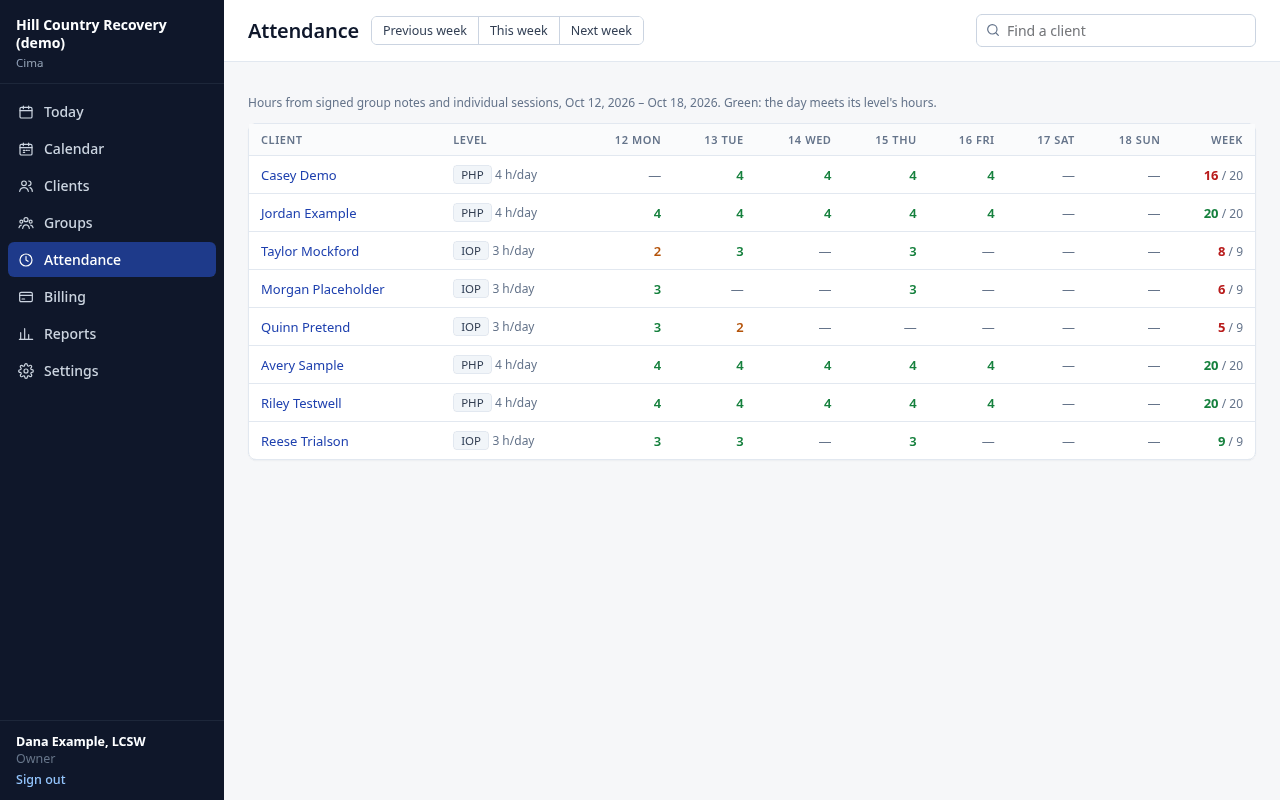
- Days bill from signed notes. A client-day that meets its level's hours becomes one charge; a short day shows why it isn't ready.
- Your charge per code is set in Settings, Fees. Payers pay their allowed amount, and electronic remittances (835s) post the payment, the contractual adjustment and the client's share on each claim, so the gap between what you billed and what each contract pays is on the claim, not in a spreadsheet.
- Reports show charges by date of service against money collected, what's owed by age for each payer, and the denial reasons that recur.
Know what every program day is worth
Cima's Program plan turns signed group notes into billable days and posts what each payer actually paid. $399 a month for up to 25 clients in the program, 30 days free.
Planning a new program's payer mix? Cima Consulting's IOP / PHP Program Launch ($39,500) includes the financial projection, credentialing and billing set-up; billing set-up on its own is $2,950. See also Cima EHR pricing.
Questions
How much does insurance pay for IOP per day?
It depends on the payer and your contract. Medicare publishes its per diem by APC in Addendum A of each year's OPPS final rule, Texas Medicaid publishes fee-for-service fees through TMHP, and commercial and Medicaid managed care rates are set in each contract and aren't published as a fee schedule.
Is IOP billed per day or per hour?
Usually per day: one unit of H0015 or S9480 (or revenue code 0905 or 0906) per client per day that meets the payer's hours. Some Medicaid programs and contracts pay each service separately instead. Your contract decides.
Does Medicare pay for IOP?
Yes, since January 1, 2024, when it's furnished by a hospital outpatient department, a community mental health center, a rural health clinic, a federally qualified health center or an opioid treatment program, to a patient certified as needing at least 9 hours of services a week. Freestanding programs that aren't one of those provider types can't bill it.
Why are there different Medicare rates for 3 and 4 services?
CMS pays IOP and PHP per diems in two tiers for each setting: days with 3 qualifying services and days with 4 or more. The 4-or-more-service day pays more.
Does Texas Medicaid pay for IOP?
Mainly through managed care plans, which may offer adult IOP and PHP as in-lieu-of services with prior authorization. Members under 21 may get them through Texas Health Steps. Substance use treatment must be delivered in a licensed chemical dependency treatment facility.
Where can I find commercial IOP rates?
In your own contract's rate exhibit. Plans also post negotiated rates in machine-readable files under the Transparency in Coverage rule, and hospitals post payer-specific negotiated charges under the hospital price transparency rule, but those are other providers' rates, not an offer to you.
Sources
All checked October 27, 2026. Rates and rules change; open the current version before relying on any detail.
- CMS, CY 2026 OPPS final rule (CMS-1834-FC) and its addenda; fact sheet, November 21, 2025.
- Federal Register, CY 2026 OPPS final rule, November 25, 2025 (PHP and IOP APCs; CMHC costs at 40 percent of hospital-based costs).
- Federal Register, CY 2027 OPPS proposed rule, July 7, 2026.
- Federal Register, CY 2024 OPPS final rule, November 22, 2023 (Medicare IOP payment).
- eCFR, 42 CFR 410.44 (intensive outpatient services); Noridian JE Part A, Intensive Outpatient Program.
- TMHP, Online Fee Lookup and Fee Schedules and Online Fee Lookup job aid (v2025_0505).
- CMS, Transparency in Coverage final rule (CMS-9915-F) and CMS-9882-F; eCFR 29 CFR 2590.715-2715A3; eCFR 45 CFR part 180 (hospital price transparency).
- HCPCS.codes, H0015.
This guide is general information. Cima isn't a law firm, an accounting firm or a billing company, and we don't guarantee any rate, contract or payment. Your contracts and each payer's manual decide what you're paid.
Bill every day your notes prove.
Cima counts each client's documented hours and bills the day only when it qualifies. See Cima for programs.
Get early access