A free guide from Cima EHR · Clinical documentation
Therapy intake forms: what goes in the packet, and a counseling intake form template to copy
The short answer: a therapy intake has two parts. The packet is what the client reads and signs before the first session: consent to treatment (with fees and the limits of confidentiality), acknowledgment of your HIPAA notice of privacy practices, your financial policy, releases of information, a telehealth consent if you see clients by video, a good faith estimate for clients who are uninsured or paying themselves, and, if you're a substance use program covered by 42 CFR Part 2, a Part 2 consent. The intake questionnaire is what the client tells you about themselves: contact and insurance details, why they're coming, history, symptoms and safety. Your intake assessment at the first session builds on both. Below: each form and the rule behind it, a timeline of what's signed when, a counseling intake form template you can copy, and the Texas rules for counselors and programs.
Updated October 28, 2026. Rules checked October 28, 2026. Written by people who run a licensed Texas PHP, IOP and outpatient program and built the intake paperwork in Cima EHR. General information, not legal advice: have your attorney review your forms.
What's in a therapy intake packet
For a therapy or counseling practice, these are the forms, what each one does, and the rule or reason behind it:
| Form | What it covers | Why, or which rule |
|---|---|---|
| Client information | Legal and preferred name, date of birth, address, phone and whether you may text or leave a message, email, emergency contact, and insurance (plan, member ID, subscriber and their date of birth) | You need it to reach the client and to bill. The insurance card photo saves retyping. |
| Consent to treatment (informed consent) | The services, fees and payment, the limits of confidentiality, how to reach you and what to do in a crisis, supervision if you're an associate, how to complain, cancellation policy, and the right to stop | Informed consent before services. Texas counselors have a rule listing required items (below). |
| Notice of privacy practices, with a signed acknowledgment | How you use and share health information and the client's rights under HIPAA | A provider who treats the client directly gives the notice by the first service and makes a good faith effort to get a written acknowledgment; if the client won't sign, you document the effort and the reason (45 CFR 164.520) |
| Financial policy | Your fee, insurance billing, copays and deductibles, late-cancel and no-show fees, payment methods, card on file, statements, and the assignment of benefits so the plan pays you | Prevents billing disputes; the assignment lets you bill the plan |
| Good faith estimate | The expected services and charges, in writing | Required by the No Surprises Act for clients who are uninsured or not using insurance (details below) |
| Releases of information | One per person or provider you'll talk to: who, what information, why, until when, and the right to revoke | A HIPAA authorization has required elements (45 CFR 164.508); psychotherapy notes need their own |
| Telehealth consent | The client's location at each session, privacy and technology limits, the emergency plan, and the option of in-person care | You need the location to act in an emergency and to stay within your license's state |
| 42 CFR Part 2 consent | Consent to disclose substance use disorder records, including to the health plan | Only for Part 2 programs (when it applies); its elements are set by 42 CFR 2.31 |
| Intake questionnaire | Why the client is coming, history, symptoms, substance use, safety, goals (the template below) | The starting point for your intake assessment |
| Screening measures | Standardized scales such as the PHQ-9 and GAD-7, scored | A baseline to measure progress against; some plans pay them as 96127 |
A licensed substance use program adds more: client rights, the grievance procedure, program rules, drug testing consent and an orientation checklist. Cima Consulting's intake packet checklist for SUD and mental health programs lists all of it.
What's signed when
| When | What |
|---|---|
| When the visit is scheduled | Good faith estimate for an uninsured or self-pay client, on the No Surprises Act timeline; send the paperwork link |
| Before the first session | Client information, consent to treatment, financial policy, telehealth consent, the intake questionnaire and screening measures |
| By the first service | Notice of privacy practices given, with the acknowledgment signed or the effort documented |
| Before any outside contact | A release for that person or provider (and a Part 2 consent first, for SUD records in a Part 2 program) |
| At the first session | Review the forms with the client, answer questions about confidentiality, and complete the intake assessment (usually billed as 90791) |
| Whenever terms change | New fees or policies in writing before they take effect, and an updated consent |
What the intake assessment itself covers, with a template and an example, is in our biopsychosocial assessment guide; how it's coded is in mental health CPT codes.
A counseling intake form template (free to copy)
This is the questionnaire the client fills in, written for adults in individual therapy. Copy it into your EHR's intake form or a document, cut what you don't use, and keep it separate from the consents so each form does one job. Questions are ours; reword them in your own voice.
New client intake form
1. About you. Legal name: ____________ · Name you go by: ________ · Pronouns: ____ · Date of birth: __/__/____ · Address: ____________ · Phone: ________ · OK to text? yes / no · OK to leave a voicemail? yes / no · Email: ____________
2. Emergency contact. Name: ____________ · Relationship: ________ · Phone: ________ · May we contact them in an emergency? yes / no
3. Insurance. Plan: ____________ · Member ID: ________ · Group: ______ · Subscriber's name and date of birth: ____________ · Secondary insurance: ________ · Or: I will pay myself (ask for a good faith estimate)
4. What brings you in. In your own words, what would you like help with? ____________ · When did it start? ________ · What have you tried? ____________ · What would be different if therapy helped? ____________
5. How you've been, the past two weeks. Mood ___ · Worry or anxiety ___ · Sleep ___ · Appetite ___ · Energy ___ · Concentration ___ · Anger or irritability ___ · Memories or nightmares about something that happened ___ (none / some / a lot)
6. Safety. In the past month, have you had thoughts of death or of ending your life? yes / no · Have you ever tried? yes / no · Thoughts of hurting someone else? yes / no · If you are in danger now, call or text 988 or call 911. Your therapist reviews these answers before your first session.
7. Past care. Therapy or counseling before? ________ · Diagnoses you've been given: ____________ · Hospital stays for mental health or substance use: ________ · Medications for mental health, and who prescribes: ____________
8. Health. Medical conditions: ____________ · Other medications and supplements: ____________ · Allergies: ________ · Primary care provider: ________ · Pregnant or postpartum? ______
9. Alcohol, tobacco and drugs. How often do you drink, and how much on a typical day? ________ · Tobacco or vaping: ________ · Cannabis: ________ · Other drugs or medications not as prescribed: ________ · Has anyone been concerned about your use? yes / no
10. Family and relationships. Who lives with you? ____________ · Relationship status: ________ · Children: ________ · Is there anyone at home you feel unsafe with? yes / no
11. Work, school and daily life. Work or school: ____________ · Military service: ______ · Any legal matters or court involvement related to why you're here? ________
12. Strengths and supports. People you can count on: ____________ · What helps you cope: ____________ · Faith, culture or community that matters to you: ____________
13. Your preferences. In person or video? ______ · Best days and times: ________ · Language: ______ · Anything you want your therapist to know before you meet: ____________
14. Signature. The information above is accurate to the best of my knowledge. Signature: ____________ · Date: __/__/____
Use the answers to plan the first session, not to replace it: anything in section 6 other than "no" gets a call from the clinician before the appointment, or the same day.
Writing the consent to treatment
The consent is where most intake packets are thin. A complete one covers, in plain language:
- The service: what therapy with you involves, its benefits and risks, the alternatives, and the client's right to ask questions and to stop.
- Confidentiality and its limits: danger to self or others, suspected abuse or neglect of a child, an elderly or disabled person, court orders, and anything else your state's law requires you to report or allows you to disclose.
- Fees and payment: or a pointer to the financial policy, signed at the same time.
- Contact and emergencies: how to reach you, how fast you answer, and that in an emergency the client calls 911 or calls or texts the 988 Suicide and Crisis Lifeline.
- Supervision: if you're pre-licensed, your supervisor's name and that they'll review the client's care.
- Complaints: how to complain to you, and to your licensing board, with its contact information.
- Records: how long you keep them, how the client gets a copy, and what happens to them if you close your practice, become incapacitated or die. Our guide to how long to keep records in Texas has the retention periods.
- Telehealth and electronic communication: if you use them, what's secure and what isn't.
Have the client sign and date it before the first service, give them a copy, and keep the signed version in the chart. Our HIPAA checklist for behavioral health covers the privacy notice and the rest of the privacy paperwork.
The good faith estimate
Under the No Surprises Act, a provider gives a written good faith estimate of expected charges to clients who are uninsured, or who have insurance but aren't using it (45 CFR 149.610; CMS, No Surprises Act). Therapy practices are included. The timing:
| When | Estimate due |
|---|---|
| Scheduled 10 or more business days ahead | Within 3 business days of scheduling |
| Scheduled 3 to 9 business days ahead | Within 1 business day of scheduling |
| The client asks for one | Within 3 business days of the request |
| Something changes | A new estimate at least 1 business day before the visit |
The estimate lists the expected services, their codes and charges, and the required disclaimers, including that a client billed $400 or more over the estimate can start the federal patient-provider dispute process. For ongoing therapy, one estimate can cover a course of sessions, up to 12 months. Clients billing their insurance don't get one; they get your financial policy and, if you're out of network, a clear statement of what they'll owe. Our sister site's out-of-network benefits guide covers superbills.
Part 2: when a substance use consent applies
42 CFR Part 2 adds its own consent for substance use disorder records, but only for a Part 2 program: a federally assisted program that holds itself out as providing, and does provide, SUD diagnosis, treatment or referral for treatment. A general therapy practice that sometimes treats substance use usually isn't one; a substance use program, or a counselor who advertises addiction treatment and takes Medicare or Medicaid, often is. Our 42 CFR Part 2 guide walks through both tests. If you are a Part 2 program:
- The consent has its own required elements (42 CFR 2.31); a HIPAA release missing one doesn't cover SUD records.
- Since the 2024 rule, a client can sign one consent for all future treatment, payment and health care operations disclosures (2024 final rule, compliance date February 16, 2026).
- Your notice of privacy practices describes Part 2 records; one combined notice can meet both rules if you're also a HIPAA covered entity.
Couples, minors, groups and programs
- Couples and family therapy: each adult signs the consent, and the consent says who the client is and how you handle information one partner shares alone. Decide that policy before the first session and put it in writing.
- Minors: a parent or legal guardian usually consents; keep proof of authority (custody order, guardianship) when parents are separated. Texas lets a minor consent on their own to counseling for suicide prevention, chemical addiction or dependency, or sexual, physical or emotional abuse (Texas Family Code §32.004).
- Group therapy: add a group agreement: what's said in group stays in group, and the limits of what you can promise about other members.
- Substance use programs (IOP, PHP, outpatient): the full packet, with rights, grievances, program rules, drug testing consent and the Part 2 consent, is in the program intake packet checklist.
Texas rules for intake paperwork
| Who | Rule | What it says |
|---|---|---|
| Licensed professional counselors | 22 TAC §681.35 | Before providing services, get a signed informed consent or signed written receipt of information. The required items include fees and payment arrangements, the limits of confidentiality, supervision, the Council's contact information for reporting violations, and the plan for the client's records if you die, become incapacitated or end your practice. Changes go to the client in writing before they take effect. A counselor employed by an agency documents in writing that the client was informed and consented. |
| Licensed professional counselors | 22 TAC §681.36 | The signed informed consent is part of the client record you keep. |
| Psychologists | 22 TAC §465.11 | Their own informed consent rule. Social workers and marriage and family therapists: check your own board chapter under the Behavioral Health Executive Council. |
| Minors | Family Code §32.004 | A minor may consent to counseling for suicide prevention, chemical addiction or dependency, or abuse. |
| Licensed chemical dependency treatment facilities | 26 TAC §564.802; chapter 564 | Written consent before any treatment; client rights explained and the grievance procedure given within 24 hours of admission (§564.701, §564.702). |
Opening a practice in Texas? Cima Consulting's guide to starting a private practice in Texas covers the rest of the setup.
Common gaps in intake paperwork
- The first session happened before the consent was signed.
- No acknowledgment of the privacy notice, and no note of the attempt.
- A release with no end date or purpose, or a call to family with no release at all.
- No good faith estimate for a self-pay client, or one without the required disclaimers.
- A safety answer nobody read until the session, days later.
- Old forms: fees, policies or the privacy notice changed and clients never saw the new version.
Comply's chart audit checklist checks the consent and release lines chart by chart.
Intake paperwork in Cima
In Cima EHR, accepting a booking request confirms the visit by text and email and sends a new client their intake paperwork. The link lasts 7 days, the email never includes health information, and there's no app or password: the client confirms their date of birth, and the link locks after 5 wrong tries. They correct their details and insurance, read and agree to each consent, sign with a finger, and fill in the PHQ-9 and GAD-7, which are scored for you; a self-harm answer alerts you right away. Consent to treatment, privacy notice, telehealth and financial policy come ready, and you edit the wording for your state. The signed forms become a locked PDF in the chart, and changes to their details wait for your OK. Consents and releases carry the 42 CFR Part 2 language when they need it. See client paperwork in the feature list and Cima for therapists.
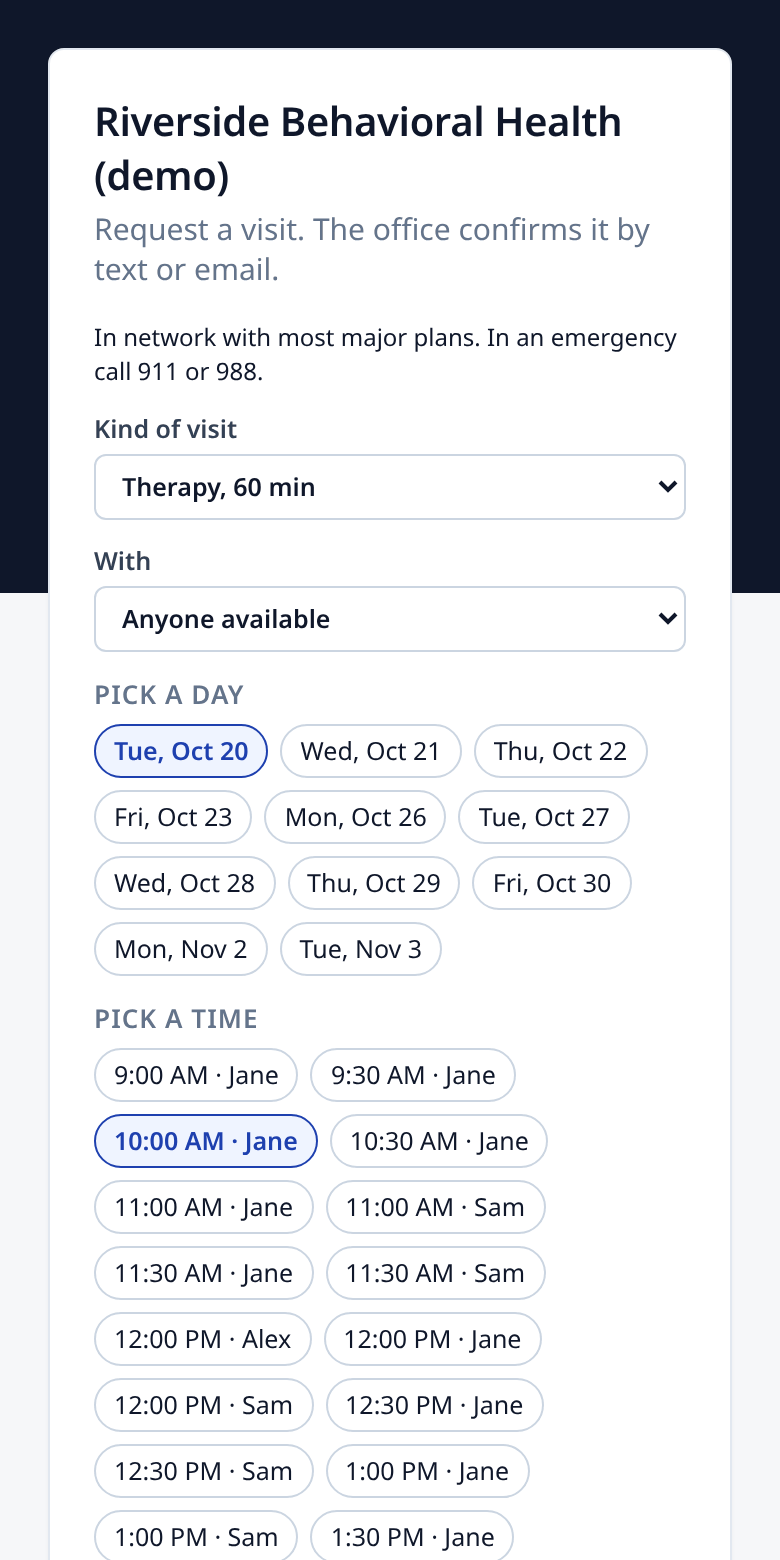
Paperwork done before they walk in
Try Cima free for 30 days with your own consent wording. Every plan includes client paperwork and reminders; see the plans and prices.
Questions
What forms does a new therapy client fill out?
Usually a client information form, a consent to treatment, an acknowledgment of the notice of privacy practices, a financial policy, an intake questionnaire and screening measures such as the PHQ-9 and GAD-7. Add a telehealth consent for video sessions, releases for anyone you'll talk to, a good faith estimate for uninsured or self-pay clients, and a Part 2 consent in a substance use program covered by Part 2.
What should be included in a counseling intake form?
Contact and emergency details, insurance, why the client is seeking help in their own words, current symptoms, safety questions, past mental health care and medications, health, alcohol and drug use, family and relationships, work or school, strengths and supports, and preferences for scheduling and format.
Is a signed HIPAA acknowledgment required?
You must give the notice of privacy practices by the first service and make a good faith effort to get a written acknowledgment. If the client won't or can't sign, you document what you tried and why it wasn't obtained.
Does every client need a good faith estimate?
No. It's required for clients who are uninsured, or who have insurance but aren't using it for your services. Clients billing their insurance get your financial policy instead.
What is the difference between an intake form and an intake assessment?
The intake form is what the client fills in before the first session. The intake assessment is the clinician's evaluation at that session: history, mental status, risk, a diagnosis and recommendations, usually billed as 90791. The form is a starting point for the assessment.
Can a minor sign their own therapy intake forms in Texas?
For some services. Texas Family Code §32.004 lets a minor consent to counseling for suicide prevention, chemical addiction or dependency, or sexual, physical or emotional abuse. Otherwise a parent or legal guardian consents.
Do therapists need a 42 CFR Part 2 consent?
Only if the practice is a Part 2 program: federally assisted and holding itself out as providing substance use disorder diagnosis, treatment or referral. Most general therapy practices aren't; substance use programs usually are.
Can intake forms be signed electronically?
Generally yes, when your system records who signed and when, and keeps the signed version unchanged. Check any payer or accreditor that wants a specific form handled a particular way.
Where can I get free printable counseling intake forms?
Copy the counseling intake form template on this page into a document and print it, or paste it into your EHR. Have your attorney review your consent and financial policy, which carry the legal weight.
What does a Texas counselor's informed consent have to include?
Under 22 TAC §681.35, items including fees and payment arrangements, the limits of confidentiality, supervision, the Council's contact information for reporting violations, and the plan for records if the counselor dies, becomes incapacitated or closes the practice, signed before services begin.
Sources
- 45 CFR 164.520, notice of privacy practices (timing and acknowledgment), and 45 CFR 164.508, authorizations. §164.520 · §164.508 (eCFR)
- 45 CFR 149.610, good faith estimates for uninsured and self-pay individuals. eCFR; CMS, No Surprises Act.
- 42 CFR Part 2 and §2.31, consent requirements. eCFR; HHS, Part 2 final rule (February 16, 2024).
- 22 Texas Administrative Code §681.35 (informed consent) and §681.36 (client records), Texas Behavioral Health Executive Council; §465.11 (psychologists' informed consent). §681.35 · §681.36 · §465.11
- Texas Family Code chapter 32 (§32.004, consent to counseling by a minor). Texas Legislature
- 26 Texas Administrative Code §564.802 (admission and consent) and §564.701–702 (rights and grievances), as of October 2026. §564.802 · chapter 564
- 988 Suicide and Crisis Lifeline.
General information, not legal advice. Cima isn't a law firm; have your attorney review your intake forms and consents.
Intake paperwork, signed on their phone before the first session.
Free for 30 days. Take the tour to see a new client's paperwork arrive.
Get early access