A free guide from Cima EHR · Clinical documentation
Biopsychosocial assessment: the domains, a template and a substance use example
The short answer: a biopsychosocial assessment (BPS) is the structured intake interview that looks at a person's biological side (physical health, substance use, medications), psychological side (mental health, thinking, safety) and social side (family, housing, work, school, legal, supports), and ends in a diagnostic impression, a list of problems, needs and strengths, and recommendations. Everything after it is built on it: the level of care, the treatment plan and the first notes. In a licensed Texas substance use program, the rule calls it a comprehensive psychosocial assessment, lists 11 areas it must cover, and requires a qualified credentialed counselor to sign it within 3 individual service days of admission. Below: each domain and what to write, a template to copy, a complete made-up example, the Texas and Medicare documentation rules, and how the BPS feeds the ASAM placement and the plan.
Updated October 28, 2026. Rules checked October 28, 2026. Written by people who run a licensed Texas PHP, IOP and outpatient program and review its assessments every week. Every client here is made up. General information, not clinical, legal or billing advice.
What a biopsychosocial assessment is, and what it isn't
The word comes from the biopsychosocial model George Engel proposed in 1977, which argued that illness can't be understood from biology alone and that psychological and social factors belong in the picture (Engel, Science, 1977). In behavioral health, the BPS is where that idea becomes paperwork: one interview, written up in a fixed order, that every later document points back to. It sits between a short screening and the treatment plan, and it's easy to confuse with the documents around it:
| Document | What it does | When |
|---|---|---|
| Screening | Decides whether the person fits the program and whether anything is urgent (withdrawal, suicide risk, medical danger) | First call or first visit, before admission |
| Biopsychosocial assessment | The full history and current picture, a diagnostic impression, and the problems, needs and strengths list | At admission; in a Texas SUD program, signed within 3 individual service days |
| ASAM level-of-care assessment | Rates risk in each ASAM dimension and recommends a level of care, for substance use | At admission, then at each review |
| Psychiatric diagnostic evaluation | The billing name for an intake evaluation by a licensed clinician (CPT 90791, or 90792 with medical services) | Usually the same visit as the BPS |
| Treatment plan | Turns the problems list into goals, measurable objectives and services | After the assessment; in Texas within 5 individual service days |
ASAM draws the same line in the 4th edition of its Criteria: its level of care assessment is the shorter interview used to recommend a level, and a full biopsychosocial assessment isn't needed for that recommendation, but it is the foundation of a comprehensive treatment plan (ASAM level of care assessment guide). In many outpatient programs, ours included, the two are done in one sitting and written as one document, organized so the ASAM ratings can be read straight out of it.
The domains, one by one
Forms differ in order and labels, but a complete BPS covers these domains. The third column marks the 11 areas the Texas rule for chemical dependency treatment facilities requires (26 TAC §564.803(a)); the rest are what payers' reviewers and Medicare contractors look for in an intake evaluation.
| Domain | What to record | Texas area? |
|---|---|---|
| Presenting problem | Why now, in the client's own words; who referred them; what happened that brought them in this week, not this year | Yes |
| Alcohol and drug use | Each substance: age of first use, pattern in the last 30 days, amount, route, last use (date and time); withdrawal and overdose history; tobacco and nicotine | Yes |
| Treatment history | Past treatment by level and date, how each ended, medications for opioid or alcohol use disorder, mutual-help groups, longest time without use | Yes |
| Medical history | Conditions, current medications and allergies, pregnancy, pain, the primary care contact, and risk behaviors for tuberculosis, HIV and sexually transmitted infections | Yes (TB, HIV and STD risk named in the rule) |
| Mental and emotional functioning | Past diagnoses, hospitalizations and psychiatric medications, trauma, current symptoms, and standardized scores (PHQ-9, GAD-7) with the date | Yes |
| Risk | Suicide and self-harm (a structured screen such as the Columbia), violence, overdose risk, and what you did about each answer that wasn't "no" | Part of mental and emotional functioning |
| Mental status | Appearance, behavior, speech, mood and affect, thought process and content, perception, orientation and memory, insight and judgment | No; expected in an intake evaluation billed to Medicare |
| Family relationships | Household, family of origin, family substance use and mental health, children and custody, partner, violence at home | Yes |
| Social and leisure | Friends who use and friends who don't, how free time is spent, faith or spirituality if the client names it, recovery supports | Yes |
| Education | Highest level, reading level if it affects treatment, learning needs | Yes |
| Employment | Job, schedule, whether use has affected work, income, military service | Yes |
| Legal problems | Open charges, probation or parole and the officer's name, court orders, CPS involvement, driving status | Yes |
| Housing and basic needs | Where they sleep, whether anyone there uses, safety, transportation, food, phone, insurance | No, but it is ASAM dimension 5 |
| Strengths and weaknesses | What has worked before, skills, people, motivation; what gets in the way. The client's goals in their words | Yes |
| Diagnostic impression | Each diagnosis by current DSM criteria with its ICD-10-CM code, within the assessor's scope of practice | Required output (§564.803(d)) |
| Summary and recommendations | The problems, needs and strengths list, the level of care, referrals, and what happens next | Required output (§564.803(c)) |
Write facts, not adjectives. "Drinks heavily" is an opinion; "8 to 10 beers a night, 6 nights a week, last drink 10/26 at 11 p.m." is something the next clinician, the reviewer and the client can all check.
Texas: what 26 TAC 564 requires, and when
For a licensed chemical dependency treatment facility, chapter 564 of the Texas Administrative Code sets who does the assessment, what it covers and the deadline. Our sister site summarizes the whole chapter in its 26 TAC 564 guide; these are the assessment rules, from §564.803 unless noted:
| Rule | What it says |
|---|---|
| Who does it | A counselor or counselor intern completes the comprehensive psychosocial assessment at admission, covering the 11 areas above |
| By video | Allowed by electronic means with synchronous audio and video. Audio-only only during a declared state of disaster, under the rule's conditions. In person if the client asks, or doesn't give verbal consent to an electronic assessment |
| What it produces | A comprehensive list of the client's problems, needs and strengths, and a diagnostic impression under current DSM standards |
| Mental health | If the assessment finds a possible mental health problem, the program gets a mental health assessment and services, in-house or by referral (§564.803(e)) |
| Deadline and signature | A qualified credentialed counselor (QCC) signs it and files it in the record within 3 individual service days of admission (§564.803(f)) |
| Outside assessments | An evaluation done in the 30 days before admission, or sent by a transferring facility, can be used if a counselor reviews it with the client and documents an update (§564.803(g)) |
| Residential only | A licensed health professional completes a physical health assessment within 96 hours of admission (§564.803(h)) |
| The plan after it | Treatment plan within 5 individual service days, built from the assessment (§564.804) |
"Individual service day" means a day the client actually receives services, not a calendar day (§564.1). An IOP client who comes Monday, Wednesday and Friday and starts on a Monday reaches service day 3 that Friday. Counting calendar days instead is never late. These rules bind licensed facilities; a counselor in private practice follows their own license board's rules and each payer's manual instead. The admission path around the assessment, from first call to first group, is in Cima Consulting's IOP admissions process.
Medicare and Medicaid documentation
A payer doesn't pay for "a BPS." It pays for an intake evaluation code, and the BPS is the documentation behind it.
- Commercial plans and Medicare pay the intake as the psychiatric diagnostic evaluation: 90791, or 90792 when a physician or nurse practitioner adds medical services. One Medicare contractor's coverage policy lists what the evaluation should hold: the reason for the visit and the referral source, the history of the present illness, psychiatric, medical, social and family history, a mental status exam, strengths and liabilities, a diagnosis or problem list, and treatment recommendations. If family is interviewed instead of the patient, the note says why (LCD L33252). A legible signature and a diagnosis the documentation supports are required (billing article A57520).
- Not with therapy the same day. Medicare's correct coding policy says 90791 and 90792 aren't separately reportable with individual, group, family or crisis psychotherapy on the same date (NCCI Policy Manual, chapter XI, 2026). Plan the assessment as its own visit.
- Texas Medicaid pays a substance use assessment as H0001: a multi-dimensional assessment on admission, done by a QCC or a counselor intern and signed off by a QCC, limited to once a day for any provider and once per episode of care (TMPPM Behavioral Health handbook, October 2026). Plan for one H0001 per episode; an update later in the same episode isn't a second H0001.
- Program days (IOP and PHP per diems) often include the assessment in the day's rate; check your contract before billing it on top. IOP and PHP billing codes covers what a per diem includes.
The time rules, add-ons and same-day limits for the evaluation and therapy codes are in behavioral health billing guidelines.
A made-up example: substance use, written up
Client L., 29, admitted to an outpatient program. Every detail is invented; the point is the shape and the level of specificity.
Biopsychosocial assessment (excerpt)
Presenting problem: Referred by the emergency department after an opioid overdose on 10/19, reversed with naloxone by her roommate. "I can't keep doing this. I almost died and I have a daughter." Started buprenorphine in the ED bridge clinic on 10/20.
Alcohol and drug use: Opioids: pills from age 21 after a dental surgery prescription, then fentanyl-pressed pills from age 26, smoked, 6 to 10 a day until 10/19; last use 10/19, about 9 p.m. Alcohol: 2 to 3 drinks on weekends, no withdrawal history. Cannabis: occasional, last use about 3 weeks ago. Nicotine: vapes daily. One prior overdose (2024), no prior withdrawal seizures.
Treatment history: 7-day detox in 2024, left against advice on day 4; no outpatient follow-up. Never on medication before this month. Longest time without opioids: about 5 months, during pregnancy.
Medical: Buprenorphine-naloxone 16 mg a day from the bridge clinic; no other medications; no known allergies. Hepatitis C antibody positive at the ED, follow-up not yet scheduled. No primary care doctor. TB, HIV and STD risk reviewed: no injection use; one partner, condom use inconsistent; agrees to testing referral.
Mental and emotional functioning: PHQ-9 of 15 today (item 9: "several days"). Low mood since her father's death last year. No psychiatric hospitalizations. Columbia screen: passive wish to be dead in the past month, no plan, intent or behavior; denies intent today; safety plan written with her and reviewed (copy in chart). GAD-7 of 9.
Mental status: Alert and oriented, casually dressed, cooperative; speech normal rate; mood "tired," affect constricted; thought process linear; no hallucinations; insight fair, judgment improving.
Family and relationships: Lives with her mother and 4-year-old daughter; mother supportive, does not use. Ex-partner uses; no contact order in place. Roommate at the time of overdose has moved out.
Social and leisure: Most friends use; one sober friend from high school. Attended one NA meeting in 2024. Likes drawing; hasn't in a year.
Education and employment: High school diploma. Lost a retail job in August for missed shifts; looking for work. Income: none; mother pays rent.
Legal: Possession charge from 2025, deferred adjudication; reports to a probation officer monthly (release signed for attendance only). No CPS case.
Strengths: Motivated by her daughter; supportive mother; already on medication; five months without opioids before. Barriers: No car (mother can drive mornings); no income; friends who use.
Diagnostic impression: Opioid use disorder, severe, on maintenance therapy (F11.20). Major depressive disorder, single episode, moderate (F32.1). Rule out: generalized anxiety disorder.
Problems, needs and strengths: (1) Opioid use with recent overdose; (2) depression with passive suicidal thoughts; (3) hepatitis C follow-up and no primary care; (4) social network that uses; (5) unemployment; (6) probation requirements. Strengths as above.
Recommendations: ASAM Level 2.1 intensive outpatient, morning track; coordinate with the buprenorphine prescriber (Part 2 consent signed); referral for hepatitis C care and a primary care visit; psychiatric evaluation for depression; naloxone kit given and reviewed with her mother; treatment plan to be written with her by service day 5.
Interview 9:00–10:25 a.m. Counselor intern: J. Ortiz. Reviewed and signed by K. Patel, LCDC (QCC), service day 2. (Made-up staff.)
Notice what makes it useful: dates and amounts, her words in two places, a risk answer followed by what was done, and a problems list that the plan can copy line by line. The six ASAM ratings that justify Level 2.1 would sit right after it; the ASAM Criteria cheat sheet has a worked placement of that part.
A biopsychosocial assessment template (free to copy)
Copy this table into your EHR's template or a document. Each row is a section heading; the middle column is what to answer. Add your own state's required wording where its rules give one.
| Section | Answer these | Notes for the writer |
|---|---|---|
| 1. Identifying information | Name, date of birth, a second identifier, date and start and stop time of the interview, in person or video, who else was present, interpreter used | Video: record the client's location and consent for this session |
| 2. Presenting problem | Why now? Referral source? What does the client want to change, in their words? | Quote at least one sentence |
| 3. Substance use | For each substance: first use, last-30-day pattern, amount, route, last use; withdrawal history; overdose history; tobacco | A grid works best, one row per substance |
| 4. Treatment history | Each past episode: level, dates, how it ended; medications for addiction; mutual-help; longest time without use | Ask for releases to get the records |
| 5. Medical | Conditions, medications, allergies, pregnancy, pain, primary care; TB, HIV, STD and hepatitis risk behaviors | Texas programs: the TB, HIV and STD line can't be blank |
| 6. Mental health | Past diagnoses, hospitalizations, psychiatric medications, trauma; current symptoms; PHQ-9 and GAD-7 scores with dates | A possible mental health problem needs an assessment or referral |
| 7. Risk | Suicide and self-harm screen result; violence; overdose risk; safety plan and actions taken | Never leave a positive answer without a response |
| 8. Mental status | Appearance, behavior, speech, mood, affect, thought process and content, perception, cognition, insight, judgment | Observed, not reported |
| 9. Family | Household; family of origin; family use and mental health; children and custody; partner; safety at home | Who could join family sessions? |
| 10. Social, leisure and spirituality | Supports who don't use; free time; faith if important to the client; recovery community | Name people, not "has supports" |
| 11. Education | Highest level; learning or reading needs | Affects handouts and homework |
| 12. Employment and income | Work, schedule, income, effect of use on work, military service | The schedule shapes the track you offer |
| 13. Legal | Charges, probation or parole, court orders, CPS, driving status | Releases for any legal contact, limited to what's needed |
| 14. Housing and basic needs | Where they live, who uses there, safety, transportation, food, phone, insurance | Feeds ASAM dimension 5 |
| 15. Strengths, weaknesses and preferences | What has worked; skills and people; barriers; what the client wants from treatment | Feeds ASAM dimension 6 |
| 16. Diagnostic impression | Each diagnosis (current DSM) with ICD-10-CM code; rule-outs | Within your scope of practice |
| 17. Problems, needs and strengths list | Numbered list, one line each | Each item goes on the plan, is referred out, or is deferred with a reason |
| 18. Recommendations | Level of care, services, referrals, next appointment, plan due date | For SUD, the ASAM ratings and the level go here or right after |
| 19. Signatures | Assessor's name, credentials, date and time signed; supervising or QCC signature and date | Texas SUD programs: QCC within 3 individual service days |
The questionnaire a client fills in before the interview is in our counseling intake form template. Running a licensed program? The packet of forms around the assessment (consent, privacy notice, Part 2 consent, rights) is on Cima Consulting's intake packet checklist.
How the BPS feeds the ASAM assessment
For substance use, a well-ordered BPS already holds nearly every fact the ASAM ratings need. This is where each one comes from, using the 4th edition dimension names:
| ASAM dimension (4th edition) | BPS sections it draws on |
|---|---|
| 1. Intoxication, Withdrawal, and Addiction Medications | Substance use (last use, withdrawal and overdose history), treatment history (medications), medical (current prescriptions) |
| 2. Biomedical Conditions | Medical history, pregnancy, pain, primary care |
| 3. Psychiatric and Cognitive Conditions | Mental health, risk, mental status, education (cognitive or learning needs) |
| 4. Substance Use-Related Risks | Substance use pattern, cravings, treatment history (how past attempts ended) |
| 5. Recovery Environment Interactions | Family, social, housing, employment, legal |
| 6. Person-Centered Considerations | Strengths and preferences, practical barriers (transport, childcare, schedule), the client's goals |
The dimension names are ASAM's; the mapping is ours. What the ratings mean and how the levels compare is in the ASAM Criteria cheat sheet, and how to run the interview and set the level is in how to complete an ASAM assessment. Mental-health-only clients don't get ASAM ratings; the BPS's recommendations section carries the level-of-care reasoning instead.
How it feeds the treatment plan
The Texas rule is the simplest test: every problem and need found in the assessment ends up on the plan, referred to someone else, or deferred with a written reason (§564.804(a)). Surveyors read the assessment's list next to the plan and look for anything that disappeared. From Client L.'s list:
| Problem from the BPS | Where it went |
|---|---|
| 1. Opioid use, recent overdose | Plan problem 1: goal "stay alive and stop using opioids"; objective "take buprenorphine daily and report doses at each session through 12/15; name 3 triggers and a plan for each by 11/14" |
| 2. Depression, passive suicidal thoughts | Plan problem 2, plus a psychiatric evaluation referral; objective "PHQ-9 below 10 by 12/15, measured every 2 weeks; review the safety plan weekly" |
| 3. Hepatitis C, no primary care | Referred: primary care and hepatitis C appointments by 11/30, tracked in notes |
| 4. Friends who use | Plan problem 3: two meetings a week and one sober contact named by 11/21 |
| 5. Unemployment | Deferred until after the first plan review: "client chose to focus on early recovery first" |
| 6. Probation | Plan intervention: monthly attendance letter under the signed release |
How to write the goals and measurable objectives themselves, with a full sample plan and a blank template, is in the SUD treatment plan guide. After that, each progress note names the goal it worked on, so the line from the assessment to the bill stays unbroken.
What reviewers flag in assessments
- Copied forward from a past episode, or from another client, with old dates and old use.
- No client voice: the presenting problem written entirely in clinical language.
- A risk answer with no response: a positive suicide item and no safety plan or action that day.
- Diagnosis without support: "opioid use disorder, severe" with nothing in the history that shows the criteria.
- Blank required areas, most often the TB, HIV and STD risk line, legal history or strengths.
- Late or unsigned: in a Texas SUD program, no QCC signature by service day 3.
- Problems that vanish: on the assessment's list but not on the plan, referred or deferred.
Comply's chart audit checklist checks these chart by chart.
Biopsychosocial assessments in Cima
Cima EHR includes an intake assessment template that asks for the presenting problem in the client's words, the substance use and psychiatric history, and your diagnostic impression, and bills as 90791 or H0001 (see Cima for addiction counselors). On the Program plan for IOP and PHP, the biopsychosocial assessment covers each substance, withdrawal and overdose history, past treatment and recovery, and ASAM dimensions 1 to 6 with a risk rating for each, and due dates for the assessment, the treatment plan and plan reviews run in calendar days you set (the defaults are 3, 5 and every 30). Clients fill in the PHQ-9 and GAD-7 on their phone before they arrive, and a self-harm answer alerts you right away. Type or dictate a few lines and, if the practice owner has turned it on, AI drafts the sections from only what you wrote, for you to edit and sign. See Cima for IOP and PHP programs and notes in the feature list.
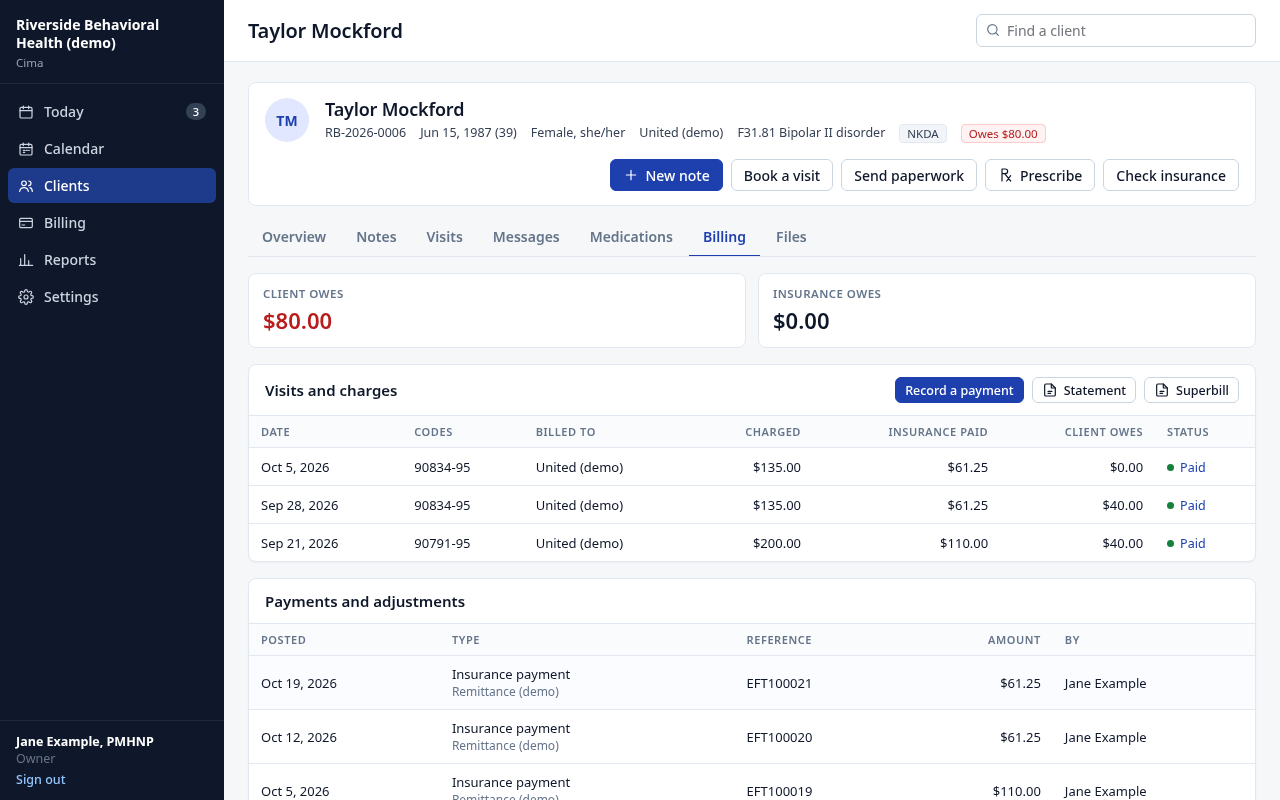
Assessments that are due, drafted and signed on time
Try Cima free for 30 days with your own intake template. Built for therapists, addiction counselors and IOP and PHP programs; see the plans and prices.
Questions
What is a biopsychosocial assessment?
A structured intake interview that covers a person's biological, psychological and social situation (physical health and substance use; mental health and safety; family, housing, work, school, legal and supports) and ends in a diagnostic impression, a list of problems, needs and strengths, and recommendations for care.
What are the components of a biopsychosocial assessment?
The presenting problem, substance use, treatment history, medical history, mental health and risk, a mental status exam, family, social and leisure, education, employment, legal, housing and basic needs, strengths and preferences, the diagnostic impression, and a summary with recommendations. Texas SUD programs must cover 11 named areas.
Is a psychosocial assessment the same as a biopsychosocial assessment?
In practice, yes: most forms use the names for the same comprehensive intake. The Texas rule for chemical dependency facilities calls it a comprehensive psychosocial assessment, and it still requires medical history, so the biological part is there either way.
Who can complete a biopsychosocial assessment?
A licensed clinician working within their scope, in most settings. In a licensed Texas chemical dependency treatment facility, a counselor or counselor intern completes it and a qualified credentialed counselor signs it within 3 individual service days of admission.
How long does a biopsychosocial assessment take?
No rule sets a length. It takes as long as covering every domain takes, and it can span more than one session as long as it's finished and signed by the deadline. In a Texas SUD program, that's 3 individual service days.
Is there a CPT code for a biopsychosocial assessment?
It's billed as the psychiatric diagnostic evaluation: 90791, or 90792 when a physician or nurse practitioner adds medical services. Texas Medicaid pays a substance use assessment as H0001, once per episode of care. Medicare's coding policy doesn't allow 90791 or 90792 with psychotherapy on the same date.
Is there a free biopsychosocial assessment template?
Yes: the template table on this page is free to copy into your EHR or a document. Add your state's required wording, and for substance use, add the ASAM dimension ratings after the recommendations.
How does a biopsychosocial assessment differ from an ASAM assessment?
The BPS is the full history and current picture, the base of the treatment plan. The ASAM level of care assessment rates risk in six dimensions to recommend a level of care. ASAM's 4th edition says the full BPS isn't needed for the level recommendation but is the foundation of the treatment plan. Many programs do both in one interview.
Can a biopsychosocial assessment be done by telehealth?
Generally yes, if the payer allows it. Texas SUD facilities may assess by synchronous audio and video; audio-only is allowed only during a declared state of disaster under the rule's conditions, and the assessment is in person if the client asks.
How often should the assessment be updated?
At each new episode of care, and when something major changes (a new diagnosis, a relapse that changes the level of care, a move or a legal change). Texas programs can use an outside assessment from the 30 days before admission only after reviewing it with the client and documenting an update.
What is the biopsychosocial model?
An approach to illness proposed by psychiatrist George Engel in 1977 in Science: that biological, psychological and social factors all have to be considered to understand and treat a person, not biology alone. The assessment takes its name from it.
Sources
- George L. Engel, "The Need for a New Medical Model: A Challenge for Biomedicine," Science 196 (4286): 129–136, April 8, 1977. science.org
- 26 Texas Administrative Code §564.803, assessment (as of October 2026). Cornell LII
- 26 Texas Administrative Code §564.804, treatment planning, and §564.1, definitions ("individual service day"). §564.804 · §564.1
- American Society of Addiction Medicine, The ASAM Criteria, Fourth Edition, level of care assessment guide; The ASAM Criteria, 4th edition.
- CMS, Local Coverage Determination L33252, psychiatric diagnostic evaluation and psychotherapy services (elements of the diagnostic evaluation). Medicare Coverage Database
- CMS, Billing and Coding article A57520 (signatures, documentation). Medicare Coverage Database
- CMS, Medicare NCCI Policy Manual, chapter XI, revised January 1, 2026 (90791 and 90792 with psychotherapy).
- TMHP, Texas Medicaid Provider Procedures Manual, Behavioral Health handbook, October 2026 (H0001).
CPT is a registered trademark of the American Medical Association. "The ASAM Criteria" is ASAM's registered trademark; dimension names are used for reference and this page isn't affiliated with ASAM. General information, not clinical, legal or billing advice.
One assessment, and the plan, the notes and the claim all agree with it.
Free for 30 days. Take the tour to see a chart from intake to claim.
Get early access