A free guide from Cima EHR · Billing and claims
Mental health CPT codes: the psychotherapy, evaluation, crisis, family and group codes, with time rules
The short answer: most mental health claims use about a dozen CPT codes. 90791 is the intake evaluation (90792 when a prescriber adds medical services). Individual psychotherapy is 90832, 90834 or 90837, picked by documented time: 16–37, 38–52, or 53 minutes or more. A prescriber who does therapy in a medication visit bills the E/M code plus 90833, 90836 or 90838. Crisis is 90839 plus 90840 for each added 30 minutes; family therapy is 90846 (client not present) or 90847 (present); group is 90853; and 90785 is the interactive complexity add-on. Telehealth uses the same codes with place of service 02 or 10 and modifier 95 (93 for audio-only). Below: the full list in plain words, the time rules, which codes go together and which don't, testing and care-management codes, Medicare's 2024–2026 additions, and a decision guide.
Updated October 28, 2026. CMS sources checked October 28, 2026. Written by people who run a licensed Texas PHP, IOP and outpatient program and built its claims engine. Code labels are our plain-English summaries, not the AMA's CPT descriptors. General information, not billing advice: your contracts and each payer's manual decide.
The mental health CPT codes therapists bill every week
These are the psychiatry codes (90785–90899 is the CPT range) that a therapy practice, a group practice or an outpatient program uses most. HCPCS codes such as H0004, H0015 and S9480, which Medicaid programs and IOPs use, are on our IOP and PHP billing codes page.
| Code | What it's for, in plain words | Time or unit | Use it when |
|---|---|---|---|
| 90791 | Psychiatric diagnostic evaluation, no medical services | Per evaluation | The intake by a therapist, counselor, social worker or psychologist. What it documents is in the biopsychosocial assessment guide. |
| 90792 | Psychiatric diagnostic evaluation with medical services | Per evaluation | The intake by a physician or nurse practitioner who also does the medical part (medication review, physical findings, orders). |
| 90832 | Individual psychotherapy, about 30 minutes | 16–37 minutes | A short session, or one cut short. |
| 90834 | Individual psychotherapy, about 45 minutes | 38–52 minutes | The common "50-minute hour" that ran 38 to 52 minutes. |
| 90837 | Individual psychotherapy, about 60 minutes | 53 minutes or more | Only when the documented time reaches 53 minutes. |
| +90833 / +90836 / +90838 | Psychotherapy done in the same visit as an E/M service | Same time bands as 90832 / 90834 / 90837 | A prescriber's medication visit that also includes therapy. Never alone. |
| 90839 | Psychotherapy for crisis, first 60 minutes | One per crisis episode, by total time | Urgent assessment and treatment of someone in crisis. |
| +90840 | Each added 30 minutes of crisis psychotherapy | Add-on to 90839 | The crisis session runs well past an hour. |
| 90846 | Family psychotherapy, client not present | Per session (50 minutes in the descriptor) | Working with parents or a partner, for the client's treatment. |
| 90847 | Family psychotherapy, client present | Per session (50 minutes in the descriptor) | A family or couples session that includes the client. |
| 90853 | Group psychotherapy (not a multiple-family group) | Per client, per session | Outpatient groups billed session by session, not inside an IOP or PHP day. |
| +90785 | Interactive complexity | Add-on | Something specific made communication in the session harder, and the note says what. |
A plus sign marks an add-on code: it's only billed with its base code, on the same claim, by the same clinician.
Psychotherapy time rules
Medicare's billing article for psychiatric codes sets the time bands most payers follow, tells you to choose the code closest to the actual time, and requires the note to show start and stop times or the total time (CMS article A57520):
| Documented psychotherapy time | Psychotherapy alone | With an E/M visit (add-on) |
|---|---|---|
| Under 16 minutes | Not billed as psychotherapy | None |
| 16–37 minutes | 90832 | +90833 |
| 38–52 minutes | 90834 | +90836 |
| 53 minutes or more | 90837 | +90838 |
- Time is face-to-face time with the client (and family, when they take part). Writing the note and scheduling don't count.
- Write the clock times. "2:00–2:51" is evidence; "50 min" can be questioned. Our progress notes guide shows a note that supports its code.
- A 50-minute session is 90834, not 90837. Some payers review 90837 more often; if you bill it, the time has to reach 53 minutes every time.
- With an E/M visit, the therapy time is separate from the time used to pick the E/M level, and both are documented.
Add-on codes: 90785 and the E/M psychotherapy codes
- +90785, interactive complexity, goes with the diagnostic evaluations (90791, 90792), the psychotherapy codes, and group psychotherapy (90853) when it's medically indicated (a Medicare contractor's billing guideline). It covers defined situations that make the session harder to run, such as caregivers whose emotions or conflict get in the way, or an event that has to be reported to a third party; the American Psychiatric Association's interactive complexity explainer walks through them. A language interpreter alone doesn't qualify. With a time-based code, the note says how much time the interactive complexity took.
- +90833, +90836, +90838 are for clinicians who bill E/M codes (physicians, nurse practitioners, physician assistants), because they ride on an E/M code (99202–99215 in the office). The E/M level is chosen from the medical decision-making or the E/M time, not counting the therapy minutes.
- +90840 only follows 90839; see crisis codes.
Crisis codes: 90839, 90840, and Medicare's G0017 and G0018
90839 covers the first 60 minutes of psychotherapy for a crisis, and +90840 each added 30 minutes. They are reported by themselves: not with the diagnostic evaluations, the other psychotherapy codes or the other psychiatry codes, which includes 90785 (Medicare contractor guideline). A short crisis contact that doesn't reach the crisis code's threshold is billed as ordinary psychotherapy.
Medicare added two HCPCS codes in 2024. When crisis psychotherapy happens in a non-facility place other than the office, such as the client's home or a mobile unit, Medicare uses G0017 (first 60 minutes) and G0018 (each added 30 minutes) instead of 90839 and 90840, and pays them at 150% of the non-facility amount for those CPT codes, as the Consolidated Appropriations Act, 2023 required. In the office and in facilities, 90839 and 90840 still apply (CMS, psychotherapy for crisis).
Since 2025, Medicare also pays G0560, safety planning interventions for people at risk of suicide or overdose, billed in 20-minute increments when the billing practitioner does the work (CY 2025 Physician Fee Schedule final rule). Commercial plans decide for themselves whether to pay these G codes.
Family and group codes
- 90846 and 90847 are for family work that serves the client's treatment plan, with the client absent or present. A couples session where one partner is the client is usually 90847. Medicare's coding policy lets a family code and an individual psychotherapy code be reported on the same date only when they are separate and distinct services, done in separate time intervals (NCCI Policy Manual, chapter XI).
- 90849 is multiple-family group psychotherapy: several clients' families together. It is a different code from 90853.
- 90853 is billed once per client per group session, each with the client's own note. Group size and length come from the payer's manual; Texas Medicaid, for example, limits its outpatient SUD group code to 16 people.
- Inside an IOP or PHP day, groups are part of the per diem and aren't billed again as 90853. See H0015 vs 90853 and group therapy notes for IOP.
Which codes can be billed together
The pairs that come up most, from Medicare's correct coding policy (NCCI chapter XI) and contractor guidance. Commercial plans often copy these edits; your contract decides.
| Same client, same day | Allowed? | Why |
|---|---|---|
| 90791 or 90792 + any psychotherapy code | No | The evaluations aren't separately reportable with individual, group, family or crisis psychotherapy on the same date. Do the intake on its own visit. |
| 90834 + 90785 | Yes, when documented | An add-on to psychotherapy, for the defined situations only |
| 90839 + 90785, or 90839 + 90834 | No | Crisis codes are reported by themselves |
| E/M (99213) + 90833 | Yes | That's what the add-on is for; time documented separately |
| 90834 + 90847 | Only if separate | Distinct services in separate time intervals, both documented |
| 90853 + an IOP day (H0015 or S9480) | Usually no | The per diem includes the day's groups |
A modifier that bypasses an edit (59 or the X modifiers) is only for a truly separate service, and the note has to show it. The full rule set, including place of service and who may bill, is in behavioral health billing guidelines.
Testing and screening codes
| Code | What it's for | Unit |
|---|---|---|
| 96127 | Brief emotional or behavioral assessment with a scored standardized instrument (PHQ-9, GAD-7 and similar) | Per instrument, where the payer pays it |
| 96130 / +96131 | Psychological testing evaluation by a psychologist or physician: integrating the results, the report, feedback | First hour / each added hour |
| 96136 / +96137 | Test administration and scoring by the psychologist or physician | First 30 minutes / each added 30 |
| 96138 / +96139 | Test administration and scoring by a technician | First 30 minutes / each added 30 |
For the per-hour testing codes, a Medicare contractor's billing article requires at least 31 minutes to report an hour, and treats the evaluation (96130–96133) as a separate service from administration and scoring (article A57481). Neuropsychological testing evaluation (96132, +96133) follows the same pattern.
Collaborative care and behavioral health integration codes
These pay for care management across a month, usually in a primary care practice with a behavioral health care manager, rather than for a session. From CMS's behavioral health integration booklet (MLN909432, January 2026):
- 99484, general behavioral health integration: at least 20 minutes of clinical staff time in a calendar month, directed by the billing practitioner. G0323 is the version for a clinical psychologist's or clinical social worker's own time.
- 99492 (first month) and 99493 (later months), psychiatric collaborative care with a psychiatric consultant, plus +99494 for each added 30 minutes; G2214 covers a first 30 minutes in a month.
- General BHI and collaborative care codes aren't billed for the same patient in the same month.
- G0552, G0553 and G0554, from 2025, pay for digital mental health treatment devices used alongside ongoing behavioral health treatment under a plan of care; for 2026, CMS extended them to cleared devices for ADHD (CY 2026 Physician Fee Schedule final rule).
Other psychiatry codes, 90845 to 90899
Less common, and many plans don't pay all of them separately. Check the plan's fee schedule, and Medicare's in the Physician Fee Schedule look-up tool, before you schedule the service.
| Code | What it's for, in plain words |
|---|---|
| 90845 | Psychoanalysis |
| 90849 | Multiple-family group psychotherapy |
| 90865 | Narcosynthesis (an interview under a medication that lowers inhibition) |
| 90867–90869 | Transcranial magnetic stimulation: the first session with mapping, later sessions, and re-mapping |
| 90870 | Electroconvulsive therapy, per session |
| 90880 | Hypnotherapy |
| 90882 | Working with agencies, employers or institutions on the client's behalf |
| 90885 | Reviewing hospital records and other reports for diagnosis |
| 90887 | Explaining results or the treatment to family or others responsible for the client |
| 90889 | Preparing a report on the client's condition for another agency, a court or an insurer |
| 90899 | Unlisted psychiatric service (needs a description and usually documentation with the claim) |
Telehealth: same codes, different place of service and modifier
A therapy session by video is billed with the same CPT code as in person. What changes is the line's place of service and modifier:
- Place of service 10 when the client is at home, 02 when they're somewhere else. For Medicare, POS 10 pays the non-facility rate and POS 02 the facility rate; the modifier doesn't change payment (CMS, telehealth and remote monitoring, MLN901705; CMS transmittal R12671CP).
- Modifier 95 for audio and video, 93 for audio-only. For Medicare, audio-only is allowed for behavioral health to a patient at home when the practitioner can do video but the patient can't or doesn't consent to it (CMS telehealth FAQ for 2026).
- Medicare's in-person visit rule for mental health telehealth (a visit within six months before starting, then yearly) doesn't apply through December 31, 2027, per the same FAQ and HHS's telehealth billing page.
- Medicaid and commercial plans set their own telehealth rules and modifiers; some still ask for GT. Use the plan's manual.
The full place-of-service table (11, 10, 02, 52, 53, 57) is in the billing guidelines.
Picking the code: a decision guide
- Is it the first evaluation of this episode? 90791, or 90792 if a prescriber did the medical part. Nothing else the same day.
- Is the client in crisis, and was it urgent assessment and treatment? 90839, plus +90840 for each added 30 minutes. For Medicare, at the client's home or a mobile unit: G0017 and G0018.
- Was family the focus, for the client's plan? 90847 with the client present, 90846 without.
- Was it a group? 90853 per client, unless it was part of an IOP or PHP day.
- Was it a prescriber's medication visit with therapy? The E/M code plus +90833, +90836 or +90838, by therapy time.
- Otherwise, individual psychotherapy by time: 90832 (16–37), 90834 (38–52), 90837 (53+). Under 16 minutes, nothing.
- Did something specific make communication harder? Add +90785, never with crisis codes.
- By video or phone? Same code, POS 10 or 02, modifier 95 or 93 (or what the plan's manual says).
Worked examples of a full day's claims, diagnosis rules and who can bill under whose NPI are in behavioral health billing guidelines.
How Cima picks the codes
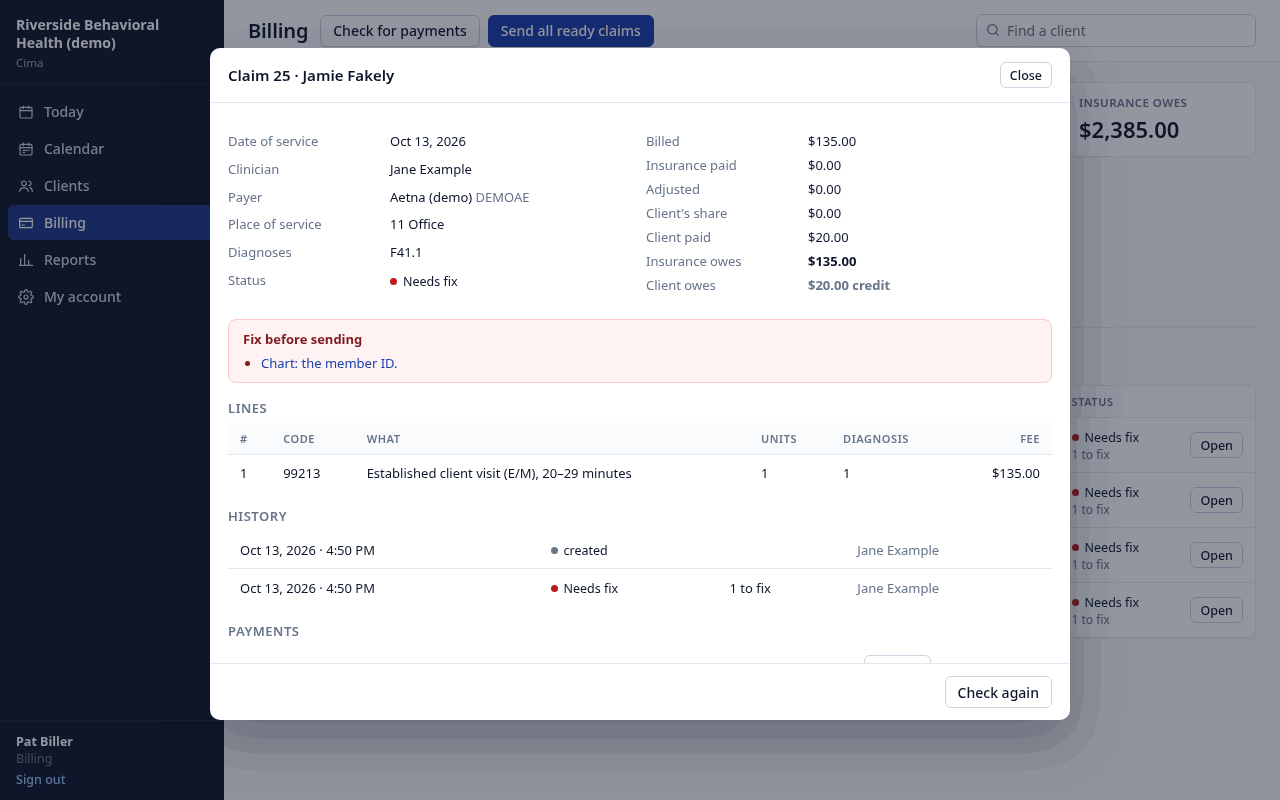
In Cima EHR, signing the note creates the charge. Session minutes pick 90832, 90834 or 90837; family sessions (90846, 90847), crisis (90839, 90840) and intake (90791) are ready too. Telehealth visits get modifier 95 and place of service 10 or 02, and the note can't be signed until the place of service and modifier match it. For nurse practitioners, time-based E/M codes are picked from the visit's total time, with psychotherapy add-on codes when you document therapy. Each claim is checked before it goes out as an 837P. See Cima for therapists, Cima for nurse practitioners and billing in the feature list.
The code comes from the note
Write and sign the note; Cima picks the code by the minutes, adds the telehealth modifier and checks the claim. Claims are billed per transaction, with no percentage of collections. See the plans, or read what behavioral health billing software should do.
Questions
What are the CPT codes for psychotherapy?
Individual psychotherapy is 90832 (16–37 minutes), 90834 (38–52) and 90837 (53 or more). With a prescriber's E/M visit, the add-ons are 90833, 90836 and 90838. Crisis is 90839 and 90840, family is 90846 and 90847, group is 90853, and 90785 is the interactive complexity add-on.
What is the CPT code for a mental health intake?
90791 for a psychiatric diagnostic evaluation without medical services, and 90792 when a physician or nurse practitioner adds medical services. Medicare doesn't allow either with psychotherapy on the same date.
What is the difference between 90834 and 90837?
Time. 90834 is 38 to 52 minutes of psychotherapy and 90837 is 53 minutes or more, by the documented time with the client. A 50-minute session is 90834.
Can I bill 90791 and 90837 on the same day?
Not to Medicare: its correct coding policy says the diagnostic evaluations aren't separately reportable with psychotherapy codes on the same date. Most commercial plans follow the same edit. Schedule the intake and the first therapy session on different days.
What is the CPT code for family therapy?
90847 when the client is present and 90846 when they aren't. The family work has to serve the client's treatment. 90849 is a multiple-family group.
What is the CPT code for group therapy?
90853, billed once per client per session, each with the client's own note. In an IOP or PHP, the day's groups are part of the per diem code instead.
When can 90785 be billed?
As an add-on to a diagnostic evaluation, psychotherapy or group psychotherapy, when a specific situation made communication harder and the note says what it was. Not with the crisis codes, and not just because an interpreter was used.
What are the crisis psychotherapy codes?
90839 for the first 60 minutes and 90840 for each added 30 minutes, reported by themselves. For Medicare, crisis psychotherapy in a non-office place such as the client's home uses G0017 and G0018, paid at 150% of the CPT codes' non-facility amount.
What modifier is used for telehealth therapy?
Usually 95 for video and 93 for audio-only, with place of service 10 (client at home) or 02 (elsewhere). Some plans still use GT; follow each payer's manual.
Do LPCs, LCSWs and psychologists use the same CPT codes?
Yes. The codes describe the service, not the license. Payers decide which licenses can bill them; Medicare has enrolled marriage and family therapists and mental health counselors since January 1, 2024.
What is the difference between CPT codes and H codes?
CPT codes (90791, 90837) come from the AMA and are what most commercial plans and Medicare pay for therapy. HCPCS H codes (H0004, H0015) are Level II codes many Medicaid programs and programs use for counseling and IOP days. See the IOP and PHP billing codes page.
Sources
- CMS, Billing and Coding: Psychiatric Diagnostic Evaluation and Psychotherapy Services, article A57520 (time bands, closest-time rule, documented time). Medicare Coverage Database
- CMS, Medicare NCCI Policy Manual, chapter XI, revised January 1, 2026 (evaluations with psychotherapy, family with individual psychotherapy).
- Medicare contractor billing and coding guideline, Psychiatry and Psychology Services (L34616 attachment): 90785 with 90853, crisis codes reported alone. cms.gov (PDF)
- CMS, Psychotherapy for crisis (G0017, G0018).
- CMS, CY 2025 Physician Fee Schedule final rule fact sheet (G0560, digital mental health treatment codes); CY 2026 final rule fact sheet (ADHD devices).
- CMS, Behavioral Health Integration Services, MLN909432, January 2026.
- CMS, Billing and Coding: Psychological and Neuropsychological Testing, article A57481.
- CMS, Telehealth and Remote Patient Monitoring, MLN901705; transmittal R12671CP (POS 02 and 10 payment, modifiers 93 and 95); Telehealth FAQs for 2026 (November 14, 2025) and updated February 26, 2026 (in-person requirement through 2027); HHS, Medicare payment policies.
- American Psychiatric Association, CPT interactive complexity.
- CMS, marriage and family therapists and mental health counselors (Medicare enrollment from January 1, 2024).
CPT is a registered trademark of the American Medical Association. The code labels on this page are our own plain-English summaries, not the AMA's descriptors; get the official descriptors from the AMA's CPT code set. General information, not billing or legal advice. Cima isn't a billing company.
Sign the note, and the right code is on the claim.
Free for 30 days. Take the tour to see a session go from note to claim.
Get early access