A free guide from Cima EHR · Choosing software
Behavioral health billing software: what it has to do, and what to ask
The short answer: behavioral health billing software turns signed sessions into clean insurance claims and records what comes back. At minimum it should check eligibility, build the charge from the note (time-based therapy codes, H codes, per diem program days), track authorizations, check each claim before it's sent, send 837 claims through a clearinghouse, post 835 remittances with their denial codes, and show what's owed by payer and age. It's different from a billing service, which does that work for you, often for a share of what it collects. Below: the features that matter for therapy and substance use billing, software vs a service, the questions to ask, the numbers to watch, and what Cima does and doesn't do.
Updated October 27, 2026. Written by the team that runs a licensed Texas PHP, IOP and outpatient program and built its own claims engine. We make Cima EHR; we name no other vendor here. General information, not legal or billing advice.
The billing cycle the software has to cover
Insurance billing runs on HIPAA standard electronic transactions, so every payer speaks the same formats. Good software handles each step, and tells you when one is stuck:
| Step | Transaction | What the software should do |
|---|---|---|
| Eligibility | 270 request / 271 response (45 CFR 162.1202) | Check coverage before the first visit and again before each visit or program week, and show the mental health or SUD benefit, not just "active." Our guide to reading a 271 shows what to look for. |
| Authorization | Usually the payer's portal or phone; the 278 standard exists | Store each authorization with its level, dates and units, count units as they're used, and warn before one runs out. |
| Charge capture | From the signed note | Pick the code from what the note shows (therapy minutes, a program day's hours), with the diagnosis, place of service and modifiers. No charge for an unsigned note. |
| Claim check | Before sending | Catch what payers reject: NPIs, taxonomy, member ID, diagnosis pointers, modifiers, authorization, filing limit. |
| Claim | 837P professional or 837I institutional (45 CFR 162.1102) | Send electronically through a clearinghouse; produce a UB-04-style 837I for program days when a payer wants a facility claim (UB-04 vs CMS-1500). |
| Acknowledgment and status | 999 and 277CA acknowledgments; 276/277 claim status (45 CFR 162.1402) | Show rejections the day they arrive, and flag a claim with no acknowledgment. |
| Payment posting | 835 remittance and EFT (45 CFR 162.1602) | Post payments, contractual adjustments and the client's share automatically, and show each denial's reason code in plain words. Enrollment is a one-time step per payer: ERA and EFT enrollment. |
| Follow-up | Denials, appeals, client balances | A work list of denials by reason, AR by payer and age, statements for client balances. |
What behavioral health needs that general medical billing doesn't
- Time-based psychotherapy codes. 90832, 90834 and 90837 depend on documented minutes; the software should read the note's start and stop times, not let someone pick a code by habit. The ranges and add-on rules are in behavioral health billing guidelines.
- HCPCS H codes and units. Medicaid and many plans pay substance use services with H codes in 15-minute or hourly units (H0004, H0005), or per day (H0015). Units have to come from the note.
- Per diem program days. An IOP or PHP day is one line, billable only when the day's notes reach the program's hours. Software that bills groups one by one gets this wrong (per diem billing for IOP and PHP).
- Authorizations by level of care. A step-down from PHP to IOP is a new authorization; claims under the old one deny.
- Carve-outs. The card says one company, a behavioral health company pays the claim. The software needs a separate payer ID for the behavioral health benefit (carve-outs).
- Who may be the rendering provider. Associates, interns and LCDCs are paid by some plans and not others. The claim check should know each clinician's credentialing by payer.
- Privacy on statements and exports. Client statements shouldn't carry diagnoses, a billing role shouldn't read note text, and substance use records disclosed for payment follow 42 CFR Part 2.
Software, a billing service, or both
"Behavioral health billing solutions" means one of three set-ups. The right one depends on who will do the work, not on the software's feature list.
| Set-up | Who does the work | How it's usually priced | Fits |
|---|---|---|---|
| Billing in your EHR | You or your staff | Part of the EHR subscription, plus per-transaction clearinghouse fees | Solo and group practices with a predictable payer list; programs with an in-house biller |
| Billing service | The service's billers, in your EHR or theirs | Often a percentage of collections, or a fee per claim | Practices with no one to own billing, or a backlog to clear |
| Both | Your EHR builds clean claims; an outside biller works denials and AR | EHR subscription plus the biller's fee | Programs that want claims built from the chart but follow-up done by specialists |
Whichever you choose, keep these in your hands: the payer contracts, the clearinghouse and ERA/EFT enrollments in the practice's name, read access to every claim and remittance, and an export of your data. If a billing company is paid a percentage, have your attorney review the arrangement, especially for Medicare and Medicaid. EHR pricing explained compares the pricing models.
Questions to ask before you buy
- Does a signed note create the charge, with the code picked from the documented time or hours? Can a claim go out for an unsigned note?
- Does it bill per diem program days, and only when the day's hours are met? Can it send an 837I when a payer wants a facility claim?
- Does it track authorizations by level of care and units, and warn before they run out?
- What does the claim check catch before sending? Ask to see a rejected claim and the message it shows.
- Do 835 remittances post automatically, with denial reasons in plain words?
- Which clearinghouse, and what does each claim, eligibility check and remittance cost? Are they billed at cost?
- Can an outside biller get a login that sees billing but not note text?
- Does it handle Texas Medicaid (TMHP and the managed care plans) the way you bill it?
- Can you export every claim, payment and client balance if you leave?
- Is it a percentage of collections anywhere in the price?
Choosing the whole EHR, not just billing? Use the therapy practice EHR checklist or, for programs, how to choose an EHR for an IOP or PHP.
The numbers billing software should show you
| Number | What it tells you |
|---|---|
| First-pass acceptance | The share of claims not rejected the first time. Measures your data and your claim check. |
| Denial rate, by reason and payer | Where money is being lost and which step owns the fix (claim denials). |
| AR by age | What's owed and for how long, by payer (working your AR aging report). |
| Days from service to claim | How close you're running to timely filing limits. |
| Notes signed on time | Claims wait on notes. Late notes are late money. |
Billing in Cima EHR
Cima EHR is an EHR with billing built in, not a billing service. What it does today:
- Signing the note creates the charge: code, modifiers, place of service, diagnoses and your fee. Therapy minutes pick 90832, 90834 or 90837; telehealth gets modifier 95 and place of service 10 or 02.
- On the Program plan, levels of care (PHP, IOP, OP) carry their per diem code and hours, and a day becomes one charge only when the signed notes reach the hours. Authorizations are tracked, with continued-stay reviews on Today 5 days before one ends.
- Each claim is checked for NPIs, tax ID, taxonomy, payer and member IDs, diagnosis format, authorizations and your filing limit before it can go out as an 837P, or an 837I for program days.
- Insurance is checked automatically the evening before each insured visit. Acknowledgments and electronic payments from payers you've enrolled with post themselves; denials show their reasons in plain English; AR aging by payer, superbills and statements (without diagnoses).
- Your outside biller gets a free login with the billing role, which never shows the text of a note, plus CSV exports and the 837 file.
What it doesn't do: it isn't a billing service, so nobody at Cima works your denials; it has no TexMedConnect connection; and claims, eligibility checks and electronic payments go through our clearinghouse partner at its standard per-transaction price, shown on the pricing page. Need a deeper eligibility check at admission? Quick VOB reads the card and the benefits for each level of care.
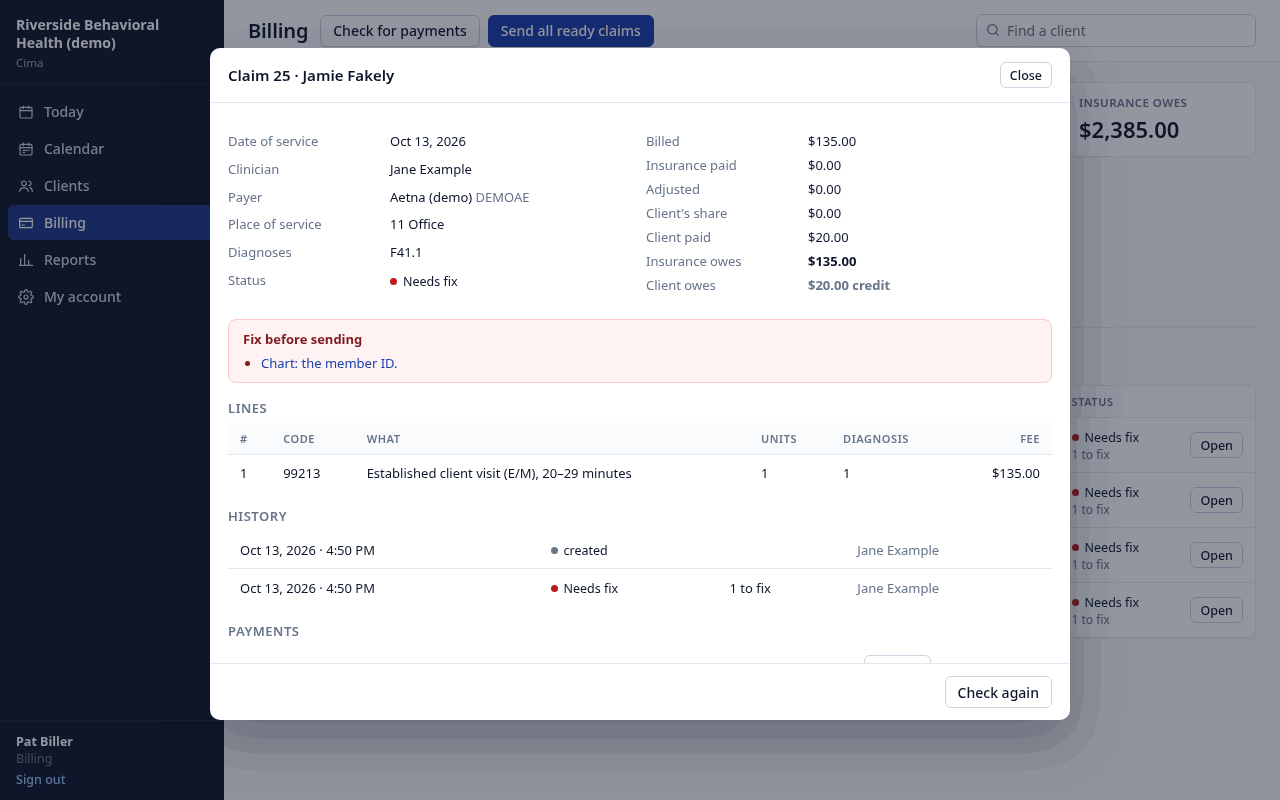
Billing built from the chart
No percentage of collections, ever. Free for 30 days; each added clinician is $39 a month. See billing in the feature list or Cima for IOP and PHP programs.
Questions
What is behavioral health billing software?
Software that turns mental health and substance use services into insurance claims and tracks payment: eligibility checks, charges from signed notes, authorizations, claim checks, electronic claims through a clearinghouse, remittance posting and denial follow-up. It's often part of the EHR.
Is billing software the same as a billing service?
No. Software is a tool your staff uses. A billing service is a company whose staff does the billing for you, usually for a percentage of collections or a fee per claim. Many practices use EHR billing and hire a biller only for denials and AR.
Does behavioral health billing software need to handle per diem billing?
If you run an IOP or PHP, yes. A program day is one line on the claim, billable only when the day's notes reach the program's hours. Software that bills each group separately will overbill or underbill.
What is a clearinghouse, and do I need one?
A company that passes your electronic claims, eligibility checks and remittances between your software and each payer, and checks formats on the way. Almost all EHR billing uses one; ask which one and what each transaction costs.
Can my outside biller use my EHR?
They should be able to, with a billing role that sees claims and payments but not the text of notes. In Cima the billing login is free.
What should billing software report?
First-pass acceptance, denial rate by reason and payer, AR by payer and age, days from service to claim, and notes signed on time.
Sources
- 45 CFR Part 162, HIPAA transaction standards: claims (162.1102), eligibility (162.1202), claim status (162.1402), payment and remittance advice (162.1602).
- X12, Claim Adjustment Reason Codes (the denial codes on an 835).
- CMS, Billing and Coding: Psychiatric Codes, article A57520 (time-based psychotherapy codes). Medicare Coverage Database
- TMHP, Texas Medicaid Provider Procedures Manual, Behavioral Health handbook, October 2026.
- 42 CFR Part 2, confidentiality of substance use disorder patient records. eCFR
CPT is a registered trademark of the American Medical Association. General information, not legal or billing advice.
Claims built from signed notes, checked before they go.
Take the tour to see a note become a claim.
Get early access