A free guide from Cima EHR · Billing and claims
Behavioral health billing guidelines: the rules behind a clean claim
The short answer: there is no single behavioral health billing manual. The guidelines come in layers: the HIPAA code sets (CPT, HCPCS and ICD-10-CM), CMS's correct coding edits and Medicare billing articles, your state Medicaid manual (in Texas, the TMPPM Behavioral Health handbook), and each payer's contract and provider manual, which win where they differ. Inside those layers, most clean claims come down to six rules: pick the code from the service and the documented time, use add-on codes only with their base code, put the right place of service and telehealth modifier on the line, lead with a diagnosis that supports the service, have the authorization, and file inside the limit. Below: where each rule lives, the codes therapists and SUD programs use most, time ranges, bundling, telehealth, who can bill, a worked day, and free training.
Updated October 27, 2026. Sources checked October 27, 2026. Written by people who run a licensed Texas PHP, IOP and outpatient program and built its claims engine. General information, not billing or legal advice: your contracts and each payer's manual decide.
Where behavioral health billing guidelines come from
When someone asks for "the behavioral health billing manual," they usually need four documents, read in this order of authority for a given claim:
| Layer | What it decides | Where to find it |
|---|---|---|
| Code sets | Which codes exist and what they mean. HIPAA makes CPT, HCPCS Level II and ICD-10-CM the required code sets on electronic claims. | 45 CFR 162.1002; the CMS HCPCS files; the CDC's ICD-10-CM files; CPT from the AMA. |
| Correct coding edits | Which code pairs can't be billed together and how many units are plausible in a day (NCCI procedure-to-procedure edits and medically unlikely edits). Medicare uses them, Medicaid programs must, and many commercial plans copy them. | The Medicare NCCI Policy Manual (chapter 11 is mental health) and the quarterly edit tables. |
| Medicare and Medicaid rules | Time ranges, documentation, who may bill, limits and prior authorization for those programs, and a model most other payers follow. | Medicare's billing article for psychiatric codes (A57520); for Texas Medicaid, the TMPPM Behavioral Health handbook, plus each Medicaid plan's manual. |
| Your contract and the payer's manual | The codes and revenue codes the plan pays you for, units, modifiers, claim form, authorization rules and filing limits. | Your participation agreement and the plan's provider manual for your state and product, including the behavioral health manager's manual if the benefit is carved out. |
When two layers disagree, the narrower one usually controls for that payer: a CPT descriptor says what a code means, but your contract says whether the plan pays it and how. Keep a one-page code map per payer, built from the contract, and update it when the contract or manual changes. The IOP and PHP billing checklist has a template.
The codes behavioral health bills most
Descriptors are paraphrased; CPT descriptors are the AMA's, HCPCS Level II are CMS's.
| Code | Service | Unit or time | Notes |
|---|---|---|---|
| 90791 / 90792 | Psychiatric diagnostic evaluation, without / with medical services | Per evaluation | The intake. 90792 is for prescribers. Not billed with psychotherapy on the same day by many payers. |
| 90832 / 90834 / 90837 | Individual psychotherapy | 30 / 45 / 60 minutes (time ranges below) | The everyday therapy codes. Time with the client, documented. |
| 90833 / 90836 / 90838 | Psychotherapy added to an E/M visit | Add-on, by psychotherapy time | For prescribers who do therapy in a medication visit. Only with an E/M code, same day, same clinician. |
| 90785 | Interactive complexity | Add-on | Only with a diagnostic evaluation or psychotherapy code, when something specific made communication harder (documented). Not with crisis codes. |
| 90839 / 90840 | Psychotherapy for crisis | First 60 minutes / each added 30 | Urgent assessment and treatment of a crisis. Time-based, total face-to-face time. |
| 90846 / 90847 | Family psychotherapy without / with the client present | Per session (50 minutes in the descriptor) | The family work has to be for the client's treatment. |
| 90853 | Group psychotherapy (not multiple-family) | Per session | One line per client per group. Not billed on top of an IOP or PHP per diem (H0015 vs 90853). |
| 96127 | Brief emotional or behavioral assessment, scored | Per standardized instrument | PHQ-9, GAD-7 and similar, where the payer pays it. |
| H0001 | Alcohol and/or drug assessment | Per assessment | Texas Medicaid: once per day for any provider and once per episode of care. |
| H0004 | Behavioral health counseling and therapy | Per 15 minutes | Texas Medicaid's outpatient SUD individual counseling code: a 60-minute session is 4 units. |
| H0005 | Alcohol and/or drug group counseling by a clinician | Texas Medicaid: per hour | Outpatient SUD group; TMHP limits a group to 16 people. |
| H0015 / S9480 / H0035 | SUD IOP / mental health IOP / mental health PHP | Usually per day | Program days. Each has its own guide: H0015, S9480, H0035. |
Texas Medicaid's units and limits for H0001, H0004 and H0005 come from TMHP's handbook and outpatient behavioral health fee schedule; the Texas Medicaid SUD fee schedule guide shows how to look up each one and its rate. Program codes, revenue codes and per diem units are in IOP and PHP billing codes.
Time rules for psychotherapy
The psychotherapy codes are chosen by the time spent with the client (and family, when present), and the note has to show it. Medicare's billing article for psychiatric codes uses these ranges, and most payers follow them:
| Documented psychotherapy time | Code | With an E/M visit (add-on) |
|---|---|---|
| Under 16 minutes | Not reported as psychotherapy | None |
| 16–37 minutes | 90832 | 90833 |
| 38–52 minutes | 90834 | 90836 |
| 53 minutes or more | 90837 | 90838 |
- Write start and stop times. "50 minutes" can be questioned; "2:00–2:50" is evidence. See progress notes for counseling for what else the note needs.
- Time is with the client. Writing the note, scheduling and phone tag aren't psychotherapy time.
- Some plans review 90837 more closely. If you bill it, the time on the note has to reach 53 minutes every time.
- Crisis time is total time. 90839 covers the first 60 minutes of crisis psychotherapy (CPT uses it from 30 minutes), and +90840 each added 30 minutes; a shorter crisis contact is billed as regular psychotherapy.
- HCPCS units are their own clock. H0004 is per 15 minutes in Texas Medicaid; how a partial unit counts is in the handbook or contract, not in the CPT time rule.
Add-on codes and bundling
- An add-on never goes alone. 90785 needs a diagnostic evaluation or psychotherapy code on the same claim; 90833, 90836 and 90838 need an E/M code by the same clinician that day, with the psychotherapy time separate from the time used to pick the E/M level.
- Interactive complexity is specific. CPT ties 90785 to defined situations, such as a caregiver whose emotions interfere with the session, or a sentinel event that requires a report to a third party. Payers deny it as a routine add-on. It isn't reported with the crisis codes.
- NCCI pairs. Some code pairs can't be billed together for the same client and day. A modifier that bypasses an edit (59 or the X modifiers) is only for a truly separate service, and the note has to show it. Read the reasoning in chapter 11 of the NCCI Policy Manual.
- Per diem days bundle the services inside them. Groups, individual sessions and assessments during an IOP or PHP day are usually paid by the day's rate, not billed again. Per diem billing for IOP and PHP covers what a day must include.
Place of service and telehealth modifiers
On a professional claim (CMS-1500 / 837P), each line carries a place of service code from the CMS place of service code set. The ones behavioral health uses most:
| POS | Meaning | Typical use |
|---|---|---|
| 11 | Office | In-person therapy in a private practice |
| 10 | Telehealth provided in the patient's home | Video or audio-only session, client at home |
| 02 | Telehealth provided other than in the patient's home | Client somewhere else: work, a car, a clinic |
| 57 | Non-residential substance abuse treatment facility | Outpatient SUD programs on a professional claim, where the payer uses it |
| 52 / 53 | Psychiatric facility, partial hospitalization / community mental health center | PHP; CMHC services |
Telehealth lines also carry the payer's modifier: 95 for synchronous video is the most common, 93 for audio-only where the payer covers it, and some older plans still ask for GT. Medicaid programs may add their own (program and clinician-level modifiers such as HF or HO are listed in the modifier table). A facility claim (UB-04 / 837I) has no place of service; see UB-04 vs CMS-1500 for when a program uses which.
Diagnosis codes
- Lead with the condition you treated. The first diagnosis on the line should be the mental health or substance use disorder the session addressed, coded to the specificity ICD-10-CM allows (for substance use, severity and remission status are part of the code).
- Z codes and R codes as primary (a relationship problem, a symptom) are a common denial on psychotherapy lines. Use them as secondary codes unless the payer's policy allows them first.
- Program codes have diagnosis rules. H0015 expects a substance use disorder first; Texas Medicaid limits the diagnoses its outpatient SUD codes accept.
- Keep it current. A diagnosis that changed at the last assessment has to change on the claim.
Who can bill, and under whose NPI
- Medicare enrolls psychiatrists, psychiatric nurse practitioners, clinical psychologists and clinical social workers, and since January 1, 2024, marriage and family therapists and mental health counselors (CMS, MFTs and MHCs). Each bills under their own NPI.
- Commercial plans credential by license type. Many won't pay a pre-licensed associate or intern as the rendering provider; some pay under a supervisor or the group under written rules. Know each payer's rule before you schedule.
- Medicaid sets its own provider types. In Texas, substance use treatment billed to Medicaid is delivered by licensed chemical dependency treatment facilities and the provider types TMHP lists.
- The rendering provider is who did the work. Billing a supervisor's NPI for an associate's session without a payer rule that allows it is a false claim, not a shortcut. Getting each clinician on each plan is what credentialing is for.
A worked day (made up)
A small Texas group practice, all clients commercially insured, every clinician credentialed with each plan:
| Visit | Documented | Billed |
|---|---|---|
| Client A, therapy in the office | 9:00–9:55, CBT for panic disorder | 90837, POS 11, F41.0 first |
| Client B, therapy by video at home | 10:00–10:46, depression | 90834, POS 10, modifier 95 |
| Client C, family session, client present | 11:00–11:50, parents and teen, teen's treatment plan goal | 90847, POS 11 |
| Client D, NP medication visit with therapy | E/M documented separately; 20 minutes of psychotherapy, times noted | The E/M code + 90833 |
| Client E, crisis walk-in | 2:10–3:20, suicidal ideation, safety plan, follow-up arranged | 90839 (70 minutes); no 90785 |
| Client F, therapy, ended early | 4:00–4:14, client left | Nothing as psychotherapy: under 16 minutes |
The guidelines as a checklist
- The code matches the service and the documented time; add-ons sit with their base code.
- The note is signed before the claim goes out.
- The diagnosis that justifies the service is first, coded to full specificity.
- Place of service and telehealth modifier match how the visit happened and what the payer requires.
- The rendering provider is credentialed with this plan for this service.
- An authorization covers the date and units, if the plan requires one (prior authorization starts at the VOB).
- The claim goes to the right payer ID (watch carve-outs) on the right form, within the timely filing limit.
- Denials are worked by reason code within days (behavioral health claim denials).
Behavioral health billing and coding training
Most of what a biller needs is free from the people who write the rules:
- CMS's Medicare Learning Network publishes free booklets and courses on Medicare billing, including mental health services (MLN).
- TMHP runs provider education and workshops for Texas Medicaid billing, and publishes the manual updates monthly (tmhp.com).
- Each payer's provider manual and its behavioral health supplement: read the claims and authorization chapters before your first claim.
- Coding credentials such as AAPC's CPC or AHIMA's CCS are general medical coding credentials, useful but not required to bill. Behavioral health is a small part of them.
For a team, a short internal manual beats any course: your payer code map, your claim check, your denial routine, and who owns each step. Programs opening from scratch can have it set up by Cima Consulting's billing set-up, $2,950, flat.
How Cima applies these guidelines
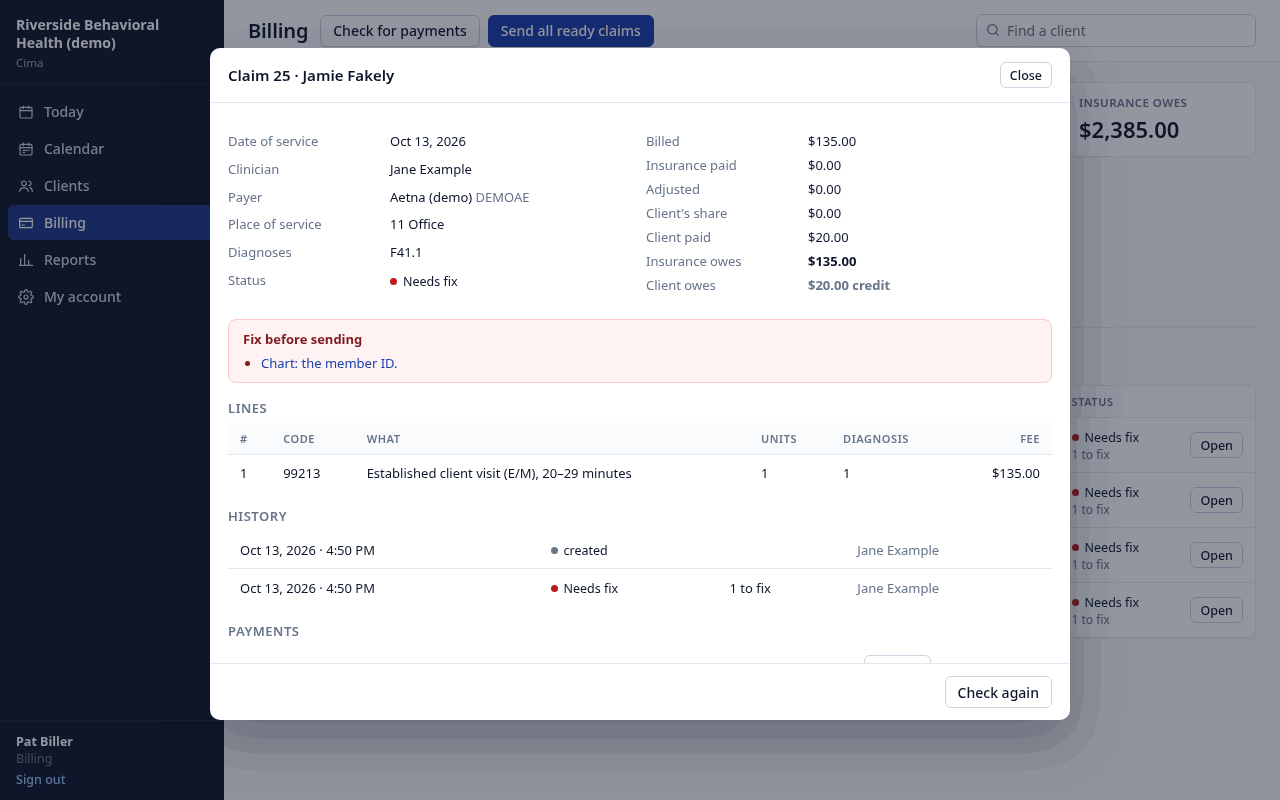
In Cima EHR, signing the note creates the charge: code, modifiers, place of service, diagnoses and your fee. Therapy minutes pick 90832, 90834 or 90837; telehealth visits get modifier 95 and place of service 10 or 02. Each claim is checked for NPIs, tax ID, taxonomy, payer and member IDs, diagnosis format, authorizations and your filing limit before it can go out as an 837P (or an 837I for program days), and electronic remittances post themselves with their reason codes. On the Program plan, IOP and PHP days become one per diem charge only when the signed notes reach the day's hours. See billing in the feature list.
The guidelines, built into the claim
Cima picks the code from the note, checks the claim before it's sent and posts the remittance with plain-English denial reasons. No percentage of collections. See the plans, or read what behavioral health billing software should do.
Questions
What are behavioral health billing guidelines?
The rules that decide how a mental health or substance use service is coded and billed: the HIPAA code sets, CMS's correct coding edits and Medicare billing articles, the state Medicaid manual, and each payer's contract and provider manual. The contract and manual decide for that payer.
Is there a behavioral health billing manual?
Not one for every payer. Texas Medicaid's is the Behavioral Health handbook in the TMPPM; Medicare's rules are in its manuals, billing articles and the NCCI Policy Manual; each commercial plan has a provider manual. Most practices keep their own short manual built from those.
How many minutes is 90837?
53 minutes or more of psychotherapy. 38–52 minutes is 90834, and 16–37 minutes is 90832, per Medicare's billing article for psychiatric codes. Under 16 minutes isn't billed as psychotherapy.
Can 90785 be billed with every session?
No. Interactive complexity is for specific situations that made communication harder, documented in the note, and only with a diagnostic evaluation or psychotherapy code. It isn't billed with the crisis codes.
What modifier is used for telehealth therapy?
Usually 95 for video, with place of service 10 (client at home) or 02 (elsewhere). Some payers use 93 for audio-only, and a few older plans still want GT. Use what the payer's manual says.
What is the difference between H0004 and 90834?
H0004 is a HCPCS code for behavioral health counseling billed in 15-minute units, used by Medicaid programs such as Texas Medicaid for outpatient substance use counseling. 90834 is a CPT psychotherapy code for a 38–52 minute session, used by most commercial plans and Medicare.
Can group therapy be billed with an IOP day?
Usually not. Groups during an IOP or PHP day are part of the per diem. 90853 is for clients who aren't in a program day, or where a contract pays groups separately.
Where can I get behavioral health billing training?
Free: CMS's Medicare Learning Network, TMHP's provider education for Texas Medicaid, and each payer's provider manual. Coding credentials such as the CPC or CCS cover general medical coding.
Sources
- 45 CFR 162.1002, medical data code sets (ICD-10-CM, HCPCS, CPT). eCFR
- CMS, Billing and Coding: Psychiatric Codes, article A57520 (psychotherapy time ranges, crisis codes, documentation). Medicare Coverage Database
- CMS, Medicare NCCI Policy Manual (chapter 11, mental health services).
- CMS, place of service code set (02, 10, 11, 52, 53, 57).
- CMS, HCPCS quarterly update (H0001, H0004, H0005, H0015, H0035, S9480 descriptors).
- CMS, marriage and family therapists and mental health counselors (Medicare enrollment from January 1, 2024).
- TMHP, Texas Medicaid Provider Procedures Manual, Behavioral Health handbook, October 2026; SUD benefit changes, January 1, 2019 (group size).
- American Psychiatric Association, CPT interactive complexity (when 90785 applies).
- CDC, ICD-10-CM.
CPT is a registered trademark of the American Medical Association; CPT descriptions here are paraphrased. General information, not billing or legal advice. Cima isn't a law firm or a billing company.
Code from the note, check before sending, post what comes back.
Cima turns a signed note into a checked claim. Take the tour.
Get early access