A free guide from Cima EHR · Billing
Peer recovery support billing: H0038, Texas Medicaid and commercial plans
The short answer: peer support is billed with HCPCS H0038 (self-help/peer services, per 15 minutes). Texas Medicaid has paid for peer specialist services since January 1, 2019, for adults 21 and older with a mental health condition or substance use disorder, when the service is in the client's person-centered recovery plan. The peer doesn't enroll or bill: an enrolled provider, such as a licensed chemical dependency treatment facility, bills for a peer who is certified through the Texas Certification Board and supervised under 1 TAC chapter 354, subchapter N. The first 104 units in a rolling six months need no prior authorization. Commercial plans are inconsistent: many pay peer work only as part of an IOP or PHP day, if at all, and Medicare doesn't enroll peers. Below: the Texas rules, certification and supervision, what each note needs, a worked unit example, commercial and Medicare options, and how to add peers to an IOP.
Updated October 27, 2026. TMHP, HHSC, CMS and payer sources checked October 27, 2026. Written by people who run a licensed Texas PHP, IOP and outpatient program. Not billing or legal advice.
Part of our billing guides, with IOP and PHP billing codes, the IOP and PHP billing checklist and the Texas Medicaid SUD fee schedule.
1. The code: H0038
- H0038 is the HCPCS code for self-help/peer services, billed in 15-minute units. Texas Medicaid's peer specialist benefit uses it, and most state Medicaid programs and the plans that pay for peer support use it too.
- Modifiers tell the payer what kind of peer service it was. Billing guides for Texas describe HE (mental health) or HF (substance use), with HQ added for a group. We couldn't confirm that list in the current Texas Medicaid Provider Procedures Manual, so check the Behavioral Health and Case Management Services handbook and each plan's billing guide before you build your fee schedule.
- "Recovery coach" is a job title, not a code or a Texas credential. A recovery coach's work is billable to Texas Medicaid only when the coach holds the state's peer specialist certification and the service meets the rules below.
2. The Texas Medicaid peer specialist benefit
The Legislature directed peer services as a Medicaid benefit in HB 1541 (2015). HHSC's rules are in 1 TAC chapter 354, subchapter N, Peer Specialist Services; a July 2026 HHSC rule in Title 26 still points to that subchapter for the definition of a certified peer specialist, so that's the current home of the rules. The rules that shape billing, from TMHP's benefit notice and the rule text:
| Rule | What it says | Source |
|---|---|---|
| Start date | Dates of service on or after January 1, 2019 | TMHP notice |
| Who can receive it | Clients 21 and older with a mental health condition and/or substance use disorder | TMHP notice |
| Recovery plan | The services must be documented in the client's person-centered recovery plan | 1 TAC 354.3015 |
| Who bills | Medicaid-enrolled providers, among them clinics and group practices, physicians, licensed therapists, local mental and behavioral health authorities and chemical dependency treatment facilities; opioid treatment providers were added March 1, 2021 | TMHP notices (2021 change) |
| Unit | 15 minutes | HCPCS descriptor; TMPPM |
| Limit | 104 units in a rolling six months without prior authorization; more with documented medical necessity | TMHP notice; Texas Children's Health Plan procedure |
| Groups | Individual or group; a group is limited to 12 people | TMHP notice; plan procedures |
| Same time as other services | Not delivered at the same time as another behavioral health service | TMHP notice; plan procedures |
| Mental health rehabilitation | Billed separately from peer specialist services | 1 TAC 354.3015 |
Telehealth. The 2019 benefit required in-person delivery. Under HB 4 (2021), HHSC allowed H0038 by synchronous audio-visual or audio-only technology, with modifier 95, as interim guidance for dates of service through August 31, 2022 while it updated the manual (Superior HealthPlan notice). Check the current Telecommunication Services handbook and each plan before billing a remote peer session; some plan procedures still say in person.
Managed care. Most Texas Medicaid members are in a managed care plan, and the plan, not TMHP, pays your claim. Plans follow the manual's amount, duration and scope but set their own authorization steps and rates. Your facility has to be contracted with each plan; see Texas Medicaid plans by area. Look up the fee-for-service rate for your provider type with TMHP's fee lookup (how to read it), and get each plan's rate in writing.
Medicaid substance use treatment in Texas has to come from a licensed chemical dependency treatment facility. If peers are part of an SUD program, the order is the HHSC CDTF license, then TMHP enrollment, then each plan.
3. Who counts as a billable peer
Texas certifies peers through the Texas Certification Board (TCB), in two tracks: Mental Health Peer Specialist and Recovery Support Peer Specialist (substance use). HHSC's page on certification for peer support as a Medicaid benefit lists who qualifies and the steps.
Eligibility: at least 18; lived experience with a mental health condition or substance use; a high school diploma or GED; current self-directed recovery; and passing criminal history and registry checks (1 TAC 354.3201).
- Self-assessment and orientation, then the attestation.
- Apply to a certified training entity and complete the core training.
- Complete the specialty training: mental health or recovery support (training entities run the recovery support course as 46 hours).
- Apply to the Texas Certification Board for the initial (six-month) certification.
- Complete 250 hours of supervised work experience, normally within six months (TCB can grant an extension), under a certified Peer Specialist Supervisor.
- Apply for the full certification, which renews every two years.
Before you schedule anyone on billable work, put their TCB certificate, its expiration date and their background check results in the staff file, and ask each plan whether it will pay for a peer still in the initial certification period. A lapsed certification makes every unit after it unbillable. The staff credential file checklist lists what else belongs in the file.
4. Supervision rules
- Who may supervise (1 TAC 354.3105, as summarized by TCB and training entities): a qualified credentialed counselor (QCC: an LPC, LCSW, LMFT, psychologist, physician, PA, LCDC, certified addictions registered nurse or APRN, within their license); a licensed practitioner of the healing arts (LPHA); a QMHP-CS supervised by a QCC or LPHA; or a qualified peer supervisor supervised by a QCC or LPHA. Supervisors complete supervisor training from a certified training entity, and TCB certifies Peer Specialist Supervisors.
- How often (TMHP notice): at least weekly for a peer with an initial certification, and at least monthly for a peer with the two-year certification.
- What supervision covers (1 TAC 354.3103): the peer's delivery of services. Write down the date, length, supervisor and topics each time.
- Federal frame. CMS's 2007 letter to state Medicaid directors set the expectations for peer support (training and credentialing, supervision, and services within an individualized plan of care), and CMS's June 2024 FAQ says states generally set the qualifications for who supervises peers.
In practice, the clinical supervisor in an SUD program is usually an LCDC or another QCC already on staff. Put peer supervision on the calendar like any other recurring task; the compliance calendar has the rest.
5. What each note needs
The Texas rule ties payment to the recovery plan; the handbook sets the rest. A peer note that holds up to a plan audit answers these questions. This is our checklist, not state text:
| Element | Why it matters |
|---|---|
| Date, start and end time | Units are 15 minutes; the times prove them, and show it didn't overlap another service |
| Individual or group, and group size | Group needs its modifier; 12 is the Medicaid limit |
| In person or remote, and where | Telehealth rules and place of service |
| The recovery plan goal it served | 1 TAC 354.3015 requires the service to be in the plan |
| What the peer did, in plain words | Shared lived experience, recovery planning, linkage to mutual help, coaching a skill: peer support, not therapy |
| The client's response and the next step | Shows the service is going somewhere |
| Any safety concern and who was told | Peers hand clinical concerns to the counselor the same day |
| Peer's name, certification and signature | Proves a certified peer delivered it |
Keep three things outside the notes: the supervision log, each peer's certification and background check, and the recovery plan with the peer services written in. For substance use records, the peer is part of the program under 42 CFR Part 2, so the same consent rules apply to what they share. Late notes get a dated late entry; see late-entry progress notes.
6. A worked example: units and limits
A client 21 or older in Texas Medicaid managed care, with peer support in the recovery plan, meets a certified peer twice a week for 45 minutes.
| Step | Math | Result |
|---|---|---|
| Units per session | 45 minutes ÷ 15 | 3 units |
| Units per week | 3 × 2 sessions | 6 units |
| Units before prior authorization | 104 units in a rolling six months (26 hours) | 104 |
| When the limit is reached | 104 ÷ 6 | During week 18 |
So request authorization for more by about week 16, with the medical necessity in the record. The window is rolling, so units from more than six months back drop off; count from the client's actual history, including units billed by another provider if the plan counts them. Partial units: check the handbook for how a session that isn't a multiple of 15 minutes is counted before you round.
7. Commercial plans
- Coverage depends on the plan. Some plans publish a policy: Cigna's administrative policy A015 addresses behavioral health coaching and peer support, and says the member's benefit plan document controls. Many plans have no H0038 policy at all.
- Inside the per diem. In an IOP or PHP, a commercial plan usually pays one per diem for the day (H0015, S9480, H0035 or revenue codes on a UB-04), and peer work is part of what the day includes rather than a separate line. Whether peer-led hours count toward the hours a day must have is a contract question; see per diem billing for IOP.
- Carve-outs. When a behavioral health company manages the benefit, its policy, not the medical plan's, decides; see behavioral health carve-outs.
- Peers aren't credentialed one by one. Commercial plans credential independently licensed clinicians, and CAQH has no peer provider type; any peer payment comes through your facility contract.
Ask each plan, in writing, during contracting:
- Do you pay H0038 separately, and with which modifiers? At what rate per unit?
- Which certification do you accept for the peer (TCB Mental Health or Recovery Support Peer Specialist)?
- Does it need prior authorization, and is there a unit limit?
- In our IOP or PHP, may peer-led groups count toward the required hours, or must they be led by a licensed clinician?
- Is peer support on a separate day from the program billable while the client is in IOP?
If a plan won't pay, a peer program can still be worth it for engagement and retention; just budget it as overhead, not revenue.
8. Medicare
- Peers don't enroll in Medicare. There's no Medicare provider type for a peer specialist, and no H0038 benefit.
- Principal illness navigation – peer support. Since 2024, the physician fee schedule includes PIN-PS codes G0140 and G0146, time-based navigation for behavioral health conditions such as serious mental illness and substance use disorder, furnished by certified or trained auxiliary personnel, including peer support specialists, incident to a billing practitioner after an initiating visit, with the patient's consent (CMS CY 2024 physician fee schedule fact sheet). It's billed by the practitioner, not the program per diem, and has its own supervision and documentation rules; read the current descriptors before you use it.
- IOP and PHP reach Medicare only through hospitals, community mental health centers and a few other provider types; see Medicare coverage of IOP and PHP.
9. Adding peers to an IOP
Texas's chemical dependency rules don't require peer specialists in an outpatient program (see IOP staffing requirements in Texas). Programs add them because clients engage better between sessions and after discharge. To do it so it's billable where it can be, and safe where it can't:
- Write the job description around peer work: recovery planning, linkage to mutual help and community supports, transportation and benefits navigation, check-ins after discharge, alumni. Say plainly what peers don't do: assessments, diagnosis, counseling or treatment plans. SAMHSA's core competencies for peer workers are a good base.
- Hire certified peers, or hire into the initial certification with a supervisor ready, and verify the TCB certification and background checks before day one.
- Name the supervisor and calendar weekly or monthly supervision by certification level.
- Add peer services to the treatment or recovery plan for each client who'll receive them, with a goal they serve.
- Schedule around the program day. Medicaid peer services can't run at the same time as another behavioral health service, so book them before or after groups, or on non-program days.
- Train for privacy and boundaries: Part 2, dual relationships, social media, and what to do when a client discloses use or a safety risk.
- Set up billing: H0038 in the fee schedule with the plan's modifiers, unit tracking against the 104-unit window, and a rule for which payers get a claim and which don't.
Building the program, payer contracts and policies is what Cima Consulting's IOP / PHP Program Launch does; for an open program, the policy and procedure manual service writes the peer policies in.
10. Setting it up in Cima
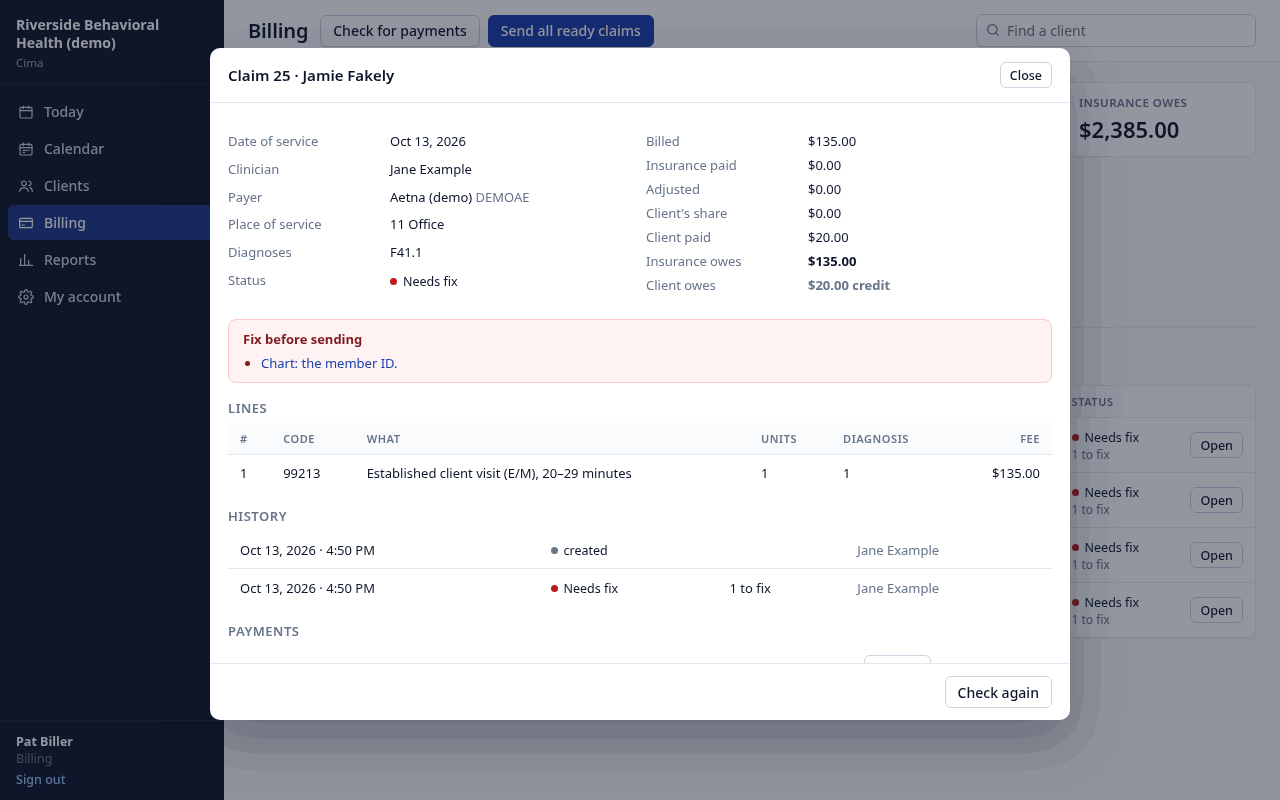
In Cima EHR for programs, Settings, Fees takes any HCPCS code, so add H0038 with your charge per unit, and create a visit type for peer sessions carrying the code. Each claim line holds the units and up to four modifiers, and the claim checker stops a line with more than four modifiers or a telehealth visit without modifier 95 or 93. The program's per diem codes for each level are set separately, so the day and the peer session stay on their own lines. When the 835 comes back, the payment and adjustment post to the claim, so you can see whether a plan is really paying H0038. See Cima's pricing.
Adding peers, or a whole program?
Cima Consulting sets up the payer side: Medicaid enrollment is $500 per clinician, facility contracts are $950 per plan, and billing set-up is $2,950. The full program launch, license to first claim, is $39,500.
Questions
What is the billing code for peer support services?
HCPCS H0038, self-help/peer services, per 15 minutes. Texas Medicaid's peer specialist benefit uses it; check the current Texas Medicaid Provider Procedures Manual and each plan for the required modifiers.
Does Texas Medicaid pay for peer support?
Yes, since January 1, 2019, for clients 21 and older with a mental health condition or substance use disorder, when the service is in the person-centered recovery plan and delivered by a certified peer specialist through a Medicaid-enrolled provider.
How many units of H0038 does Texas Medicaid allow?
104 units (26 hours) in a rolling six-month period without prior authorization; more can be approved with documented medical necessity.
Can a peer specialist bill Medicaid on their own?
No. The service is billed by a Medicaid-enrolled provider, such as a clinic, a local mental or behavioral health authority or a chemical dependency treatment facility, that employs or contracts with the certified peer.
Who can supervise a peer specialist in Texas?
A qualified credentialed counselor (such as an LPC, LCSW, LMFT or LCDC), a licensed practitioner of the healing arts, or a QMHP-CS or qualified peer supervisor who is supervised by one of them, after supervisor training. Supervision is at least weekly during the initial certification and at least monthly after.
Do commercial insurance plans pay for peer recovery coaches?
Some do, under a plan-specific policy; many don't pay H0038 separately, and in an IOP or PHP the peer's work is usually part of the per diem. Ask each plan in writing.
Does Medicare pay for peer support?
Not as H0038, and peers can't enroll. Since 2024 a billing practitioner can bill principal illness navigation – peer support (G0140, G0146) for qualifying behavioral health conditions when certified or trained auxiliary staff such as peer specialists furnish it.
Sources
All checked October 27, 2026. TMHP, HHSC and payers revise rules; open the current version before relying on any detail.
- TMHP, Peer Specialist Services to Become a Benefit of Texas Medicaid January 1, 2019; Effective March 1, 2021, Benefits for Peer Specialist Services to Change.
- Texas Administrative Code, 1 TAC chapter 354, subchapter N, Peer Specialist Services, including 354.3015 (Cornell LII).
- Texas HHSC, Certification for Peer Support as a Medicaid Benefit; Texas Certification Board, certification applications.
- Texas Legislature, HB 1541 (84R) bill analysis.
- Superior HealthPlan, HB 4 interim telehealth guidance; Texas Children's Health Plan, Peer Specialist and Certified Family Partner Services Procedure.
- CMS, June 2024 Medicaid FAQ on peer support supervision; CY 2024 Medicare physician fee schedule final rule fact sheet.
- Cigna, Administrative Policy A015, Behavioral Health Coaching and Peer Support Services.
- SAMHSA, Core Competencies for Peer Workers.
This guide is general information. Cima isn't a law firm or a billing company. HHSC, TMHP, CMS and each health plan make their own coverage and payment decisions; we don't guarantee rates, approvals or dates.
Every unit counted. Every claim checked before it goes.
Cima tracks codes, modifiers and units on each line and posts what each plan actually paid. See Cima for programs.
Get early access