A free guide from Cima EHR · Clinical documentation
ASAM Criteria cheat sheet: the six dimensions, levels of care and the 4th edition
The short answer: The ASAM Criteria, from the American Society of Addiction Medicine, place a person in substance use treatment by looking at six dimensions of need (withdrawal and addiction medications, physical health, mental health and cognition, substance use risks, recovery environment, and the person's own preferences and barriers) and matching them to a level of care, from outpatient (Level 1) through intensive outpatient (2.1), high-intensity outpatient or PHP (2.5), residential (3.x) and inpatient (4). The 4th edition (adults, October 2023) renamed and reordered the dimensions, dropped "readiness to change" as its own dimension, added levels 1.0, 1.7 and 2.7, renamed 2.5, and folded withdrawal management into the levels. Below: one-screen tables, a 3rd-to-4th edition crosswalk, how ratings work, and where each piece belongs in the chart.
Updated October 27, 2026. ASAM and payer sources checked October 27, 2026. Written in our own words by the team that runs a licensed Texas PHP, IOP and outpatient program; it is not ASAM's text. Not clinical, legal or billing advice: the published Criteria and each payer's forms decide.
The six dimensions at a glance
The dimension names below are the 4th edition's, with the 3rd edition's in the second column because many payer forms still use them. The question and the evidence columns are our own summary of what a reviewer looks for, from writing these assessments and reviews every week.
| # | 4th edition (2023) | 3rd edition (2013) | The question, in plain words | What to cite from the chart |
|---|---|---|---|---|
| 1 | Intoxication, Withdrawal, and Addiction Medications | Acute Intoxication and/or Withdrawal Potential | Is the person intoxicated or at risk of withdrawal now, and how is any addiction medication going? | Last use, withdrawal scale scores (CIWA-Ar, COWS), vital signs, medication and adherence |
| 2 | Biomedical Conditions | Biomedical Conditions and Complications | Which physical health problems affect treatment, or are made worse by use? | Conditions, medications, pregnancy, pain, primary care contact, labs |
| 3 | Psychiatric and Cognitive Conditions | Emotional, Behavioral, or Cognitive Conditions and Complications | What mental health, cognitive or safety concerns are present, and how stable are they? | Diagnoses, PHQ-9 and GAD-7 trend, suicide risk screen, safety plan, psychiatric care |
| 4 | Substance Use-Related Risks | Relapse, Continued Use, or Continued Problem Potential (was dimension 5) | How likely is use to continue or return, and how much harm would follow? | Craving frequency and intensity, lapses, drug screens, high-risk situations, skills actually used |
| 5 | Recovery Environment Interactions | Recovery/Living Environment (was dimension 6) | Do home, relationships, work, legal pressures and community help recovery or work against it? | Housing, use in the home, supports, job or school, legal status, transportation |
| 6 | Person-Centered Considerations | New. The 3rd edition's dimension 4, Readiness to Change, is no longer a separate dimension. | What does the person want, what gets in the way of care, and what help with motivation do they need? | Their goals in their own words, preferences, practical barriers (childcare, cost, transport), motivation |
The 4th edition doesn't just rename: its dimension 4 is the old dimension 5, its dimension 5 is the old dimension 6, and readiness is weighed across the dimensions rather than scored alone. When you move a form from the 3rd to the 4th edition, renumbering is the change most likely to put a sentence in the wrong box.
Severity and risk ratings
For each dimension, the assessor rates how serious the current need or risk is, and the ratings together point to a level. Most forms we see use a five-step scale, 0 to 4:
| Rating | Label most forms use | What it means, in plain words |
|---|---|---|
| 0 | None or stable | No current problem in this dimension, or a past one that's fully stable. |
| 1 | Mild | A minor concern the person manages with little help. |
| 2 | Moderate | A real problem that needs attention in treatment, without immediate danger. |
| 3 | Significant | A serious problem that's hard to manage, needing close monitoring or more structure. |
| 4 | Severe | Imminent danger or an urgent need that calls for the most intensive services. |
That scale is the one county and payer training materials teach for the 3rd edition (for example Los Angeles County's dimension risk rating handout). The 4th edition revised the risk ratings, added subdimensions, and built the ratings into its decision rules, the dimensional admission criteria for each level. It also separates a shorter level-of-care assessment from a fuller treatment-planning assessment, and treats dimension 6 as shared decision-making with the person rather than one more risk score (summaries from IRETA and Colorado's Medicaid agency). So: use the scale your payer's form asks for, and follow the book for the decision rules.
Three rules that hold in either edition:
- Rate today, not history. A past seizure in withdrawal matters to dimension 1 because it raises current risk, not because it happened.
- Every number gets a fact. "D4: 3" alone can't be checked. "D4: 3. Lapse on 10/25, cravings daily at 8 of 10, no coping plan used yet" can.
- Show the change. At each review, say whether the rating went up, down or held, and why. That's what a continued-stay review is built on.
Levels of care, with the 3rd-to-4th edition crosswalk
The level numbers carry meaning: the whole number is the broad setting (1 outpatient, 2 intensive outpatient and day programs, 3 residential, 4 inpatient), and the decimal is intensity within it. Plain-language descriptions are ours; check the published Criteria for each level's full standards.
| 4th edition level | Name | In plain words | 3rd edition |
|---|---|---|---|
| 1.0 | Long-Term Remission Monitoring | Check-ins for people in sustained remission, with quick re-engagement if needed | New |
| 1.5 | Outpatient Therapy | Individual and group counseling sessions; for adults, generally fewer than 9 hours a week | Level 1, Outpatient |
| 1.7 | Medically Managed Outpatient | Outpatient medical care for addiction, including opioid treatment programs and low-intensity withdrawal management | New; absorbs outpatient withdrawal management and opioid treatment services |
| 2.1 | Intensive Outpatient | A structured program several days a week; for adults, commonly 9 or more hours a week. Usually billed as H0015. | 2.1, Intensive Outpatient |
| 2.5 | High-Intensity Outpatient | A day program, commonly 20 or more hours a week; what most payers and contracts still call PHP. Billed as S0201 or H0035. | 2.5, Partial Hospitalization |
| 2.7 | Medically Managed Intensive Outpatient | High-intensity outpatient with daily medical management, including withdrawal management | New |
| 3.1 | Clinically Managed Low-Intensity Residential | 24-hour living structure with lower-intensity treatment | 3.1 |
| 3.5 | Clinically Managed High-Intensity Residential | 24-hour, high-intensity clinical treatment; includes clinically managed withdrawal management | 3.5, plus what was 3.2-WM; 3.3 is gone |
| 3.7 | Medically Managed Residential | 24-hour care with medical and nursing staff for significant withdrawal, medical or psychiatric needs | 3.7 and 3.7-WM |
| 4 | Medically Managed Inpatient | Hospital-level care around the clock | 4 and 4-WM |
Gone from the continuum: Level 0.5 (early intervention), Level 3.3, and withdrawal management as separate "-WM" levels. Sources for the crosswalk: Washington's 4th edition transition guidebook, Illinois's transition page and the ATTC overview. The hours (9 for IOP, 20 for PHP) are the figures most payers write into contracts; read the Criteria and your contract for the exact standard. For what each outpatient level means for an owner (staffing, schedules, which to open first), see IOP vs. PHP vs. outpatient.
What changed in the 4th edition
ASAM released the adult volume of the 4th edition digitally on October 5, 2023, ten years after the 3rd. The changes that touch a program's paperwork:
- Dimensions renamed and reordered, with readiness to change folded into the others and a new dimension 6 for the person's preferences, barriers to care and need for motivational help.
- Subdimensions and revised risk ratings, built into decision rules for each level instead of left to judgment alone.
- New and renamed levels: 1.0, 1.7 and 2.7 added; 2.5 renamed high-intensity outpatient; 3.7 defined as residential, with 4 as inpatient; 0.5 and 3.3 removed.
- Withdrawal management inside the levels, rather than a parallel set of "-WM" levels.
- Co-occurring capability expected at every level, not a specialty add-on.
- A biomedically enhanced program designation for programs that can deliver more medical care than their level usually requires.
- Adolescents in their own volume. The 4th edition's Adolescents and Transition-Aged Youth volume came out digitally on March 31, 2026, with print following in June 2026; until a payer adopts it, adolescent reviews may still use the 3rd edition.
ASAM's own summary is on its 4th edition page.
Which edition to use
The one each payer and your state require, which may not be the newest. States and plans move on their own schedules, and some keep 3rd edition forms for years. In Texas, the Texas Medicaid behavioral health handbook (October 2026) ties substance use levels of care to the current ASAM Criteria and the HHSC licensing rules; commercial plans may use ASAM, their own criteria, or both. What we do in the program we run:
- Write admission, continued-stay and discharge criteria to the edition each major payer uses, and keep one line in the policy that maps old names to new ("PHP" in a contract = Level 2.5).
- Answer each payer's form in its own words and numbering, even when it's the older edition.
- Recheck at contract renewal and when a state notice announces a transition date.
Mental-health-only programs don't use ASAM; payers use their own medical-necessity guidelines for those levels. See S9480 for mental health IOP.
How the ASAM Criteria map to the chart
Placement isn't one form. The same six dimensions run through every document, and a reviewer reads them as one story. In a Texas chemical dependency treatment facility, 26 TAC chapter 564 sets the deadlines (summarized in our sister site's 26 TAC 564 guide):
| Document | The ASAM content it needs | Texas rule | Our guide |
|---|---|---|---|
| Assessment | All six dimensions with a rating and a fact each, the level recommended, and why a less intensive level won't do | QCC-signed assessment within 3 individual service days | IOP admissions process |
| Treatment plan | Problems and goals drawn from the dimensions rated highest | Within 5 individual service days | SUD treatment plan guide |
| Progress and group notes | Which goal (and so which dimension) the session worked on, and the person's response | Each note within 72 hours | Group therapy notes for IOP |
| Plan review and continued-stay review | Ratings now vs. last time, why this level still, step-down criteria | Plan review justifies continued length of stay (§564.804(i)) | ASAM continued-stay documentation |
| Level-of-care change | The dimensional change behind the move up or down | QCC-signed decision with rationale and effective date (§564.804(k)) | Discharge planning for IOP |
| Discharge summary | Status in each dimension at discharge and the continuing care level | Within 30 days of discharge | SUD discharge summary |
The claims follow the level too: a Level 2.1 day is an IOP code, a Level 2.5 day a PHP code, and the code changes on the date the level does (see IOP and PHP billing codes).
A worked placement
A made-up adult, Client D, at intake: alcohol use disorder, severe; last drink yesterday; no history of complicated withdrawal; mild hypertension; PHQ-9 of 16 with no suicidal thinking; daily cravings; lives alone, works full time; wants to keep working.
| Dimension | Rating and the fact behind it |
|---|---|
| 1 | 1, mild. CIWA-Ar 6 at intake, no prior complicated withdrawal; prescriber to evaluate for naltrexone. |
| 2 | 1, mild. Hypertension on medication, sees a primary care doctor; release signed. |
| 3 | 2, moderate. PHQ-9 16, item 9 "not at all," sleep 4 hours; safety plan reviewed. |
| 4 | 3, significant. Daily cravings at 8 of 10, three failed attempts to cut down alone in six months. |
| 5 | 2, moderate. Lives alone, no sober supports yet; coworkers drink after shifts. |
| 6 | Wants to keep full-time work; can attend evenings; no transport barrier. |
Placement: Level 2.1, intensive outpatient, evening track. Withdrawal risk is low enough for outpatient care with prescriber follow-up (D1), and the living situation doesn't call for 24-hour structure; but daily cravings with repeated failed attempts (D4), no supports (D5) and moderate depression (D3) need more than weekly sessions. Dimension 6 sets the schedule. If withdrawal signs rise, the plan says who reassesses and when.
Common mistakes
- Ratings with no facts, or the same sentence in every dimension.
- Placing at the level you offer rather than the one the person needs. If the indicated level isn't available, document what was indicated, what was offered and why.
- Copy-forward reviews that repeat the intake picture weeks later.
- Wrong edition in the wrong box: recovery environment facts under dimension 6 on a 4th edition form.
- Ignoring dimension 6 barriers that explain missed days, then losing the continued stay over attendance.
- Using ASAM for a mental-health-only client.
Our chart audit checklist includes these checks, done the way a payer auditor does them.
Getting the real Criteria
The ASAM Criteria are copyrighted by ASAM, which is why this page summarizes in our own words and doesn't reproduce its tables or wording. The text, the decision rules and the dimensional admission criteria are in the books, sold by ASAM and its publisher in print and digital editions. Free "ASAM Criteria PDF" downloads online are often unauthorized copies of an older edition. ASAM also licenses software built on the Criteria, and with Optum offers the ASAM Criteria Navigator for utilization reviews. For training, start with ASAM's own courses on its site.
ASAM in Cima
In Cima's Program plan for IOP and PHP, the continued-stay review has a required section for ASAM dimensions 1 to 6, next to progress, current risks, why a lower level can't safely do it, and the step-down plan; a section too thin to mean anything blocks signing with a message saying which. Every authorization ending in the next 5 days shows on the clinician's Today screen under UR due. With AI help turned on by the practice owner, Cima drafts the sections from your own shorthand and leaves a section empty rather than guess. PHP, IOP and outpatient are levels on one chart, so a level change keeps the history together.
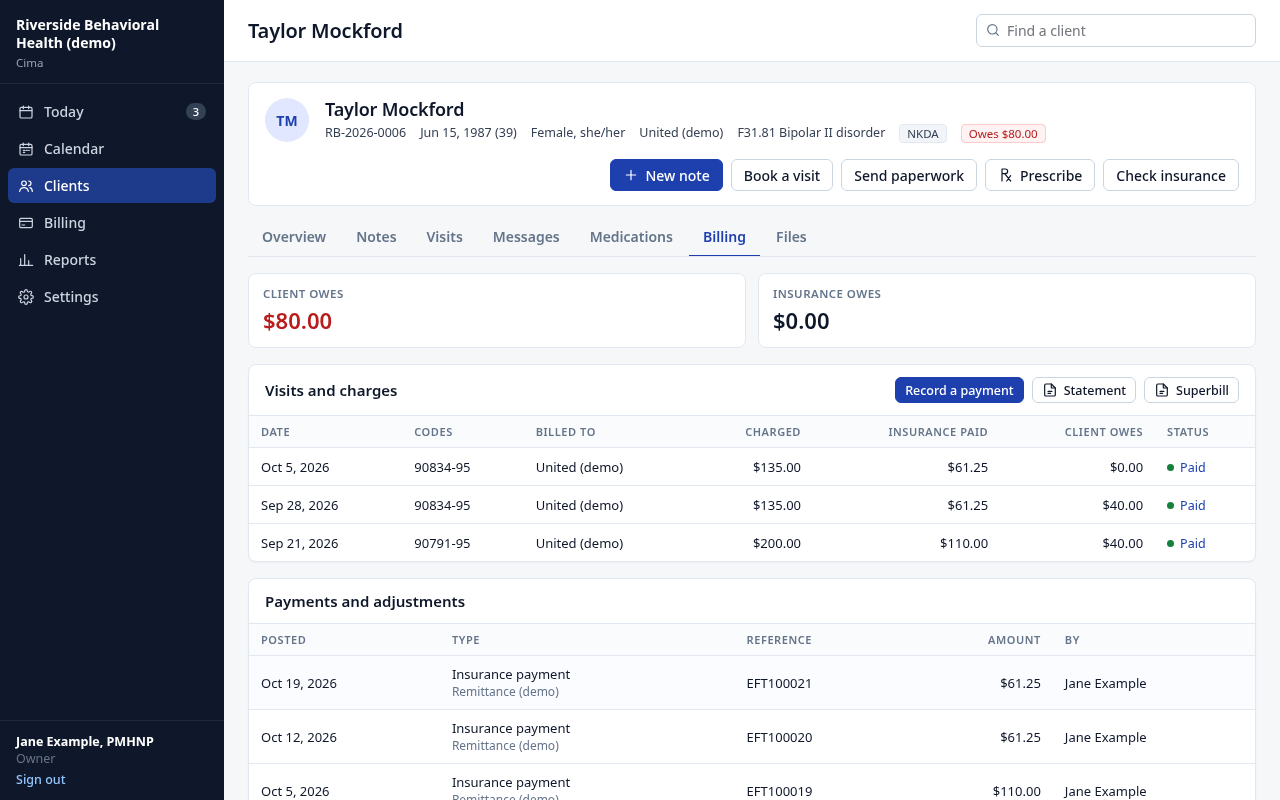
ASAM-based reviews, prompted before the authorization ends
Cima's Program plan is $399 a month for up to 25 clients in the program: group notes, attendance, per diem billing, and continued-stay reviews built around the six dimensions. Each added clinician is $39 a month.
Opening a program? Cima Consulting writes your ASAM-based admission, continued-stay and discharge criteria as part of the IOP / PHP Program Launch. Already open and want an outside read? A chart audit reads ten charts for medical necessity and level-of-care support, with a fix list for each: $1,250 per 10 charts.
Questions
What is the ASAM Criteria?
A set of standards from the American Society of Addiction Medicine for assessing people with substance use and co-occurring conditions across six dimensions and matching them to the least intensive level of care that's safe and effective. Most states and many payers use it for placement and utilization review.
What does ASAM stand for?
The American Society of Addiction Medicine, the professional society of addiction medicine physicians and clinicians that publishes The ASAM Criteria.
What are the six ASAM dimensions?
In the 4th edition: 1 intoxication, withdrawal and addiction medications; 2 biomedical conditions; 3 psychiatric and cognitive conditions; 4 substance use-related risks; 5 recovery environment interactions; 6 person-centered considerations.
What is the newest edition of the ASAM Criteria?
The 4th edition. The adult volume came out in October 2023, and the Adolescents and Transition-Aged Youth volume in 2026 (digital March 31, print June). Payers adopt it on their own schedules.
What changed in the ASAM 4th edition?
Renamed and reordered dimensions, readiness to change folded into the others, a new person-centered dimension, revised risk ratings with subdimensions and decision rules, new levels 1.0, 1.7 and 2.7, Level 2.5 renamed high-intensity outpatient, and withdrawal management built into the levels.
How do you score the ASAM Criteria?
Each dimension gets a severity or risk rating, commonly 0 (none) to 4 (severe), backed by a specific fact. The 4th edition's decision rules turn the ratings into a level; dimension 6 shapes the plan with the person. Use your payer's form and the published Criteria.
What is ASAM Level 2.1?
Intensive outpatient: a structured program several days a week, for adults commonly 9 or more hours a week. A substance use IOP day is usually billed as H0015.
What is ASAM Level 3.7?
Medically managed residential treatment: 24-hour care with medical and nursing staff for people with significant withdrawal risk or medical or psychiatric needs. In the 4th edition it also covers what was Level 3.7-WM.
Is there a free ASAM Criteria PDF or cheat sheet?
The Criteria themselves are copyrighted and sold by ASAM. Free summaries like this page explain the structure in other words; for the actual decision rules, get the book or ASAM's licensed tools.
Is there a crosswalk from the 3rd to the 4th edition?
Yes: the dimension and level tables above map them, and state Medicaid agencies such as Washington's publish transition guides. The level numbers mostly carry over; the dimension numbers 4 to 6 don't.
Is the ASAM Criteria used for mental health?
No. It's for substance use and co-occurring conditions. Mental-health-only levels are reviewed against payers' own medical-necessity guidelines.
What does the ASAM Criteria help determine?
The level of care a person needs now, whether they still need it at each review, when they're ready to step down, and what the treatment plan should focus on.
Sources
- American Society of Addiction Medicine, The ASAM Criteria, 4th edition; release announcement, October 5, 2023; Adolescents and Transition-Aged Youth volume; software.
- Washington Health Care Authority, ASAM 4th edition transition guidebook; Illinois DHS, transition from the 3rd to the 4th edition; Colorado HCPF, 4th edition summary.
- Mountain Plains ATTC, 4th edition overview handout; IRETA, major changes in the 4th edition; Los Angeles County SAPC, dimension risk rating handout.
- TMHP, Texas Medicaid Provider Procedures Manual, Behavioral Health handbook, October 2026; 26 TAC §564.804 (Cornell LII).
- Optum, ASAM Criteria Navigator.
"The ASAM Criteria" is ASAM's registered trademark and copyrighted work. This page is an independent summary in our own words, not affiliated with or endorsed by ASAM. General information, not clinical, legal or billing advice.
Six dimensions, one chart, every review on time.
Cima's Program plan builds the continued-stay review around the ASAM dimensions and prompts it 5 days before the authorization ends. Take the tour.
Get early access