A free guide from Cima EHR · Billing codes
H0015: the alcohol and/or drug intensive outpatient code
The short answer: H0015 is the HCPCS Level II code for a substance use intensive outpatient program (IOP). CMS's descriptor defines it as a treatment program that runs at least 3 hours a day and at least 3 days a week on an individualized treatment plan, covering assessment, counseling, crisis intervention and activity therapy or education. Most payers bill it as one unit per qualifying day (a per diem), with revenue code 0906 on a UB-04. Medicare doesn't pay it; commercial plans, TRICARE and Medicaid plans do, including Texas Medicaid plans, which have required the code on IOP claims since July 1, 2025. Below: the descriptor phrase by phrase, units, diagnoses, modifiers, who pays, H0015 vs S9480 and 90853, and a worked day.
Updated October 27, 2026. Sources checked October 27, 2026. Written by people who run a licensed Texas PHP, IOP and outpatient program and bill H0015 every week. General information, not billing or legal advice: your contract and each payer's manual decide.
The H0015 description, phrase by phrase
Alcohol and/or drug services; intensive outpatient (treatment program that operates at least 3 hours/day and at least 3 days/week and is based on an individualized treatment plan), including assessment, counseling; crisis intervention, and activity therapies or education
HCPCS Level II long descriptor from the CMS code set (CMS HCPCS quarterly update files; also listed at HCPCS.codes, coverage code I, not payable by Medicare). HCPCS Level II is a public CMS code set, not CPT.
Each phrase in that sentence turns into something a payer auditor looks for in the chart. This is how we read it when we set up a program's schedule and notes:
| Phrase | What it means for you | What an auditor checks |
|---|---|---|
| Alcohol and/or drug services | A substance use program. A program whose clients are mostly there for depression or anxiety is a mental health IOP, which usually bills S9480. | A primary substance use diagnosis on the claim and in the assessment. |
| Intensive outpatient | More than weekly therapy, less than partial hospitalization. In ASAM terms, Level 2.1. | An assessment that places the client at IOP, and a reason a lower level won't do. |
| At least 3 hours/day | A day under 3 documented hours doesn't meet the code. Schedule 3-hour blocks, not 2.5. | Start and end times on every note that day, adding up to 3 hours or more. |
| At least 3 days/week | The program runs 3 or more days a week, and the client's plan schedules them that often. | The program schedule, and attendance that roughly matches the plan. |
| Individualized treatment plan | The day exists to work on this client's goals, not a generic curriculum. | A current, signed plan, and notes that name the goal each session worked on. |
| Including assessment, counseling, crisis intervention, activity therapies or education | Those services are inside the day. Most payers won't pay them again on separate codes that day. | No group, individual or assessment codes billed on top of H0015 for the same date, unless the contract allows it. |
One thing the descriptor doesn't say is "per diem." Unlike S9480 and S0201, the unit isn't written into H0015, so the payer sets it. That's the next section.
Is H0015 a per diem code? Units and hours
Usually, yes. Most commercial plans, TRICARE and the Medicaid programs we've seen pay H0015 as one unit per date of service when the day meets the hours. Louisiana Medicaid, for example, limits H0015 to one unit a day, and New Mexico pays its H0015 daily rate only for at least 3 hours of service. But because the unit isn't in the descriptor, some payers define it differently: one Delaware Medicaid plan's code list treats H0015 as hourly for some members, with a modifier changing what it means. Read your contract's definition before you build a claim.
- Per diem: one line per day attended, one unit, never several days or "two groups" on one line. A week of IOP is three or more lines.
- Hours: 3 documented clinical hours is the floor in the descriptor. Your contract may ask for more, or count only certain services toward the hours. Per diem billing for IOP and PHP lists the thresholds by payer and what counts as an hour.
- The week: 3 days a week is the program minimum; adult IOP under the ASAM Criteria is commonly 9 or more hours a week. A client attending two 3-hour days has two billable days, and a continued-stay problem.
- Authorized days: plans authorize IOP in days. Each billed day uses one, so billing a short day burns an authorized day for nothing.
Diagnosis codes and ASAM level
No ICD-10 code is tied to H0015 by CMS, but the descriptor ("alcohol and/or drug services") means the primary diagnosis should be a substance use disorder: in ICD-10-CM, the F10–F19 block of mental and behavioral disorders due to psychoactive substance use (the CDC's ICD-10-CM files have the full list). A few practical rules:
- Primary diagnosis drives the code. A client with alcohol use disorder and depression in the substance use track: H0015 with the F10 code first. The same client in a mental health track for depression: S9480 with the depression code first. Pick by the program the client is actually in.
- Use the specific code. Severity (mild, moderate, severe) and remission status are part of the code. "In early remission" on an IOP admission invites a medical-necessity question.
- Texas Medicaid restricts the diagnoses that outpatient substance use codes accept; a claim with a diagnosis outside the list denies. Check the Texas Medicaid behavioral health handbook.
- ASAM level 2.1. Most payers review substance use IOP against The ASAM Criteria: the client's needs across six dimensions place them at Level 2.1, intensive outpatient. Our ASAM Criteria cheat sheet summarizes the dimensions and levels, and ASAM continued-stay documentation shows how to write the reviews that keep H0015 days authorized.
Revenue code, place of service and modifiers
Revenue code (UB-04)
On a facility claim (UB-04, sent as an 837I), H0015 normally rides with revenue code 0906, intensive outpatient services, chemical dependency. Some payers accept 0905 (psychiatric) with either H0015 or S9480; TRICARE takes either pairing. In Texas, Superior HealthPlan's Medicaid notice maps SUD IOP to H0015 with 0906 and says the HCPCS code, not the revenue code, is the required part (Superior, September 2025). Which form a contract wants is covered in UB-04 vs CMS-1500.
Place of service (CMS-1500)
A professional claim (CMS-1500, 837P) needs a place of service code; a UB-04 has none. For an in-person H0015 day, programs commonly use 57, non-residential substance abuse treatment facility, from the CMS place of service code set; some payers want 11 (office) or the POS named in the contract. Telehealth days use 02 or 10 with the payer's modifier, and only if the payer covers virtual IOP: see running a virtual IOP for the rules plan by plan.
Modifiers
Commercial plans usually take H0015 with no modifier. Medicaid programs and some managed care plans add them: HF (substance abuse program), HA/HB (adolescent or adult program), HO/HN (clinician degree), and 95, 93 or GT for video or audio-only, depending on the plan. Never add a modifier the payer's billing guide doesn't list. The full modifier table is on IOP and PHP billing codes.
Who pays H0015
| Payer | H0015? | What to know |
|---|---|---|
| Commercial plans and their behavioral health managers | Yes, the usual SUD IOP code | Prior authorization by level, one unit per day, the contract's definition of a day. Some want a UB-04 with 0906; others a CMS-1500. |
| Texas Medicaid (managed care) | Yes, through the plans | For adults, plans offer IOP as an in-lieu-of service under HHSC's Uniform Managed Care Manual 16.3; members under 21 get it through Texas Health Steps. HHSC asked plans to track IOP by HCPCS code, and Superior has required H0015 on SUD IOP claims since July 1, 2025. Medicaid SUD treatment must be delivered in a licensed chemical dependency treatment facility (TMHP). Details: Texas Medicaid for IOP and PHP programs. |
| Medicare | No | Coverage code I: not payable by Medicare. Medicare's IOP benefit (since 2024) pays hospitals, CMHCs, FQHCs and rural health clinics, which bill each service as a line item on a UB-04 with condition code 92 (CMS MLN MM13222). A freestanding program can't bill Medicare for the day at all. See Medicare coverage of IOP and PHP. |
| TRICARE | Yes | On a UB-04 with 0905 or 0906, one line per date of service; the program must be TRICARE-authorized. |
| Other states' Medicaid | Usually | Each state sets hours, units and modifiers. Read the state manual and each plan's billing guide; don't carry one state's rules into another. |
What it pays is a separate question with its own guides: IOP reimbursement rates for every payer, and the Texas Medicaid SUD fee schedule for looking H0015 up at TMHP.
H0015 vs S9480, H0005, 90853 and the other program codes
The comparisons people search for most, side by side. Descriptors are paraphrased except where quoted.
| Code | What it is | Unit | Use it instead of H0015 when |
|---|---|---|---|
| S9480 | Intensive outpatient psychiatric services, per diem (an S code for private payers) | Day | The program and the client's primary diagnosis are mental health, not substance use. |
| H0005 | Alcohol and/or drug group counseling by a clinician | Session (Texas Medicaid: per hour) | The client is in standard outpatient, not IOP. A group session, not a program day. |
| 90853 | CPT group psychotherapy (other than a multiple-family group) | Session | Outpatient clients billed session by session, or a contract that pays groups separately. Medicare pays 90853; it doesn't pay H0015. |
| H2036 | Alcohol and/or other drug treatment program, per diem (no hours or level in the descriptor) | Day | A Medicaid manual or contract names it for the level. Otherwise don't. |
| H0035 / S0201 | Partial hospitalization, less than 24 hours | Day (S0201 says per diem; H0035 doesn't) | The client is authorized for PHP (ASAM 2.5), not IOP. A step-down from PHP to IOP changes the code on the date of the change. |
H0015 vs 90853, in practice
The question behind "H0015 vs 90853" is usually: can we bill the groups instead of, or on top of, the day? On top of: almost never. The groups are the day; billing 90853 for the same client and date as H0015 is a duplicate payment request, and payers say so in their policies (one plan's IOP payment policy calls the per diem a bundled payment and won't pay individual services billed alongside it). Instead of: only for clients who aren't in the IOP level, such as an outpatient client attending one group a week. If a payer won't contract the per diem at all, that's a contracting problem, not a coding one; don't bill three 90853s to approximate an IOP day.
One H0015 day, start to finish
A made-up adult client, Client B, in a substance use IOP that runs Monday, Wednesday and Thursday, 9:00 to 12:15 with a break. Contract: H0015, one unit per day of 3 or more documented hours, UB-04 with 0906.
| Time | Service | Documented | Counts toward the 3 hours? |
|---|---|---|---|
| 9:00–10:30 | Process group (relapse prevention) | Group note with Client B's own entry: present, participated, linked to plan goal 2 | Yes, 1.5 hours |
| 10:30–10:45 | Break | Not a service | No |
| 10:45–12:15 | Skills group (craving management) | Group note, own entry, goal 1 | Yes, 1.5 hours |
| Total | Two groups | Both notes signed the same day | 3.0 hours: billable, 1 unit |
UB-04 line (made up): revenue code 0906 · HCPCS H0015 · service date 11/04/2026 · units 1 · the program's charge for the day.
The same day on a CMS-1500 (if the contract wants one): date of service 11/04/2026 · POS 57 · H0015 (plus HF only if the payer lists it) · diagnosis pointer to the F10 code · units 1.
Not billed: 90853 for either group, or a second unit for the second group.
If Client B had left at 11:30, the day would be 2.25 hours: not billable as H0015, and not "rounded up." The early exit time goes in the note, the counselor follows up, and the shortfall goes into the next continued-stay review. If the second group happened but its note was never written, write it now as a dated late entry; never backdate (see late entry progress notes).
H0015 documentation requirements
Payers write their own lists, but every H0015 audit we've seen reduces to these. Keep them for every billed day:
- A substance use assessment with the diagnosis and the ASAM placement at Level 2.1 (in Texas, a QCC-signed assessment under 26 TAC chapter 564).
- A current individualized treatment plan, signed, with goals the day's notes point to; reviewed on schedule (the SUD treatment plan guide).
- A signed note for each session with start and end time and the client's own entry, not a copied paragraph (group therapy notes for IOP).
- Hours that reach 3 for the date, from the notes alone.
- An authorization covering the date and the IOP level, with days left.
- Continued-stay reviews that justify each new block of days.
- Attendance that agrees with the notes and the schedule.
Why H0015 claims deny
- A mental health primary diagnosis on an H0015 line, or H0015 billed for a mental health program.
- More than one unit on a date, or a date past the authorized days.
- The client was authorized for PHP that day (or stepped down a day earlier than the claim says).
- A revenue code with no HCPCS code, which Texas Medicaid plans now deny.
- Group or individual codes billed on the same day as H0015.
- Billed to Medicare, which doesn't pay it.
The reason codes and fixes are in behavioral health claim denials, and the IOP and PHP billing checklist runs these checks in order before a claim goes out.
H0015 in Cima
In Cima's Program plan for IOP and PHP, IOP is set up with H0015 by default, at 3 hours a day and 9 a week, under Settings, Program. You can switch the level to S9480, add up to four modifiers, and change the hours to match your contracts. A day becomes one unit of H0015 only when the client's signed notes reach the day's hours; the biller's list says why any other day isn't ready ("2 h documented; IOP needs 3", or no authorization covering the date). Facility claims carry revenue code 0906 by default; the 837P is the default form. One claim per client per day, checked before sending. One honest limit: the code is set per level, not per payer, so if two plans want different IOP codes, tell us before you go live.
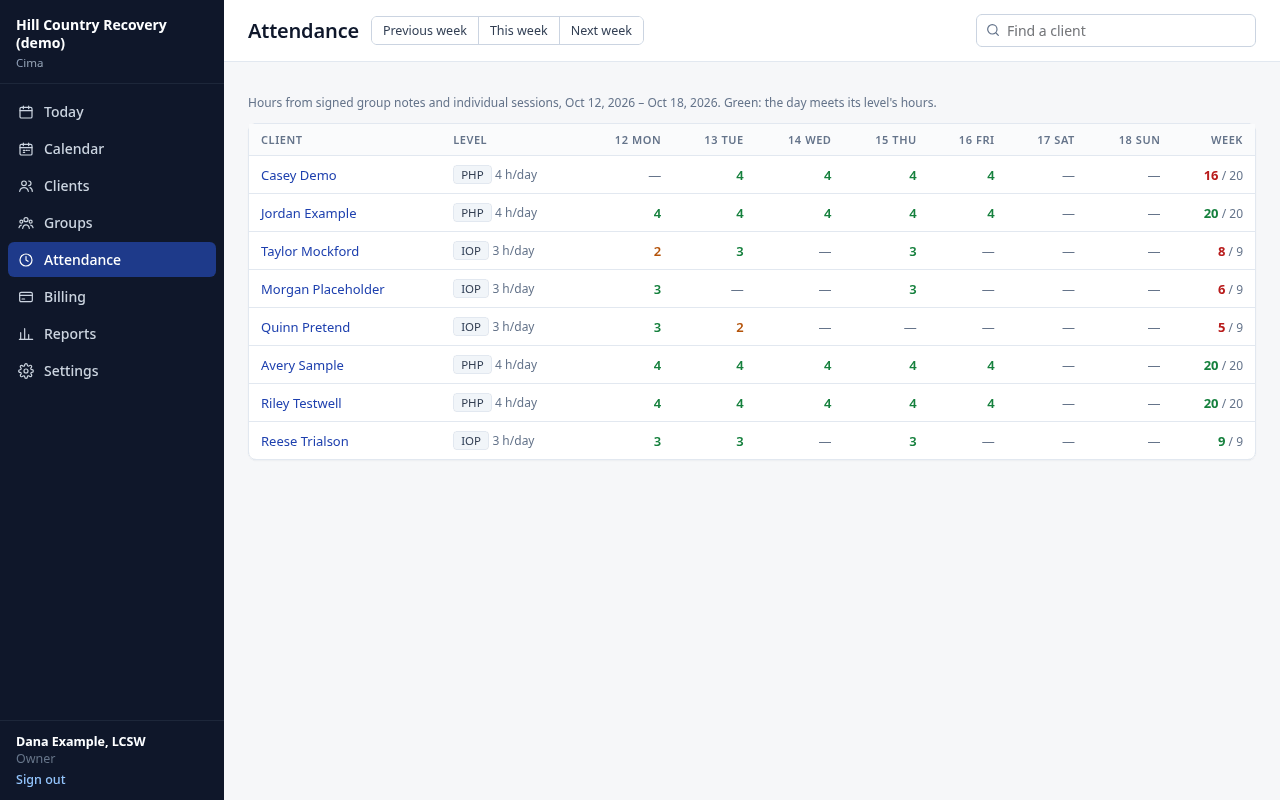
Bill H0015 only for the days your notes prove
Cima's Program plan is $399 a month for up to 25 clients: levels of care, group notes with each client's own entry, attendance hours, per diem claims on a CMS-1500 or UB-04, and authorizations. Each added clinician is $39 a month.
See Cima for IOP and PHP programs or compare the plans. Opening a program and want the codes confirmed in every contract, plus the clearinghouse, ERA and EFT set up? Cima Consulting's billing set-up is $2,950, flat, and the IOP / PHP Program Launch includes it.
Questions
What is H0015?
A HCPCS Level II code for alcohol and/or drug intensive outpatient treatment: a program running at least 3 hours a day, at least 3 days a week, on an individualized treatment plan, including assessment, counseling, crisis intervention and activity therapy or education. It's the usual code for a substance use IOP day.
Is H0015 a CPT code?
No. It's a HCPCS Level II code maintained by CMS. CPT (Level I) codes like 90853 are the AMA's. People search "H0015 CPT code" because both sets go in the same box on a claim.
Is H0015 a per diem code?
Usually. The descriptor doesn't name a unit, but most payers pay one unit per day that meets the hours. A few Medicaid plans define it differently, such as hourly, so check the contract or manual.
How many hours is H0015?
At least 3 hours a day, at least 3 days a week, per the descriptor. Contracts may require more or count only certain services. Adult IOP under the ASAM Criteria is commonly 9 or more hours a week.
Does Medicare cover H0015?
No. H0015 carries coverage code I, not payable by Medicare. Medicare pays IOP only to hospitals, CMHCs, FQHCs, rural health clinics and (for opioid use disorder) opioid treatment programs, billed as line items with condition code 92.
What revenue code goes with H0015?
Usually 0906, intensive outpatient services, chemical dependency. Some payers accept 0905. Superior HealthPlan's Texas Medicaid mapping is H0015 with 0906, with the HCPCS code required.
What diagnosis code goes with H0015?
A substance use disorder as the primary diagnosis, from ICD-10-CM F10–F19, coded to severity and remission status. A mental health primary diagnosis points to S9480 instead.
What modifiers go with H0015?
Often none for commercial plans. Medicaid plans may require HF, HA or HB, clinician-level modifiers, or 95, 93 or GT for telehealth. Use only the modifiers the payer's billing guide lists.
Can H0015 be billed as telehealth?
Only where the payer covers virtual IOP. The code stays H0015; the claim shows telehealth with POS 02 or 10 and the plan's modifier on a CMS-1500, or the modifier alone on a UB-04. Get each plan's rule in writing.
What is the difference between H0015 and 90853?
H0015 is a whole IOP day; 90853 is one group psychotherapy session. Within an H0015 day the groups are already paid, so 90853 isn't billed on top. Use 90853 for outpatient clients or where a contract pays groups separately.
What is the difference between H0015 and H0005?
H0005 is one alcohol and drug group counseling session by a clinician, used for standard outpatient. H0015 is a full intensive outpatient program day of 3 hours or more.
What is the difference between H0015 and H0035?
H0015 is substance use IOP. H0035 is mental health partial hospitalization, the more intensive level, under 24 hours. Bill the level the authorization covers on that date.
What does H0015 pay?
Whatever your contract says. There's no Medicare rate, and Texas Medicaid plans set their own per diems. See IOP reimbursement rates for where rates are published and how to compare them.
Sources
- CMS, HCPCS quarterly update (the official alpha-numeric HCPCS file with long descriptors and coverage codes); HCPCS.codes, H0015 (descriptor and coverage code from the CMS file).
- CMS, place of service code set (POS 57, 11, 02, 10).
- CMS, MLN Matters MM13222 (Medicare IOP, condition code 92).
- Superior HealthPlan, PHP and IOP billing code update, September 2025 (H0015 with 0906; HCPCS required from July 1, 2025).
- Texas HHSC, Uniform Managed Care Manual 16.3 (in-lieu-of services); TMHP, SUD benefit changes, January 1, 2019; TMPPM Behavioral Health handbook, October 2026.
- TRICARE For Life, PHP and IOP claims (0905/0906 with H0015 or S9480).
- Louisiana Department of Health, Informational Bulletin 22-36; New Mexico HSD, IOP rate letter; Highmark Health Options (Delaware), outpatient SUD code list; CareSource, IOP payment policy.
- CDC, ICD-10-CM.
CPT is a registered trademark of the American Medical Association; CPT descriptions here are paraphrased. This guide is general information, not billing or legal advice. Cima isn't a law firm or a billing company.
Every H0015 day, backed by signed notes.
Cima counts each client's hours from signed group notes and bills the day only when it reaches the level's hours. Take the tour.
Get early access