A free guide from Cima EHR · Clinical documentation
Progress notes for counseling and mental health: SOAP, DAP and BIRP, with examples
The short answer: a progress note is the record of one session. It shows what you did, how the client responded, and where they are on their treatment plan, with the date, the start and stop time, and your signature and credentials. SOAP, DAP and BIRP are three orders for the same content, and none of the rules below requires one over another: pick one, use it for every note, and make every note point back to the plan. Below: what every note needs and why, the three formats side by side, one made-up session written all three ways, examples for substance use and mental health counseling, a progress note form to copy, and the mistakes chart auditors find.
Updated October 27, 2026. Written by people who run a licensed Texas PHP, IOP and outpatient program and review its notes every week. Every client in this guide is made up. General information, not clinical, legal or billing advice.
What every progress note needs
Whatever the format, payers, surveyors and the rules look for the same things. This is the list we check our own notes against, with where each item comes from:
| Element | What to write | Why it's there |
|---|---|---|
| Who and when | Client name and a second identifier, date of service | Every page of the record has to tie to one client and one date. |
| Start and stop time | 9:02–9:51, not "50 min" alone | Psychotherapy codes are picked by time. Medicare's billing article for psychiatric codes (A57520) uses 16–37 minutes for 90832, 38–52 for 90834 and 53 or more for 90837. A licensed Texas substance use program records the duration of every service (26 TAC §564.804(l)). |
| Service and setting | Individual, family or group; in person, video or audio-only; who else attended | It decides the code, the place of service and any telehealth modifier on the claim. |
| What the client brought | Their report, in their words where it matters, and what you observed | It's the evidence the session was needed. |
| What you did | The intervention by name: motivational interviewing, a CBT thought record, relapse-prevention planning | A payer pays for treatment, not for a conversation. "Supportive counseling" alone says little. |
| How the client responded | What they did with it: practiced the skill, pushed back, named a trigger | It shows the treatment is working or needs to change. |
| Progress toward the plan | Which goal or objective the session worked on, and movement since last time | Audit tools ask whether notes show progress toward the treatment plan's goals (Optum's treatment record audit tool, for one). See the SUD treatment plan guide for goals that notes can point to. |
| Risk | Any safety concern raised or screened, and what you did about it | A risk noted with no response is the worst thing an auditor can find. |
| Plan | Next session, homework, referrals, coordination | It sets up the next note and shows continuity of care. |
| Signature | Your name, credentials and the date you signed | Medicare requires services to be authenticated by the person who provided them (Program Integrity Manual, ch. 3, §3.3.2.4); Texas facility rules require the signature and credentials of the person who gave the service. |
Nothing on that list is about length. A good note for a 50-minute session is often 150 to 250 words. What makes it hold up is that each line is specific to this client and this day.
SOAP vs DAP vs BIRP: the formats side by side
Each format puts the same content under different headings. The differences are about emphasis, not rules.
| Format | Sections | Good fit for | Watch out for |
|---|---|---|---|
| SOAP | Subjective, Objective, Assessment, Plan | Practices that share charts with prescribers and medical staff, who read SOAP every day | The intervention has no heading of its own, so it gets left out. Put it in Assessment or Plan, by name. |
| DAP | Data, Assessment, Plan | Counselors who want a short note; outpatient therapy | "Data" turns into a story of the session. Keep the client's report, your observations and the intervention in it, briefly. |
| BIRP | Behavior, Intervention, Response, Plan | Substance use and program settings, where payers look for the intervention and the response | Progress toward the plan has no heading. Add the goal number to Intervention or Response. |
| GIRP | Goal, Intervention, Response, Plan | Programs that want the plan goal first on every note | The client's own report can get squeezed out; put it under Response. |
If a group practice or program can't agree, use the format your EHR's template uses, so every clinician writes the same way and an auditor reads every chart the same way.
One session, written three ways
A made-up client, Client M, 41, in outpatient counseling for alcohol use disorder, moderate. Treatment plan goal 1: reduce cravings and drinking days; objective 1a: use two craving-management skills when triggered, reported weekly. Goal 2: build sober support; objective 2a: attend two recovery meetings a week. Individual session, in person, 2:00 to 2:48 pm.
SOAP
S: Client reports one drinking day since last session (Saturday, "four or five beers" at a family barbecue). Says cravings were "a 7 out of 10" on Friday after an argument with his brother. Attended one recovery meeting, not two: "I didn't want to go alone."
O: On time, casually dressed, good eye contact. Mood "frustrated," affect congruent. Denies thoughts of harming himself or others. Breath alcohol screen at check-in 0.00.
A: Partial progress on objective 1a: used urge surfing on Friday but not at the barbecue, where alcohol was offered and no plan was in place. Objective 2a not met; isolation and social anxiety are the barrier. Reviewed the Saturday lapse with a chain analysis: trigger (family event, brother present), thought ("one won't matter"), behavior, consequence. Used motivational interviewing to explore his reasons to attend meetings; he named his daughter's graduation in May. Client identified leaving early and bringing his own drinks as options for the next family event.
P: Client will write a 3-step plan for the family event on the 14th and bring it next session. Will attend Tuesday's meeting with his sponsor contact (he will text him tonight). Next session in one week. Continue current plan; review goal 2 at the 30-day plan review.
DAP
D: 48-minute individual session, in person. Client reports one drinking day (Saturday, family barbecue, 4–5 beers), cravings 7/10 Friday after a conflict with his brother, and one of two planned meetings attended. Breath alcohol 0.00. Mood frustrated, affect congruent, denies SI/HI. Completed a chain analysis of the lapse; used motivational interviewing on meeting attendance.
A: Partial progress on objective 1a (used urge surfing once; no plan for a high-risk social event). Objective 2a not met; social anxiety is the barrier. Client engaged, identified his own reasons (daughter's graduation) and two options for the next event. Risk of further lapses at family events is high without a plan.
P: Written 3-step plan for the event on the 14th, due next session. Tuesday meeting with sponsor contact. Weekly sessions continue; goal 2 reviewed at the 30-day plan review.
BIRP
B: Client arrived on time, mood frustrated, affect congruent, denies SI/HI, breath alcohol 0.00. Reports one drinking day (Saturday, 4–5 beers at a family barbecue), cravings 7/10 Friday after an argument with his brother, and one of two planned recovery meetings.
I: Chain analysis of the Saturday lapse (goal 1, objective 1a). Motivational interviewing on attending meetings alone (goal 2, objective 2a). Reviewed urge surfing.
R: Client named the trigger and the thought that led to drinking, and said urge surfing worked Friday. Identified his daughter's graduation as his reason to stay engaged, and chose leaving early and bringing his own drinks for the next event. Partial progress on 1a; 2a not met.
P: 3-step event plan due next session; text sponsor contact tonight and attend Tuesday's meeting; weekly sessions; review goal 2 at the 30-day plan review.
2:00–2:48 pm. Signed: A. Rivera, LCDC, 10/27/2026, 3:10 pm. (Made-up clinician.)
All three hold the same facts. If you read them side by side, that's the point: the format doesn't make the note. The specific details (the barbecue, the 7 out of 10, the daughter's graduation, the goal numbers) do.
Progress note examples for substance use counseling
Substance use notes carry a few things a general therapy note may not. Add them when they apply:
- Use since the last session, in the client's words and in numbers (days used, amount), plus any drug test or breath result and what you did with it.
- Cravings and triggers, rated the same way every time, so progress is visible across notes.
- Recovery supports: meetings, sponsor or peer contact, sober housing, family involvement.
- Medication coordination for clients on medication for opioid or alcohol use disorder: adherence as reported, contact with the prescriber, under the client's consent.
- The ASAM dimension the session addressed, when the program reviews placement by dimension. It makes continued-stay reviews far easier to write. See the ASAM Criteria cheat sheet and ASAM continued-stay documentation.
Weak vs strong, the same session
| Weak | Strong |
|---|---|
| "Client discussed relapse prevention. Client is doing well. Continue plan." | "Client reported 0 use days and cravings 3/10 (down from 6/10 at admission). Practiced refusal skills by role-play for a work happy hour (goal 1, objective 1b); client wrote two refusal lines in his own words. UDS collected 10/20 negative for all panels tested. Next: practice with his sponsor before Friday." |
| "Group: coping skills. Client participated." | "Client shared that boredom on weekends is her main trigger and asked the group for ideas; chose a Saturday volunteer shift (goal 2). Arrived 10 minutes late (9:10) due to bus; attended until 10:30." |
For licensed Texas chemical dependency treatment facilities, every treatment service is documented within 72 hours with the date, the nature of the contact, its duration, and the signature and credentials of the person who provided it, and group, education and life skills notes also name the topic (26 TAC §564.804(l)). Counselors in their own practice who treat substance use can start from Cima for addiction counselors.
Progress note examples for mental health therapy
A made-up client, Client J, 29, generalized anxiety disorder. Plan goal: reduce worry that interferes with work; objective: complete a thought record three times a week and report GAD-7 every two weeks. Video session, 10:00 to 10:54 am.
DAP, mental health
D: 54-minute individual psychotherapy by video; client at home in Texas, alone, identity confirmed. GAD-7 today 12 (14 two weeks ago). Client completed 2 of 3 thought records; reports worry about a performance review kept her up two nights. Reviewed one thought record ("If the review is bad, I'll be fired"); used Socratic questioning and evidence for and against. Introduced scheduled worry time (15 minutes at 6 pm).
A: Moderate symptoms, improving (GAD-7 down 2 points). Engaged; generated two balanced thoughts on her own. Sleep remains the main impairment. No safety concerns; denies SI.
P: Thought records 3×/week; scheduled worry time daily; sleep log for one week. GAD-7 at the next session in one week. Consider referral for a medication evaluation if sleep doesn't improve by the plan review.
Two details there matter for billing: the 54 minutes support 90837 (53 minutes or more), and the video visit gets the telehealth place of service and modifier the payer requires. In Cima, the session length picks the code; see Cima for therapists.
Group therapy progress notes
A group note has two parts: the session part (topic, time, facilitator), which is the same for everyone, and each client's own entry, which never is. Copying one paragraph into twelve charts is the most common reason group notes don't support the bill. Our guide to group therapy notes for IOP and PHP has the full rules, a cloned vs individualized example and the Texas group-size limits.
Progress notes vs psychotherapy notes
They are not the same thing, and the difference matters for privacy. Under HIPAA, psychotherapy notes are a mental health professional's notes analyzing the contents of a counseling session that are kept separate from the rest of the record. The definition excludes medication monitoring, session start and stop times, the modalities and frequency of treatment, test results, and any summary of the diagnosis, functional status, treatment plan, symptoms, prognosis and progress (45 CFR 164.501). Those excluded items are exactly what a progress note holds.
- Progress notes are part of the medical record. They support the claim, are shared for treatment and payment under the usual rules, and are what a payer asks for in an audit.
- Psychotherapy notes, if you keep them, need the client's specific authorization for most disclosures, and a payer can't make that authorization a condition of payment. Most clinicians don't keep separate ones. If you do, never put billing support in them. HHS explains the rules in its HIPAA guidance on mental health.
- Substance use programs have a parallel category since the 2024 Part 2 rule: SUD counseling notes, which need their own consent. See 42 CFR Part 2 after the 2024 rule.
A progress note form to copy
A blank progress note template that works with any format. Paste it into your EHR's template or a document; fill every line.
Progress note
Client: ____________ · Date of birth or ID: ________ · Date of service: __/__/____
Start time: ____ · Stop time: ____ · Service: individual / family / group · In person / video / audio-only · Others present: ________
Treatment plan goal(s) and objective(s) addressed: ____________
Client report and presentation (S / D / B): ____________
Intervention(s), by name (I): ____________
Client response, and progress toward the objective (A / R): ____________
Risk: screened? __ · Concerns and action taken: ____________
Substance use (if applicable): use since last session ____ · cravings __/10 · test result ____
Plan: homework ____ · next session ____ · referrals or coordination ____
Clinician: ____________ · Credentials: ____ · Signature: ____________ · Date and time signed: ________
Supervisor co-signature (if required): ____________ · Date: ______
When to write it, and how to correct it
- Same day is the habit to build. Notes written days later are less specific and harder to defend. Licensed Texas substance use facilities have a hard 72-hour limit, and many payer contracts set their own.
- Never backdate. A note written late is a late entry, dated the day it was written and saying which session it documents. Our guide to late entry progress notes has the wording.
- Corrections are addenda. Once signed, a note isn't edited; you add a dated, signed addendum (Medicare's Program Integrity Manual, ch. 3, §3.3.2.5; 26 TAC §564.507 for Texas facilities).
- Pre-licensed clinicians (LPC Associates, LMFT Associates, LCDC interns) need their supervisor's co-signature where the payer or the license board requires it, on the schedule it sets.
What chart audits find
- Cloned notes: the same sentences across sessions or clients. Payers treat them as not supporting the service.
- No time, or a time that doesn't support the code billed (a 45-minute note billed as 90837).
- No link to the plan: notes that never name a goal, or name goals from an expired plan.
- "Client doing well" with nothing measurable behind it.
- Risk raised, no response: passive suicidal thoughts noted with no screening or safety plan.
- Unsigned or late notes, or a claim sent before the note was signed.
Running a program? The chart audit checklist turns these into a monthly review.
Progress notes in Cima
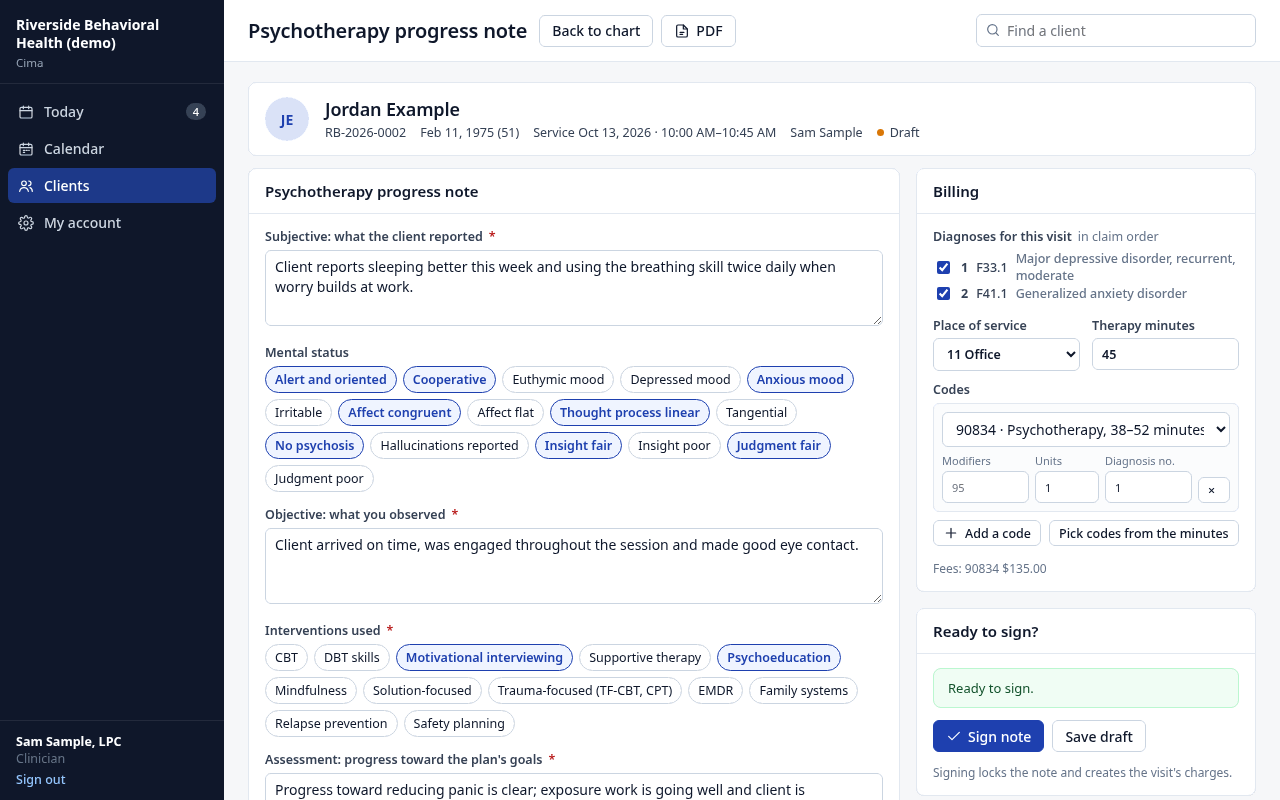
Cima EHR comes with templates for a psychotherapy progress note (SOAP), intake assessment, treatment plan and discharge summary. Type or dictate a few lines and, if the practice owner has turned it on, AI drafts the sections from only what you wrote, for you to edit. Before you sign, Cima lists what's missing, and a moderate or high risk rating needs a safety plan. You sign with your PIN; signed notes are locked and corrections are dated addenda; a note signed more than 72 hours after the visit is marked as a late entry. The session's minutes pick 90832, 90834 or 90837 for the claim. Group notes take the topic once and each client's own entry, and entries that read 80% alike are stopped before signing. Associates' notes wait for their supervisor's co-sign. See notes in the feature list.
Notes that are done when the session is
Try Cima free for 30 days with your own templates. Built for therapists, addiction counselors and IOP and PHP programs; see the plans and prices.
Questions
What should a counseling progress note include?
The date, start and stop time, the type of service and setting, what the client reported and how they presented, the intervention you used, how the client responded, progress toward a named treatment plan goal, any risk and your response, the plan for next time, and your signature with credentials and the date signed.
What is the difference between SOAP, DAP and BIRP notes?
They order the same content differently. SOAP is Subjective, Objective, Assessment, Plan. DAP is Data, Assessment, Plan. BIRP is Behavior, Intervention, Response, Plan. BIRP puts the intervention and response up front, which suits substance use and program settings; SOAP suits shared charts with medical staff; DAP is the shortest.
Which progress note format is required?
None of the rules cited here requires a specific format. Medicare, Texas facility rules and payer audit tools ask for content: time, the service, the response, progress toward the plan and a signature. Use one format consistently across the practice.
How long should a therapy progress note be?
Long enough to show what happened and why it was needed. For a 50-minute session that's often 150 to 250 words. Specific details matter more than length.
Are progress notes the same as psychotherapy notes?
No. Under HIPAA, psychotherapy notes are a clinician's separate notes analyzing a session, kept apart from the record. Progress notes are part of the record: times, the treatment, symptoms, progress and the plan. Payers review progress notes; they can't require psychotherapy notes as a condition of payment.
How soon must a progress note be written?
Same day is best practice. A licensed Texas chemical dependency treatment facility must document each service within 72 hours. Payer contracts and license boards may set their own limits. A note written later is a late entry, never backdated.
Do group therapy progress notes need an entry for each client?
Yes. The topic and summary can be shared, but each client needs their own entry: attendance and time, participation, what they said and did, and the goal they worked on.
What should a substance use progress note add?
Use since the last session, cravings on a consistent scale, drug test results and your response, recovery supports such as meetings, medication coordination under consent, and the ASAM dimension the session addressed when the program tracks them.
Can AI write my progress notes?
It can draft them from what you wrote, but you remain the author: review every line, correct it and sign it. Use a tool covered by a Business Associate Agreement, and tell clients if your state requires notice. In Cima, AI drafts only from your own words and the owner decides whether it's on.
Is there a progress note form I can use?
Yes, copy the form on this page. It works with SOAP, DAP or BIRP: fill each line, link the goal, and sign with your credentials and the date and time signed.
Sources
- 45 CFR 164.501, definition of psychotherapy notes; 45 CFR 164.508(a)(2), authorization for psychotherapy notes. eCFR
- HHS Office for Civil Rights, HIPAA privacy rule and sharing information related to mental health.
- CMS, Billing and Coding: Psychiatric Codes, article A57520 (psychotherapy time ranges for 90832, 90834, 90837; documented time). Medicare Coverage Database
- CMS, Medicare Program Integrity Manual, chapter 3, §3.3.2.4 (signatures) and §3.3.2.5 (amendments, corrections and delayed entries). cms.gov (PDF)
- 26 Texas Administrative Code §564.804(l), documentation of treatment services within 72 hours, and §564.507, documentation standards (as of October 2026). §564.804 · §564.507
- Optum, Treatment Record Audit Tool (progress notes describe progress toward the plan's goals). PDF
- 42 CFR Part 2 (SUD counseling notes, consent), as amended in 2024. eCFR
CPT is a registered trademark of the American Medical Association. General information, not clinical, legal or billing advice. Payer rules differ by plan and change; confirm with each plan and your contracts.
Specific notes, signed on time, tied to the plan.
Free for 30 days. Take the tour to see a note go from draft to claim.
Get early access