A free guide from Cima EHR · Choosing software
Addiction treatment software: what a substance use program needs, level by level
The short answer: addiction treatment software (also called substance abuse treatment software, or a behavioral health EHR for SUD) is the system that holds a program's clinical record and its billing: the ASAM-based assessment, treatment plan, progress and group notes, drug test results, 42 CFR Part 2 consents, authorizations and claims. What you need depends on your levels of care. Detox and residential programs need medication administration, a bed board and 24-hour nursing documentation. Outpatient, IOP and PHP programs need group notes, attendance hours, per diem billing and utilization review. Opioid treatment programs need dosing records. Buy for the levels you'll run in the next year. Below: the kinds of systems, what each level needs, the features every SUD program needs, questions to ask vendors, and where Cima EHR, which we make, fits and doesn't.
Updated October 27, 2026. Written by people who run a licensed Texas PHP, IOP and outpatient program and built the EHR it uses. We name no other vendor here. General information, not legal advice.
The kinds of behavioral health EHR systems
Vendors use the same words for very different products. Sort them by what they were built for:
| Kind of system | Built for | Usually has | Usually lacks |
|---|---|---|---|
| Therapy practice EHR | Individual clinicians and group practices billing session by session | Scheduling, notes, superbills, claims, client portal | Levels of care, group attendance hours, per diem billing, Part 2 release handling |
| Outpatient program EHR | PHP, IOP and outpatient SUD and mental health programs | Group notes with each client's entry, attendance hours, per diem claims, authorizations, continued-stay reviews | Beds, medication administration, nursing flowsheets |
| Full-continuum treatment center platform | Programs that run detox and residential, often with outpatient | Medication orders and administration, bed board, admissions CRM, nursing documentation, revenue cycle tools | Often priced and staffed for larger programs |
| Opioid treatment program software | Methadone and buprenorphine dispensing programs | Dosing and take-home records, inventory, the records 42 CFR Part 8 requires | Often paired with a separate EHR for counseling |
| Add-ons | Any of the above | Admissions CRM, VOB tools, billing services, compliance and survey tools | They don't replace the chart |
What each level of care needs from the software
Levels follow The ASAM Criteria; our ASAM Criteria cheat sheet maps the 3rd and 4th edition numbers.
| Level | Software must handle | Billing shape |
|---|---|---|
| Withdrawal management (detox) | Physician or prescriber orders, a medication administration record, vitals and withdrawal rating scales on a schedule, 24-hour nursing notes, discharge to the next level | Per diem facility claims, usually with revenue codes on a UB-04 |
| Residential | Bed board and census, medication administration, daily schedule and notes, passes and incidents, level transfers | Per diem facility claims and authorizations by days |
| PHP and IOP | Program schedules, group notes with each client's own entry, attendance hours per day, step-downs between levels, continued-stay reviews | One per diem line per qualifying day (H0015, S9480, H0035 or revenue codes) |
| Outpatient | Scheduling, reminders, individual and group notes, treatment plan reviews | Session codes: CPT psychotherapy or H0004 and H0005 for Medicaid |
| Medication for opioid use disorder | E-prescribing, including controlled substances where buprenorphine is prescribed; in an OTP, dosing and take-home records | E/M visits, or the payer's bundled OTP codes |
Texas licensed facilities have their own record rules under 26 TAC chapter 564: an assessment within set days, plans and reviews on deadlines, services documented within 72 hours. Our guide to the Texas rules a behavioral health EHR has to handle lists them.
What every substance use program needs, whatever the level
- 42 CFR Part 2 releases. Disclosures go out only under a valid consent or a listed exception, and each one carries the federal notice (42 CFR 2.31, 2.32). The software should check the consent before records leave. See the Part 2 guide.
- An ASAM-based assessment and placement, with the six dimensions recorded so continued-stay reviews can draw on them (continued-stay documentation).
- Treatment plans with measurable objectives, review dates and the client's agreement, and notes that name the goal they worked on (the SUD treatment plan guide).
- Signed, timed notes, locked once signed, with dated addenda and honest late-entry stamps (progress notes for counseling).
- Drug testing: orders, results and what the clinician did with them. Point-of-care cups need a CLIA certificate of waiver (CMS, CLIA).
- Claims built from the chart: per diem days only when the hours are met, authorizations tracked, claim checks before sending (behavioral health billing software).
- Security that HIPAA expects: a Business Associate Agreement, unique logins, an audit log of who viewed what (45 CFR 164.312), and role-based access so billing staff don't read therapy notes.
- Your data out, any time, in a format you can use, including after you leave.
Does addiction treatment software need to be ONC-certified?
Usually not, for a private outpatient program. Certification under ONC's Health IT Certification Program matters when a program or funder requires certified technology: for example, SAMHSA's CCBHC certification criteria call for certified health IT, and some state contracts and grants do too. Ask your funders before you buy. Cima EHR isn't ONC-certified, so it isn't the right choice for a CCBHC.
Questions to ask addiction treatment software vendors
- Which levels of care does it support today, and which are on a roadmap? Ask to see each one with demo data.
- How does it handle a step-down (PHP to IOP, residential to IOP) in the chart, the authorization and the claim?
- Show me a group note for twelve clients. How does each client get their own entry, and what stops copied entries?
- How does it decide a program day is billable? Does it count hours from signed notes?
- How does a Part 2 release work, start to finish? What happens if the consent has expired?
- Is e-prescribing live today, and does it include controlled substances?
- Does it have a medication administration record and bed board, if we run beds?
- What does it cost for our size in year one and year two, including set-up, per-user fees, clearinghouse fees and add-ons?
- Who signs the Business Associate Agreement, and where is the data hosted?
- How do we get all our data out if we leave?
For IOP and PHP programs, our buyer's checklist for IOP and PHP EHRs goes deeper, and the IOP EHR comparison lays out what vendors publish.
How addiction treatment software is priced
Three models, often mixed: per user (each clinician or staff login), per program or per bed, and a percentage of collections when billing services are bundled. Many full-continuum platforms quote only after a demo. Ask for the total for your census and staff, set-up and training fees, and what happens to the price at renewal. How much a behavioral health EHR costs walks through each model with questions to ask.
Where Cima EHR fits, and where it doesn't
Cima EHR's Program plan is built for PHP, IOP and outpatient programs, including substance use programs: levels of care with each level's hours and per diem code, group notes with each client's own entry (entries that read 80% alike are stopped before signing), attendance hours from signed notes, one per diem charge for each day that meets its hours, authorizations, and continued-stay reviews on Today 5 days before one ends. Part 2 releases are checked against a current signed consent and carry the federal notice. Solo counselors who treat substance use use the same system on a smaller plan (Cima for addiction counselors).
It doesn't fit every program, and we'd rather say so here:
- No detox, residential or recovery-housing levels, no bed board and no medication administration record. If you run beds, choose a full-continuum platform.
- No lab orders or results; e-prescribing is being finished now.
- Not ONC-certified.
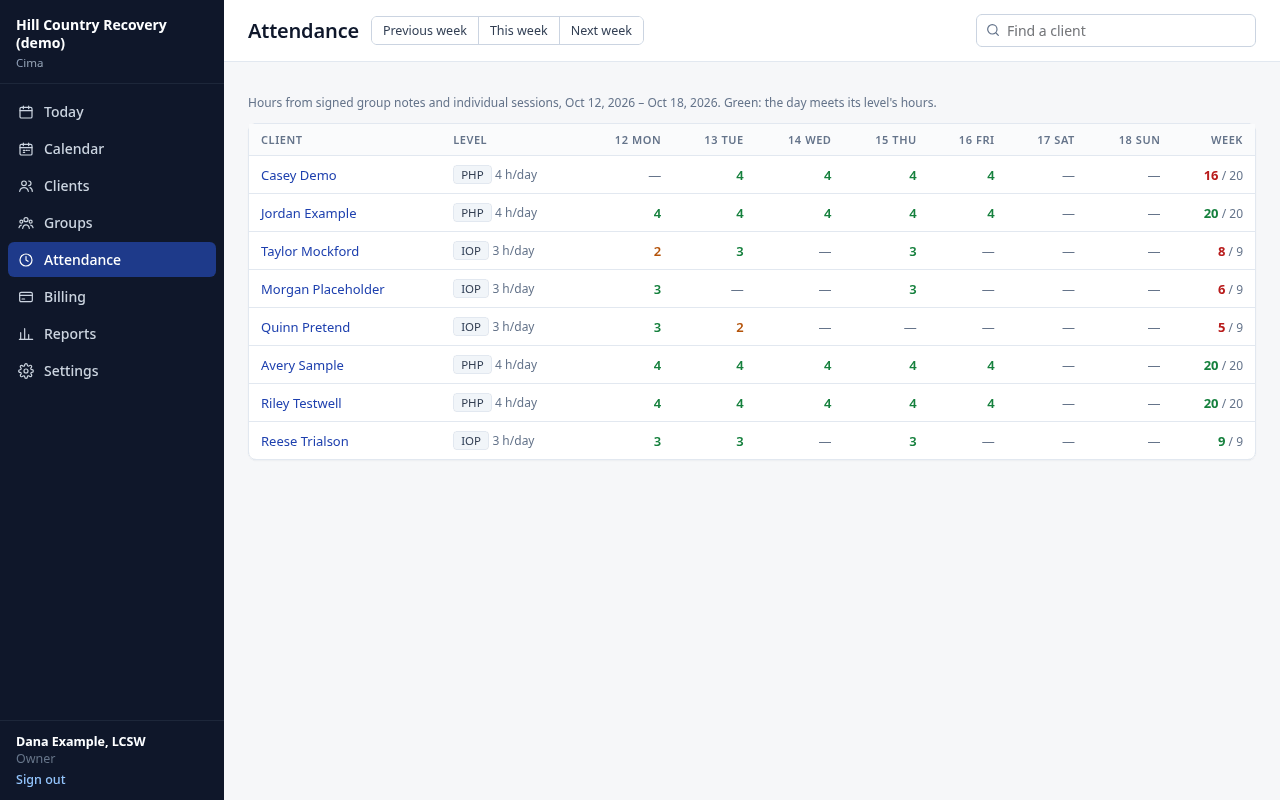
An EHR for outpatient SUD programs
See Cima for IOP and PHP programs, or compare the plans: one monthly price for the program, each added clinician $39 a month, no percentage of collections.
Questions
What is addiction treatment software?
The EHR and billing system a substance use treatment program runs on: assessment and ASAM placement, treatment plans, progress and group notes, drug test results, Part 2 consents, authorizations and claims. Programs with beds also need medication administration and a bed board.
Is substance abuse treatment software different from a regular EHR?
It adds what SUD programs need and general EHRs don't: 42 CFR Part 2 consent and redisclosure handling, ASAM-based assessment and continued-stay reviews, group notes with attendance hours, per diem program billing and H codes.
What should a behavioral health EHR system include?
Scheduling, intake paperwork, assessments, treatment plans, signed and timed notes, e-prescribing where you prescribe, claims and remittance posting, role-based access with an audit log, and a Business Associate Agreement. Programs add levels of care, group notes, attendance and per diem billing.
Can one system cover detox, residential and outpatient?
Full-continuum platforms do. Outpatient program EHRs, including Cima, cover PHP, IOP and outpatient only. Running two systems means two charts for a client who steps down, so choose for the levels you'll run within a year.
Does addiction treatment software need ONC certification?
Only if a program, funder or contract requires it, such as CCBHC certification. Most private outpatient programs don't need it. Ask your funders before you buy.
How much does addiction treatment software cost?
It depends on the model: per user, per program or bed, or a percentage of collections with bundled billing. Ask for a written year-one and year-two total for your census and staff, including set-up and clearinghouse fees.
Sources
- 42 CFR Part 2, confidentiality of substance use disorder patient records, including §2.31, consent requirements. eCFR, Part 2
- 45 CFR 164.312, HIPAA technical safeguards (access control, audit controls). eCFR
- American Society of Addiction Medicine, The ASAM Criteria.
- SAMHSA, CCBHC certification criteria (2023), health information technology.
- 26 Texas Administrative Code chapter 564, chemical dependency treatment facilities. law.cornell.edu
- CMS, Clinical Laboratory Improvement Amendments (CLIA).
- SAMHSA, 42 CFR Part 8 changes (opioid treatment program standards).
General information, not legal advice. Features described for Cima EHR are as of the updated date above.
Outpatient SUD programs, on one honest system.
PHP, IOP and outpatient, with group notes, hours and per diem claims. Take the tour.
Get early access