A free buyer's guide from Cima EHR · Choosing software
Behavioral health EHR (mental health EMR): what it must do that a medical EHR doesn't
The short answer: a behavioral health EHR, also called a mental health EMR or mental health electronic health record, is the system a therapy practice, psychiatric practice or treatment program keeps its clinical record and its billing in. A general medical EHR is built around visits, orders, labs and prescriptions. A behavioral health EHR also has to handle 42 CFR Part 2 consent and redisclosure for substance use records, tie the treatment plan to every note, write group notes with each client's own entry, record ASAM dimensions and the level of care, repeat standard measures like the PHQ-9 and act on the scores, document telehealth sessions, and build claims with behavioral health codes: time-based psychotherapy codes, H codes and per diem program days. Below: each of those, a buyer's checklist for vendor demos, when certification matters, what it costs, how to switch, and where Cima EHR, which we make, fits and doesn't.
Updated October 28, 2026. From the team that runs a licensed Texas PHP, IOP and outpatient program and built Cima EHR for it. We name no other vendor here. General information, not legal advice.
What a behavioral health EHR is, and EHR vs EMR
A behavioral health EHR holds the whole chart for mental health and substance use care: the client's details and insurance, the intake or biopsychosocial assessment, diagnoses, the treatment plan, progress and group notes, screening scores, consents and releases, and the claims built from each visit. Most also run the business side: scheduling, reminders, intake paperwork and payments.
The federal health IT office (ONC, now ASTP/ONC) describes an EMR as the digital version of one practice's paper chart and an EHR as a record built to be shared with other providers, such as labs and specialists, (HealthIT.gov FAQ), and it notes that many people use the two words interchangeably (ONC, "EMR vs EHR"). In behavioral health they name the same products: a "mental health EMR", a "behavioral health EMR" and a "behavioral health EHR" are the same kind of system.
"Behavioral health software" is the wider shelf, and it helps to know which part you're shopping for:
- The EHR: the clinical record, from intake to discharge.
- Practice management: scheduling, reminders, intake forms, eligibility, payments and the practice's numbers. Usually built into the EHR; our guide to mental health practice management software covers that half.
- Billing: charges, claims, remittances, denials and AR. See what behavioral health billing software should do.
- Add-ons: admissions and benefits checks (Quick VOB), survey and safety work for licensed programs (Comply), e-prescribing networks and video.
Which kind of behavioral health EHR your practice needs
Vendors sell very different products under the same name. Start from who you are and what decides the choice:
| Your practice | What decides it | Read next |
|---|---|---|
| Solo therapist or counselor (LPC, LCSW, LMFT, psychologist) | Booking and reminders, quick notes, superbills or claims, the price for one clinician | The therapy practice EHR checklist; Cima for therapists |
| Group practice | Each clinician's caseload, supervisor co-sign, roles for billers and front desk, per-clinician pricing | Cima for group practices |
| Psychiatric NP or psychiatrist | E/M coding, e-prescribing including controlled substances, screenings | Cima for nurse practitioners |
| Substance use counselor or LCDC | Part 2 releases, ASAM-based assessment, H codes | Cima for addiction counselors |
| IOP or PHP program | Group notes, attendance hours, per diem claims, authorizations and utilization review | How to choose an EHR for an IOP or PHP |
| Detox, residential or opioid treatment program | Medication administration, a bed board, dosing records | Addiction treatment software, level by level |
| Anyone in Texas | US-only storage, AI disclosure, 15-business-day records requests, TMHP claims | The Texas rules a behavioral health EHR has to handle |
What a behavioral health EHR must do that a medical EHR doesn't
A general medical EHR can store a therapy note. What it usually can't do is enforce the rules and run the workflows that make behavioral health records different. These are the ten to test in a demo.
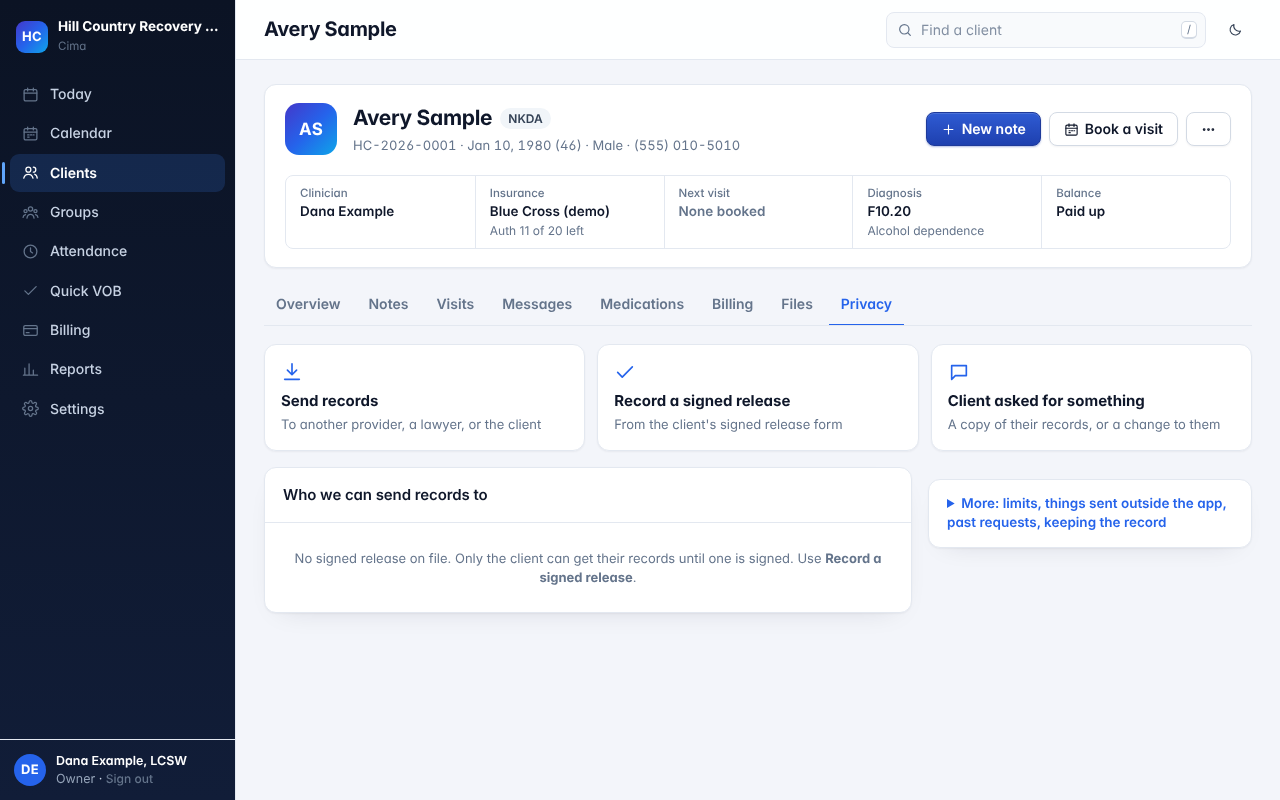
1. 42 CFR Part 2 consent and redisclosure
Records that identify someone as having a substance use disorder, created by a federally assisted SUD program, fall under 42 CFR Part 2 on top of HIPAA. HHS's 2024 final rule (Federal Register, February 16, 2024; HHS fact sheet) moved Part 2 closer to HIPAA, with compliance required by February 16, 2026. What that asks of the software:
- Consents with the elements of §2.31, including the single consent that can now cover all future treatment, payment and health care operations (TPO) until the client revokes it in writing.
- Three consents kept separate: the TPO consent, any consent to share SUD counseling notes, and any consent to use records in a legal proceeding.
- A check before anything leaves. An expired or revoked consent should stop the release, not just warn.
- The notice with every disclosure. Each release made with consent carries the §2.32 notice: the records can't be used against the client in a proceeding without their consent or a court order, and can be redisclosed only as the consent or Part 2 allows, or as HIPAA allows for a covered entity or business associate that received them for TPO.
- A log of each disclosure, so you can answer a client's request for an accounting. Breaches of Part 2 records now follow HIPAA's breach notification rule.
A general medical EHR treats a release as a HIPAA authorization and stops there. 42 CFR Part 2 after the 2024 rule has the full rule and a program checklist.
2. Psychotherapy notes kept apart
HIPAA gives psychotherapy notes, a clinician's separate notes analyzing the contents of a session, extra protection: most disclosures need the client's specific authorization, and a health plan can't make that authorization a condition of payment (45 CFR 164.501 and 164.508(a)(2); HHS guidance on mental health). They get that protection only when they're kept separate from the rest of the record. If you keep them, the EHR needs a place for them that billing staff, record copies and payer requests never reach. Progress notes, which support the claim, are different: see progress notes vs psychotherapy notes.
3. Treatment plans tied to every note
Payers and surveyors read the plan and the notes together. The plan needs problems, measurable objectives with target dates, interventions and how often they happen, a review date and the client's agreement. Each progress note and each group entry should name the goal it worked on, so the record shows why that service was needed that day. In many medical EHRs a "care plan" is a free-text field that no note points back to. The SUD treatment plan guide has goals and objectives written so notes can refer to them.
4. Group notes with each client's own entry
Groups run from weekly group psychotherapy (CPT 90853) to a full IOP day. The EHR should take the topic and summary once, then give every client present their own entry: attendance and time, participation, response, and the treatment-plan goal. One signature should sign them all, and entries copied from one client to the next should be caught before signing, because notes that read the same for everyone in the room are what payers deny or claw back. Group therapy notes for IOP and PHP shows cloned and individualized entries side by side.
5. ASAM dimensions and the level of care
Substance use placement and continued-stay decisions use The ASAM Criteria, now in its 4th edition, and payers ask for each dimension when they review an authorization. The EHR should record the dimensions at intake and in every review, keep the client's level of care (outpatient, IOP, PHP and the rest) on the chart with its dates, track each authorization by level, and keep one chart through a step-down. See the ASAM Criteria cheat sheet and continued-stay documentation.
6. Measurement-based care
Measurement-based care means giving a standard measure, such as the PHQ-9 for depression or the GAD-7 for anxiety, at intake and again during treatment, and using the scores to change course. The Joint Commission requires accredited behavioral health organizations to monitor outcomes with a standardized instrument used as a repeated measure (standard CTS.03.01.09, revised in January 2018: R3 Report Issue 13; Joint Commission FAQ on measurement-based care). The EHR should send the measure to the client's phone, score it, show the trend, report outcomes across clients, and alert the clinician at once when an answer shows risk. Our sister site's Joint Commission behavioral health checklist puts the outcomes work on a schedule.
7. Telehealth, documented and coded
The EHR should hold the video visit (built in, or your own HIPAA-ready video link), a telehealth consent signed with the intake paperwork, and the client's location and identity check for each session where your state or payer asks for them. The claim needs the right pair: place of service 10 when the client is at home or 02 elsewhere, with modifier 95 for video or 93 for audio only, as CMS pairs them (CMS change request; CMS place of service codes). For Medicare, the in-person visit otherwise required before mental health telehealth is delayed through December 31, 2027 (CMS telehealth FAQ, October 9, 2026). Commercial plans and Medicaid set their own rules.
8. Claims with behavioral health codes
Behavioral health billing has its own codes and its own traps. The software should build each charge from the signed note:
- Time-based psychotherapy codes. 90832, 90834 and 90837 depend on documented minutes (90837 needs 53 or more), with 90791 for the diagnostic evaluation, 90846 and 90847 for family sessions and 90839 and 90840 for crisis (CMS billing article A57520). The code should come from the note's times, not habit.
- HCPCS H codes in units. Medicaid and many plans pay substance use services such as the H0001 assessment, H0004 counseling (per 15 minutes) and H0005 group counseling, with units that have to come from the note.
- Per diem program days. One line per IOP or PHP day (H0015, S9480, S0201 or revenue codes on a UB-04), billable only when that day's signed notes reach its hours. See per diem billing for IOP and PHP.
- Both claim forms. The 837P (CMS-1500) for professional claims, and the 837I (UB-04) when a payer wants a facility claim.
- Who can render. Medicare has paid licensed mental health counselors and marriage and family therapists since January 1, 2024 (CMS); associates and interns are paid by some plans and not others, so the claim check should know who is credentialed where.
- Carve-outs. The card often names one company while a behavioral health company pays the claim; the payer ID has to be the right one (behavioral health carve-outs).
The codes, units and time rules are in behavioral health billing guidelines.
9. E-prescribing, if you prescribe
Psychiatric prescribers need e-prescribing that covers controlled substances (EPCS), governed by the DEA's rules in 21 CFR part 1311: identity proofing and two-factor signing for each prescriber. Ask whether it's live today and whether it's priced as an add-on. A therapy-only practice can skip this item.
10. Roles, supervision and a record that can't be quietly changed
Behavioral health practices have associates and interns whose notes need a supervisor's co-sign, billers who need claims but not therapy notes (HIPAA's minimum necessary standard, 45 CFR 164.502(b)), and auditors who check whether a note changed after it was signed. The EHR should enforce roles on the server, route supervisees' notes for co-signature, keep an audit log of who viewed what (45 CFR 164.312), lock signed notes with dated addenda for corrections, and mark late notes as late entries instead of letting anyone backdate them.
The behavioral health EHR buyer's checklist
Take this to every demo, ours included. Ask the vendor to do each item live with made-up clients, not describe it. Anything they can't show, get in writing with a date.
| Requirement | What good looks like | Ask them to show you |
|---|---|---|
| Part 2 consent and redisclosure | §2.31 consents including the single TPO consent; release blocked when the consent is expired or revoked; §2.32 notice attached; each disclosure logged | A release under an expired consent, then one under a valid consent with the notice |
| Psychotherapy notes | Kept apart from the record, out of billing views, record copies and payer requests | Where they live and which roles can open them |
| Treatment plans | Measurable objectives, target and review dates, the client's agreement; notes name the goal | A progress note pulling in the plan's goals |
| Group notes | Summary once, each client's own entry, one signature, copied entries caught | A group of eight with two late arrivals |
| ASAM and level of care | Six dimensions in the assessment and reviews; level of care with dates; step-down on one chart | A continued-stay review and a step-down from PHP to IOP |
| Measurement-based care | Standard measures on the client's phone, scored and trended; an alert on risk; an outcomes report | A self-harm answer on the PHQ-9 and what happens next |
| Telehealth | Video built in or your own link; consent; location where required; POS 02 or 10 with modifier 95 or 93 | A telehealth visit from booking to claim |
| Behavioral health claims | Code from documented minutes; H codes in units; per diem days; 837P and 837I; remittances post themselves | A 53-minute session and the code it picks |
| Authorizations | Tracked by level of care and units, a reminder before the last day, linked to the review | An authorization ending in 5 days and who hears about it |
| E-prescribing | Live today, with EPCS if you prescribe controlled substances | A test prescription and the two-factor sign-off |
| Supervision and integrity | Co-sign for associates; signed notes locked; dated addenda; late-entry marks | Someone trying to edit a signed note |
| Security and the BAA | A business associate agreement at sign-up; multi-factor sign-in; roles enforced; every chart view logged | The audit log for one chart |
| Client paperwork | Intake forms and consents signed on the client's phone, with an identity check | The client's side, on your own phone |
| Reports | Notes signed on time, no-shows, money owed by age, denials, outcomes; every report exportable | The report you'd read on Monday morning |
| Data export and exit | A full export any time, free; records readable for a stated time after you cancel | The export file itself |
| Total cost | One monthly total with every line: plan, seats, claims, remittances, eligibility checks, add-ons, setup | A written quote for your size, year one and year two |
Want to weight and score the finalists? The therapy practice scoring sheet works for practices, and the IOP and PHP scoring sheet for programs.
Does a mental health EHR need to be certified?
Usually not. ONC's Health IT Certification Program is voluntary (HealthIT.gov), and no federal rule makes a private therapy practice or outpatient program use certified software. Certification matters when:
- A funder or certification requires it. SAMHSA's CCBHC certification criteria call for certified health IT, and some state contracts and grants do too.
- You report Medicare's MIPS Promoting Interoperability category, which requires EHR technology certified to ONC's criteria (CMS Quality Payment Program).
- A hospital system or health information exchange you share records with asks for it in its agreement.
Cima EHR isn't ONC-certified, so it isn't the right fit for a CCBHC or a clinician who must report Promoting Interoperability. Also watch for "HIPAA certified": no government agency certifies software for HIPAA. Ask for a signed BAA and a plain description of the safeguards instead; our security page lists ours and what we don't claim.
What a behavioral health EHR costs
Mental health EHRs charge in six ways, usually mixed: per clinician, per client or census, per transaction (claims, remittances, eligibility checks), one-time setup, add-ons (e-prescribing, AI notes, video, texting), and a percentage of collections when billing is bundled in. Two quotes can't be compared until each is one monthly total for your practice with every line included. How much a behavioral health EHR costs has published examples and a worksheet that turns any quote into one number.
Cima EHR's plans, drawn from the same price list as our pricing page:
Solo
+ $39/month for each added clinician
- Calendar, reminders and online booking
- Notes with AI drafting
- Insurance claims and superbills
- Client paperwork by text
Solo PrescriberFor NPs
+ $39/month for each added clinician
- Everything in Solo
- E/M and medication-management coding
- E-prescribing, controlled substances too (coming soon)
- Psychiatric and primary-care templates
Program (IOP / PHP)
+ $39/month for each added clinician
- Everything in Prescriber
- Levels of care and group notes
- Attendance and per diem billing
- Authorizations and continued-stay reviews
Each clinician after the first is $39 a month, and billing and front-desk logins are free. The Program plan covers up to 25 clients in the program at once. Claims, electronic remittances and eligibility checks go through our clearinghouse at its standard per-transaction price:
- Claim sent30¢
- Electronic payment back from the payer (ERA)20¢
- Insurance question to a payer (a benefits check is 1 or more)30¢
- Claim status check30¢
No setup fee, no percentage of collections, month to month, and 30 days free with no card. Every line is on the pricing page.
How to switch to a new mental health EMR
A practice can usually switch in about two weeks. The longest step is electronic payment (ERA) enrollment, which takes 1 to 3 weeks per payer, so it starts first. In order:
- Download everything from the old system while your account is open: the full export and each client's chart as PDFs. Keep them, encrypted, for as long as your state and licensing board require (Texas rules, by license, are in how long to keep records in Texas).
- Start ERA and EFT enrollment with each payer, so remittances reach the new system's clearinghouse.
- Import your client list from a CSV. Names, dates of birth, contact details, insurance and diagnoses usually move; past notes, appointments and open claims usually don't.
- Re-check insurance for each insured client, and send current clients the new system's intake paperwork and consents to sign.
- Enter what's open: each client's level of care, current authorization and treatment plan, before their first visit on the new system.
- Cut over on a date. From then, every new visit is documented and billed in the new system. Finish older notes and claims in the old one, and keep it until its last claims are paid.
Switching EHRs has the full two-week plan and what Cima's import reads.
Where Cima EHR fits, and where it doesn't
We built Cima for the practices and outpatient programs we know: therapists, counselors, psychiatric NPs, group practices and IOP/PHP programs. Here is how it answers the checklist today, from the feature list:
| Checklist item | Cima EHR today |
|---|---|
| Part 2 | Records leave only under a current signed release or another legal basis you record; an expired or revoked release stops the send; a Part 2 release carries the 42 CFR 2.32 notice; every release goes on the client's list of disclosures. The BAA includes Part 2's qualified service organization terms. |
| Treatment plans | Problems in the client's words, goals, measurable objectives with target dates, interventions, frequency, a review-by date and whether the client agreed. Progress notes ask for progress toward the plan's goals; group entries name the goal worked on. |
| Group notes (Program plan) | Topic and summary once, each client's own entry, one PIN to sign them all. Entries that read 80% alike are stopped before signing. |
| Levels of care and ASAM (Program plan) | PHP, IOP and OP, each with its day and week hours and per diem code; attendance hours from signed notes; continued-stay reviews on Today 5 days before an authorization ends, with ASAM dimensions 1 to 6. |
| Measurement-based care | PHQ-9 and GAD-7 on the client's phone or in session, scored with severity bands. Any answer above "Not at all" on the PHQ-9 self-harm question puts a red safety card on Today and emails the clinician right away. The outcomes report shows PHQ-9 improvement and remission. The Columbia suicide screen (C-SSRS) isn't built in yet. |
| Telehealth | No built-in video: add your own HIPAA-ready video link to the visit and it goes in the reminder. The telehealth consent is in the intake paperwork, and the claim gets modifier 95 with place of service 10 or 02. |
| Claims | Signing the note creates the charge. Minutes pick 90832, 90834 or 90837, and 90791, 90846, 90847, 90839 and 90840 are ready. Each claim is checked before it goes out as an 837P, or an 837I for program days; remittances from payers you've enrolled with post themselves. Psychological testing codes (96130 to 96139) aren't in Cima's code list yet. |
| E-prescribing | Coming soon on Solo Prescriber and Program, through a certified network with two-factor sign-off for controlled substances. Not live yet. |
| AI note drafting | In every plan and off until the owner turns it on. It drafts sections from only what the clinician wrote, for them to edit and sign, on AWS's HIPAA-eligible AI service under the BAA. |
| Supervision and integrity | Notes by an LPC-A, LMFT-A, LCDC-I or intern wait for a licensed supervisor's co-sign. Signed notes are locked; corrections are dated addenda; a note signed more than 72 hours after the visit is marked a late entry. |
| Security | A BAA at sign-up; hosted in the US on HIPAA-eligible AWS; passkey, or password plus a 6-digit code; roles enforced by the server (billing never sees note text or screening results); every chart view logged in a record that can't be edited. |
| Export | The whole practice in one file, or one chart as a PDF, free, any time, and for at least 90 days after you cancel. |
| Not built for | Detox, residential or recovery housing (no bed board, no medication administration record); lab orders; ONC certification; programs over 25 clients without talking to us first. |
If one of those gaps is a must-have, another EHR is the right answer today, and we'd rather say so here. If not, take the tour, or start with the page for your practice: Cima for IOP and PHP programs if you run groups and per diem days.
Run your own week through Cima
Send intake paperwork to your own phone, sign a note and a Part 2 release, and see the claim. 30 days free, no card to start.
Questions
What is a behavioral health EHR?
An electronic health record built for mental health and substance use care: intake assessments, diagnoses, treatment plans tied to notes, individual and group notes, screening scores, consents and 42 CFR Part 2 releases, and claims with behavioral health codes. Most include scheduling, reminders and billing too.
Is a mental health EMR the same as a behavioral health EHR?
In practice, yes. ONC uses "EMR" for one practice's digital chart and "EHR" for a record built to be shared, but vendors and buyers use "mental health EMR", "behavioral health EMR" and "mental health electronic health records" for the same systems. Judge the product by what it does, not the label.
What is the best EHR for mental health?
The one that fits how you practice. Write down your license types, payers, claim forms, whether you treat substance use, whether you run groups or a program, and whether you prescribe. Then score each vendor on the checklist above from what you see done live, and compare one written monthly total. A solo therapist and a 20-client IOP usually land on different answers.
What is the best EHR for a mental health private practice?
For a solo or small private practice, look for booking and reminders clients actually use, intake paperwork they finish on their phone, quick notes that lock when signed, superbills or claims to match how you're paid, a free full export and a BAA at sign-up, at a price that makes sense for one clinician. The therapy practice EHR checklist has 60 checks and a scoring sheet.
What should mental health EMR systems include?
Scheduling and reminders, intake forms and consents, an assessment, treatment plans, progress and group notes, standard screenings such as the PHQ-9 and GAD-7, Part 2 releases if you treat substance use, telehealth documentation, claims and remittance posting, role-based access with an audit log, a BAA, and a full data export. Programs add levels of care, attendance and per diem billing.
What is behavioral health software?
An umbrella term for the software mental health and substance use providers run on: the EHR, practice management (scheduling, intake, payments), billing and claims, and add-ons such as benefits verification, e-prescribing, video and compliance tools. Many products combine several of these.
How do I compare behavioral health EHR vendors?
Ask each to run your own week live, with made-up clients: an intake, a treatment plan, a group or a telehealth session, a Part 2 release, a claim and a report. Get the monthly total, the contract length, renewal and price-increase terms, and the export terms in writing, and talk to two practices your size on your payers.
Is there a mental health EHR with telehealth built in?
Some include video; others, Cima among them, let you add your own HIPAA-ready video link to the visit. Either way, check that the video service signs a BAA, that a telehealth consent is in the paperwork, and that claims carry the right place of service and modifier for each payer.
Can AI write notes in a mental health EHR?
AI can draft a note for the clinician to review, edit and sign. It must run under a business associate agreement, never a consumer chatbot, and some states add rules: Texas requires a practitioner who uses AI in diagnosis or treatment recommendations to review what it produced and tell clients (see the Texas rules). In Cima it's off until the owner turns it on and drafts only from what the clinician wrote.
How much does EHR software for mental health cost?
It depends on the model: per clinician, per client or census, per claim, setup fees, add-ons, or a percentage of collections. Ask for one written monthly total for your practice. Cima's plans and per-transaction prices are on the pricing page, with 30 days free.
Sources
- HHS, Fact sheet: 42 CFR Part 2 final rule; Federal Register, Confidentiality of Substance Use Disorder (SUD) Patient Records, February 16, 2024 (compliance date February 16, 2026).
- eCFR, 42 CFR Part 2, §2.31 (consent) and §2.32 (notice with each disclosure).
- eCFR, 45 CFR 164.501 (psychotherapy notes), 164.502(b) (minimum necessary), 164.312 (technical safeguards); HHS, HIPAA and mental health.
- ASTP/ONC, the difference between an EHR, an EMR and a personal health record; Certification Program for Health IT.
- CMS Quality Payment Program, Promoting Interoperability requirements; SAMHSA, CCBHC certification criteria (2023).
- The Joint Commission, R3 Report Issue 13: Revised outcome measures standard for behavioral health care and Measurement-based care FAQ.
- American Society of Addiction Medicine, The ASAM Criteria, 4th edition.
- CMS, telehealth FAQ (October 9, 2026), change request on telehealth place of service and modifiers and place of service code set.
- CMS, Billing and Coding: Psychiatric Codes (A57520); Marriage and family therapists and mental health counselors.
- eCFR, 21 CFR part 1311 (electronic prescriptions for controlled substances).
- Cima EHR's own features as published on features, pricing and security, checked October 28, 2026.
CPT is a registered trademark of the American Medical Association. General information, not legal or billing advice; confirm codes and telehealth rules with each payer.
A behavioral health EHR, built by people who use one.
Free for 30 days. See every feature or compare the plans.
Get early access